staying grounded during a trade war

(We have Emma to thank for putting together this timely piece of writing, and including practical resources for coping during this stressful time)


At The Branches, we frame our yoga practice as a way to nurture self care and build our inner resilience so that we can work for a better world. I have been contemplating this “mission statement” of ours in the past few weeks. It feels like a catalytic moment to put our practice into practice. We don’t know what life will look like with the looming tariff war. There is a great deal of uncertainty we all face at this moment in time. And, the curiosity, embodiment and inner connection we practice in yoga can be part of how we face that uncertainty. 

Can we approach this difficult time the way we might approach a difficult pose in a class? Can we stay attentive to our breath and feel the ground beneath us? Can we find the moments of lightness amidst the challenge? 

I have found it really difficult to read the news recently without spiraling into anxiety and fear. But I have been reminding myself that the way I hold my body and the way I choose to breathe can help me stay grounded. I am also reminding myself that reaching out for connection, and talking to others that share similar concerns is also deeply helpful. 

I wanted to share a few resources that are helping me stay grounded, and that are reminding me of the bigger picture. 

The first is a printable PDF created by Leslie, one of our studio directors. It is called the Autonomic Nervous System Toolkit. You might have come across it already; it contains a bunch of techniques for bringing yourself and your nervous system back to the present moment. When I read the news, the threat-detection part of my nervous system can go into overdrive and I can feel my mind and heart racing a mile a minute. This toolkit is for that moment, so you can come back to yourself and decide what makes sense to do next. 

The second resource is a very practical article about how to buy Canadian during this economic stalemate with the US. The author details what all the terminology means (how Made in Canada is different from terms like 100% Canadian) and encourages us to make changes in a range of sectors (not just groceries but service providers, entertainment, social media). It is rousing and encouraging and thoughtful. I hope you give it a read. 

And lastly, this resource is about how to stay grounded in the Trump era. It is a long form article, written by a career activist. It gives a great deal of practical suggestions for how to approach change in your own sphere of influence and community, while keeping an eye on the larger powers. I came across it a few months ago and I keep coming back to it again and again. It is really helpful to read the thoughts and ideas of someone who has spent their life working for positive change, and who is not naive about how slowly that change comes about. 

Thank you for being part of a community that cares about the world. Our yoga practice could easily be a way that we escape from or ignore the difficulties of the world. Instead we hope that yoga practice can be a place of refuge that allows us reprieve, so we can then return to our work in the world, renewed and more prepared to act with thoughtfulness, care and compassion. 

With care,
Emma

my relationship to darkness

(A seasonal reflection from Branches’ co-director & teacher, Emma)


As the winter solstice approaches, I am contemplating my relationship to darkness.
 
Three years ago near the start of winter, I gathered with a group of ten women about this very topic. We sat in a circle and each took a turn answering the question “What is your relationship to darkness?” 
 

As each person answered, we slowly crossed over the border of friendship into the space of intimates. We became more fully human to one another. We gave one another the great honour of bearing witness to some of our deepest pain. We also got to see one another embodying incredible strength or hard-won healing. The pain or difficulty wasn’t necessarily finished or over (as we know that’s not how grief or trauma works) but hearing others articulate how darkness had been part of shaping them was breathtaking.


Darkness is part of the human experience. Whether that is the literal darkness of night, or the metaphorical darkness of harm, loss, grief and pain, we all carry our knowledge of darkness with us.


And if that is true, the opposite is also true. We are all affected and shaped by light; by the beauty that we are and that we see. By the love we have received, and that we have learned to give. By the light of day, by warmth and summertime. Darkness and light are both an intrinsic part of our life on this earth. 
 

As we head into the longest nights of the year, I can feel the darkness calling me. And when I feel the metaphorical darkness arising too strongly, when grief or rage become too much, I lean into my felt sense of darkness. The sometimes magical feeling of being outside on a quiet, snowy night. The twinkling of stars that are only visible because of the darkness. The soft darkness at the end of an evening yoga practice. I remember I can be held by darkness, not only challenged by it. 

I have honed my relationship to darkness through my yoga practice; perhaps you have too. I have returned from places of deep sadness by coming to my mat again and again. I have also learned to be with darkness by walking with others at The Branches; in the talking circles of our yoga teacher training communities, and different groups gathering for yoga retreats and workshops over the years. 

The darkness of winter and night is regenerative, and cyclical, and there are many ways we make our ways through it. In community with others; with our plethora of practices (therapy, yoga, art, meditation, dog walking, you name it). We make it through the darkness with the long arc of time and the (hopefully) even longer arc of love.

As the year draws to a close, I hope you are finding connection to yourself and community. On behalf of Leena, Wendy, Nicole and all the teachers and staff at The Branches, we wish you a season of rest, renewal and delight.

Solstice blessings, 
Emma 
 

P.S. Sitting in circle is something we do in our Yoga Teacher Training programs, and something I have both led and participated in in a wide range of contexts over the last fifteen years. If learning how to gather people in community and conversation is of interest to you, I hope to share my experience with this and mentor others to start their own circles in a workshop format in the coming spring. Do be in touch if that’s something you want to hear more about. 

Why we stopped trying so hard (to get all the likes on Instagram)

Emma and Leslie here!

Depending on your personal relationship to social media, you might have noticed that for a while there, The Branches was on an absolute blitz of creating original, silly, opinionated, and informative content, especially on Instagram.

People would sometimes approach us in public spaces to say stuff like, “Oh my goodness, you guys are so funny on Instagram!” or, “I love your posts! I’m going to come to class one day!” 

Despite the fun of making silly videos or the adrenaline of sharing hot takes, we’ve always had a rather ambivalent relationship with Instagram. As a business, we felt compelled to use it in order to compete for people’s attention and maybe someday their studentship. As community leaders, we felt conflicted about using it, since social media has become increasingly addictive, and degrades our own presence and attention – the exact thing we hope to strengthen through the practices we teach.

As our content production increased at QSY/The Branches, we were increasingly taking personal breaks from social media for our own mental health. Each of us found that being on Instagram caused us to overconsume content, leading to feelings of comparison and competition, or simply wasted time. For work, it led to constantly thinking about the algorithm, about how any and everything could be turned into a post or a reel. It caused us to question how we should be showing up on the platform – do we engage in the “performative wellbeing” in the form of positive affirmations, fancy poses, or colourful meals that prove how “deep,” our practices are or “healthy” we are in the eyes of potential students? Or do we overshare intimate facts and experiences from our healing journeys to appear “authentic” and “relatable” (and to do better with an algorithm that rewards drama?)

This focus on creating and maintaining a particular kind of online business persona took time away from going deeper into the embodiment practices that we love to share. It pulled our attention into performing on and for a tiny screen, and away from the rich experience of moving through the world with presence, relating to others with mindful awareness, and taking meaningful action towards the world we want to live in.

If you’ve been reading our newsletter long enough, you’ll know we’re not ignorant to the other side of the coin. Of course social media has its benefits, like the democratization of news, space to organize for social justice, some potential for useful learning, and perhaps obviously, more accessible social connection with communities near and far.

Anyway, you might also have noticed that at some point, we just… stopped trying so hard. And we more or less stopped posting on our individual accounts, too. We’ve wondered from a curious perspective, but we’ve also lamented from an exasperated perspective: does sustainable success really require studios and/or teachers to self-promote on social media?

In the end, we don’t really want to play the game of Instagram. We don’t like what it does to our brains or to our creativity, confining it to a tiny box, and consumed in an endless scroll. We want to be thinking about how we show up in community with others, not how we can articulate that in a post. We want to practice presence as we teach, not make reels about our teaching.

We’d love to hear back from you – how do you relate to your own use of social media? Are you using it to follow yoga teachers, or your favourite local businesses? Are you on there as a teacher or creator, hoping to find success? How do you protect your mental wellbeing while engaging?

In community,

Emma and Leslie

I’m finally not intimidated anymore

Hello, Wendy here. So, I’ve dabbled in strength training at several points in my life. And each time my motivation would eventually decline, or I’d reach a point where I just felt too intimidated and confused to know how to progress. Sound familiar to any of you?

Strength Training for Longevity and Healthspan

As I enter my mid-life journey, I’m learning how valuable resistance training can be for maintaining mobility and strength as we age. For folks who will go through menopause, and especially folks like me with a long family history of osteoporosis, strength training can also help increase bone density and prevent osteoporosis, (this article does a really good job of summing that up if you’re interested). Based on these life stages, I have been feeling really motivated to find a way to add resistance training back into my life.

Recently, I decided to start on my own again, and it was great… for a while. I was learning a lot, getting stronger, and I felt good in my body – all things that kept me interested. But, inevitably, I would get busy or tired and skip a session, or two, then three, and my motivation would begin to wane. 

Finding the Right Coach & Community

One thing I’ve learned about myself (and still have a hard time accepting), is that no matter how much I want to do things on my own, I really need other people in order to stay motivated. But all of my past ‘gym’ experiences had been unpleasant. I either got a bunch of unwanted advice, or unwanted commentary that made me not want to be in those spaces. I needed MY people – people who would lift each other up.

Enter Strength Essentials…

From the first time I walked into Nicole’s Strength Essentials class I was struck by just how supportive it felt. It was such a radical departure from the intimidating experiences I had in the past. Nicole presented things in such an easy to understand, accessible way. We learned lots of options of how to progress, and Nicole was there to help folks to find ways to make things work for their body. It was so refreshing to not feel intimidated to ask questions or to ask for advice. With the number of questions I hear each time I’m there, it’s obvious other folks feel the same way.

The Camaraderie Effect

The instruction in Strength Essentials is wonderful (thanks Nicole!), but I’m also blown away by the community of support that has formed among the participants in the class. We celebrate each other’s triumphs, and share lots of laughter to help get through the challenges. I often hear folks encouraging each other (“You got this!”), or commiserating after a particularly hard set (“Wow, that was a hard one!”). We joke about how there’s no way we can do another round of pushups (why are they so hard?!), but then we all look at each other and do it anyway.

I’ve found a group of people who are there to learn and to take care of their bodies. No one is in class to show off or to ‘prove’ themselves to anyone, so it feels so much more welcoming than my previous experiences. I finally found MY people – and I keep going back because of them.

Sound like your people, too? Come join us for casual weight lifting with friends in Strength Essentials – I think you might love it! Just be prepared to laugh a lot 🙂

With enthusiasm,
Wendy

Noticing Our Confinement

A Story About Outdoor Cats & The Enneagram

This is a guest post by Tamara Shantz, Spiritual Director and Enneagram Teacher. Tamara’s work centres on “practicing incarnation,” with the Enneagram as a key piece of the puzzle.

Our cat Izzy is NOT an indoor cat. 

When we first took Izzy and her brother Alex in six years ago, they had been living as outdoor cats for at least a year. We hoped to transition them to being fully indoors, but after months of constant crying and complaining, we caved, and allowed Izzy and Alex to move freely between inside and outside.

Alex died really unexpectedly the other summer, and we were so devastated. As we grieved Alex, we were also trying to figure out what to do about Izzy. There was a possibility that Alex had died from exposure to rat poison, so until we got the results from an autopsy, we decided to keep Izzy inside. 

One day of her confinement, she spent about 8 hours loudly petitioning to be let outside. There was nothing pleasant about Izzy’s confinement for anyone in the household. Thankfully, in the end, rat poison was not the cause of Alex’s death and we decided to return to Izzy’s usual state of roaming freely between our indoor and outdoor spaces. 

Protection or Imprisonment?

This experience with Izzy got me thinking about the idea of protection. I’m sure any parents (of human or fur babies) can relate to the choice-making we do for the protection of our vulnerable charges, even when they conflict with the desires of the one we seek to protect.

I have no doubt that Izzy did not feel protected. She felt imprisoned. Like many protective acts or barriers in the world, it really depends on perspective.

What one person sees as an act of protection, for another, is an act of confinement.

We can find this dynamic within ourselves as well. 

The Wisdom of Enneagram

The Enneagram is a tool for self awareness that describes 9 basic personality structures. It sees your personality as a collection of coping strategies – defence mechanisms that develop in order to keep yourself safe. Especially when we are children, at our most vulnerable, we need to learn how to protect ourselves in the world. We begin to create a tough outer layer to defend the tender parts of our truest selves. 

And so Ones begin to perfect themselves, Twos start to shower others with care and kindness, Threes get busy, and so on. Each one of us believing that these strategies will keep us safe; will bring us love.

Nothing Is Inherently Wrong

What I have found to be so beautiful about working with the Enneagram is that this development process isn’t seen as something that has gone wrong, or that these protective layers are to be judged in any way. 

It has been incredibly liberating to be introduced to the Enneagram’s perspective on human development where there is nothing inherently wrong. The structures of our Enneagram type, the ways that we have tried to protect ourselves are necessary, natural, and good.

There is beauty, love, and power at work in the formation of our personalities.

From Protection to Protest

Just as our choice to confine Izzy was rooted in love, it was still confining!

Even as our personality formation is essential and marked by love, these same traits and structures that have protected us can also begin to chafe. They begin to feel confining. 

Like Izzy, I have found myself at the closed windows of my being, loudly protesting my confinement. 

This is where meaningful work with the Enneagram really begins. 

One of the purposes of learning about your Enneagram type is to begin to see these various coping strategies clearly, to notice when they become activated, and to develop the freedom to let these habitual patterns go. 

I find my home at point Nine on the Enneagram. One of my primary coping strategies has been to numb out, dissociating from physical sensation and retreat into my daydreams.

For many years this was a necessary habit to keep me safe. But as I moved into adulthood, I began to realize how this numbness also was its own prison, and work with this limitation. My confinement is much clearer and more temporary than it used to be.

Letting Ourselves Be Outdoor Cats

We were a bit anxious when we ended Izzy’s confinement, but we do have some tools we use to keep her (and the birds) safe: a bright, rainbow clown collar and bell, neighbours who keep an eye out for her, and an early ‘bedtime’. 

The Enneagram can provide these tools for each of our own processes by helping us to become acquainted with our unique confinement, and offering practices to help us feel supported as we risk venturing outside of our protective walls.

Curious? It won’t kill ya! Join us for a workshop to dive in: The Enneagram: Nine Journeys of the Soul on February 10 and 11. Registration here.

You can learn more about Tamara and her work on her website.

Restorative practice for rebellious rest

A note from Leena, Co-Director and long-time teacher at The Branches

I believe that in these hectic times, resting is a counter-cultural, even rebellious, act.

Leena Miller-Cressman

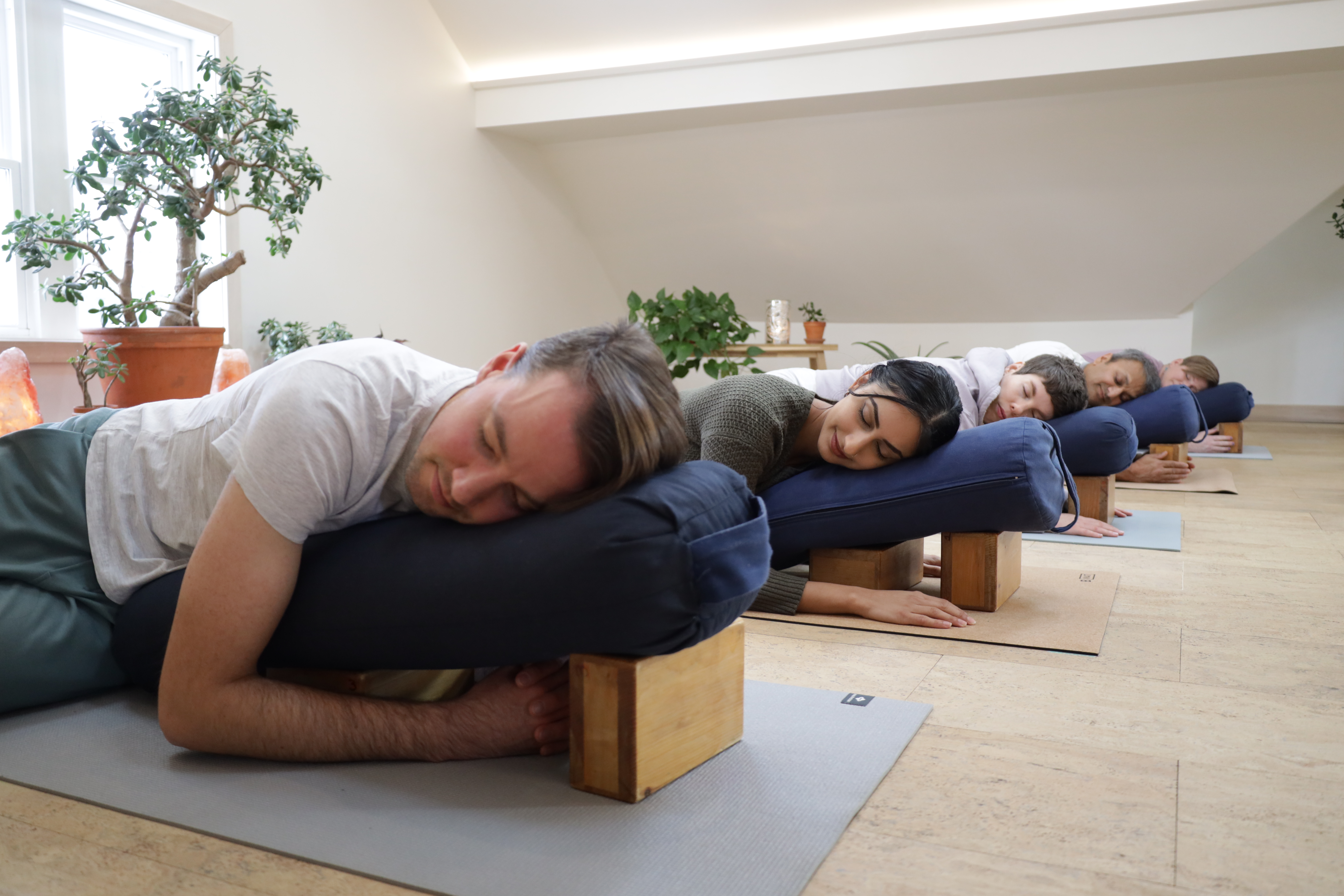
Rest and leisure are inherent human needs for our sanity and spirit. Yet our fast-paced culture is always driving us to do more: be more productive, fit another activity into the schedule, answer one more email. This stresses our nervous systems and can erode our mental and physical health. Restorative Yoga is a form of resistance to the hustle. You can relearn the sacred art of rest and stillness.

Just like fields need to lay fallow to regenerate, or a compost pile needs time to turn to fertilizer, and animals hibernate in cold winter months, our bodies and minds also need time to pause and just be, rather than always doing more.


I learned the principles of restorative yoga (quiet, darkness, warmth, support, slowness, and stillness) from the work of Judith Hanson Lasater, and I incorporate them every time I practice and teach restorative yoga.

As part of our commitment to rebellious rest, we offer weekly restorative practice sessions on our drop-in schedule, as well as special candlelit workshops throughout the Winter season.

Whether we have the pleasure of guiding you through a restorative practice or not, I invite us all to do just a little less, and instead be a little more rebellious, and rest.

With care,
Leena


My Secret Revolutionary Agenda

Emma here, and I’m going to let you in on my secret revolutionary agenda for teaching yoga. My agenda is Body Positivity, with a side of creating a better world.

When I teach a yoga class, I’m teaching breath, poses and mindfulness. But underneath all of that, I am inviting presence, softness and forgiveness for all the ways that we have abandoned our bodies, and the bodies of others. I am creating space for people to come back to their bodies, rekindle connection, and emerge with a renewed relationship with their bodies. This is how I am quietly working to change the world. 

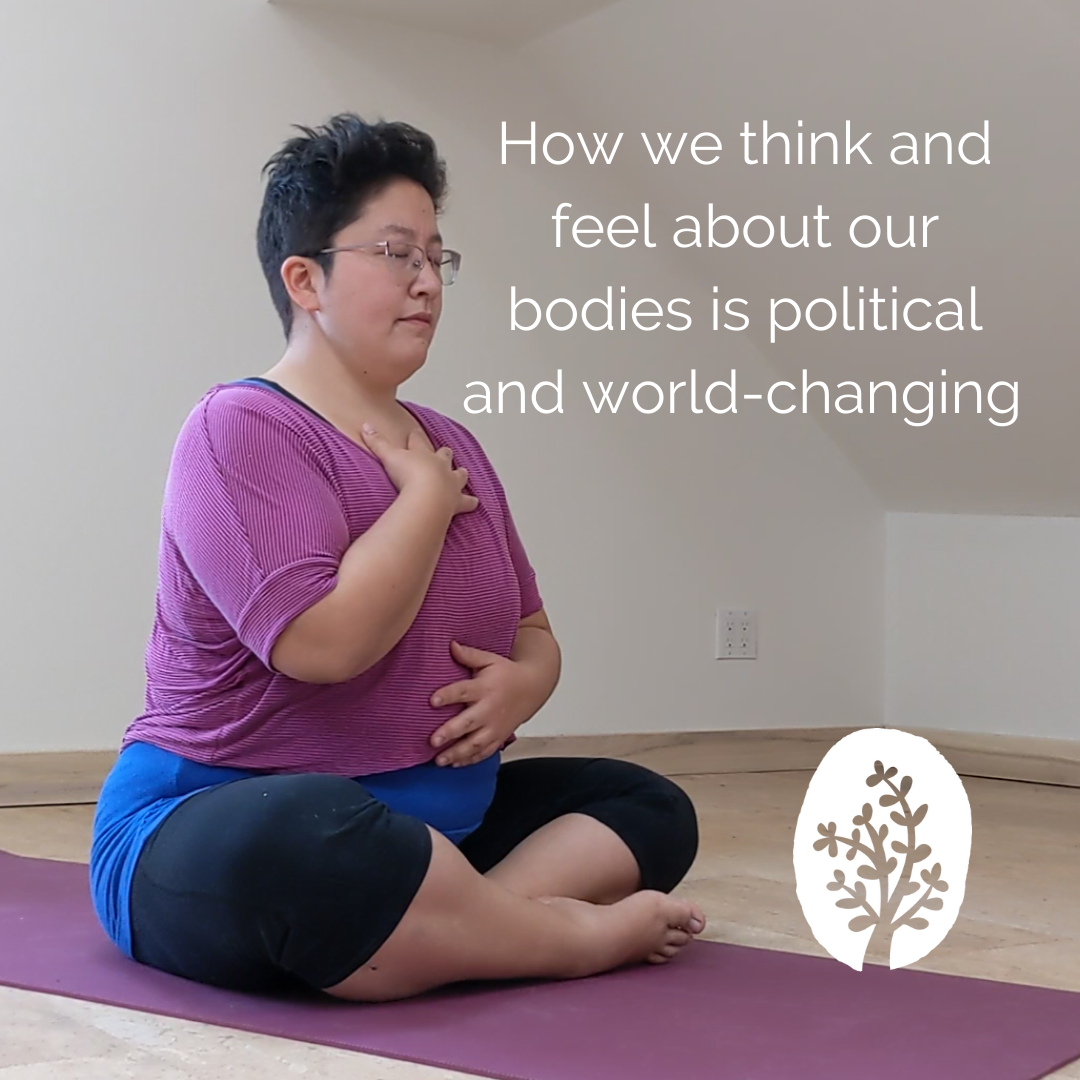
How we think and feel about our bodies is political and world-changing because it affects how we think about the bodies of others around us. It affects which other bodies we believe are deserving of care, attention, love or rest. It affects how we vote, what we buy, who we listen to, and how we bring up our children. Body Positivity as a practice can reshape how we see not only ourselves, but all the bodies around us. 

It’s about unwinding our attention from how we look to what we want – what kind of world we want to live in. If we’re not preoccupied with our weight or shape or height or skin, what would we spend our time building? Body Positivity is about remaking our world, remaking our definition of beauty and worth, remaking our lives to celebrate the beautiful differences that we have and are. 

Body Positivity was at its inception, a political stance. In the mainstream it has been whitewashed and watered-down to simplified slogans like “love the body you have”. Body Positivity was created by Fat, Black, queer women and femmes, and was intended as a political statement/practice for those whose bodies were the least accepted by the mainstream. Remembering this history, we can think of Body Positivity as a collective practice with a radical intention. Rather than mainly considering our perception of *our own* bodies, can we commit to accepting, loving or uplifting *all* bodies? Particularly those bodies that we might not see regularly represented in our world?

A Body Positive Yoga Practice does not need to include directives to LOVE YOUR BODY (has hearing that helped anyone actually love their body, ever?). Body Positivity is not about cheerleading or slogans. It is about presence and awareness, excavating old beliefs and cultivating new ones. 

I rarely say things like “Love your body” in my classes, because it isn’t that simple, and it isn’t the point. You don’t learn to love something by being told to do so. You learn to love something by getting to know them, and seeing their wondrous and curious quirks! You learn to love something with presence, attention and consistency. 

A few years ago my friend Simone shared a Body-Positive idea with me that I have never forgotten. It seemed like an idea to remake the world. It was revolutionary and ground-changing and incredibly simple. It was this: At the Jewish summer camp where Simone worked, they had one rule for the kids. NO BODY TALK. This meant that talking about other people’s bodies was off the table, including compliments (about clothes, jewelry, haircuts).  

I was flummoxed. 

“So the kids can’t even say they like another kid’s shirt?”

“No, because one kid getting attention for their shirt might make another kid self-conscious if they never get compliments on their clothes.”

I continued to prod.

“What about if you were wearing something really interesting, like a really unusual hat?”

“They can talk about that. They can ask questions. One thing we suggest is that they ask for the story of someone’s hat or shirt. That way it’s a bit more about curiosity than approval or status.”  

I loved this idea for so many reasons, one of which is that it de-centres what is at the surface and asks us to look deeper. It’s easy to talk about someone’s haircut, but how are they actually doing under there? Body Positivity is not about just saying nice things to yourself or others; it’s about really getting to know ourselves, learning the deeper stories and hearing the difficult truths. 

My deepest hope is that the practice of Body Positivity will help us recognize and celebrate the gorgeous differences in all bodies, and that out of that will grow the seeds for a better world. 

Many of these ideas were inspired by Sonya Renee Taylor’s work, and her amazing book “The Body is Not an Apology”. What I am calling Revolutionary Body Positivity, she calls Radical Self Love. I really, really recommend her book.

Want to reflect a bit more on these ideas? I made you a downloadable set of journaling prompts for you to cozy up to with your pen for some deeper thinking and feeling.

And, if you want to be part of an intentionally Body-Positive space, join our 30 Days of Body Positive Practice, starting Jan 2.

Let’s make community care the new buzzword

Self-care is a buzzword, and we use it liberally at Queen Street Yoga. It can be an important practice of slowing down, taking time for yourself, and caring for your heart, body and mind. However, self-care and yoga practice can be inaccessible to many people. What we need to complement self-care and enhance overall wellness is community care, where people “are committed to leveraging their privilege to benefit others. ¹
Community care takes the onus off of the individual to take care of themselves, all by themselves, and places the responsibility for care within the community, in friend networks, or through structured groups or organizations. For true wellness, “people should receive community care from both their government and their friend networks.” Of course, we know that that doesn’t always happen. And recently, with drastic cuts to provincial healthcare, education, and the arts, more and more community care is being taken away from those who need it most. 

We want community care to become as strong a buzzword as self-care. We also want it to mean something, and to actively practice and embody it. Two ways that we are amplifying the principle of community care at Queen Street Yoga are:

Continue reading “Let’s make community care the new buzzword”

The Body’s Intelligence: How Craniosacral Therapy works

by Amanda Ingall

My first craniosacral treatment was a pivotal moment in my life. Somehow the appointment brought me into a deep place of connection with my mind and body. I left feeling completely relaxed, my movements felt fluid. I felt connected to my core. I wanted more.  

What I experienced that day is something I now call the wisdom of the body. I also think of it as the body’s ability to heal and restore itself.  This happens when a therapist is able to listen and respond to the body’s intelligence, rather than impose a treatment from the outside.  Craniosacral is a form of bodywork that works from the inside out, moving from your body, outwards into the hands of the therapist.

So, how does it work?

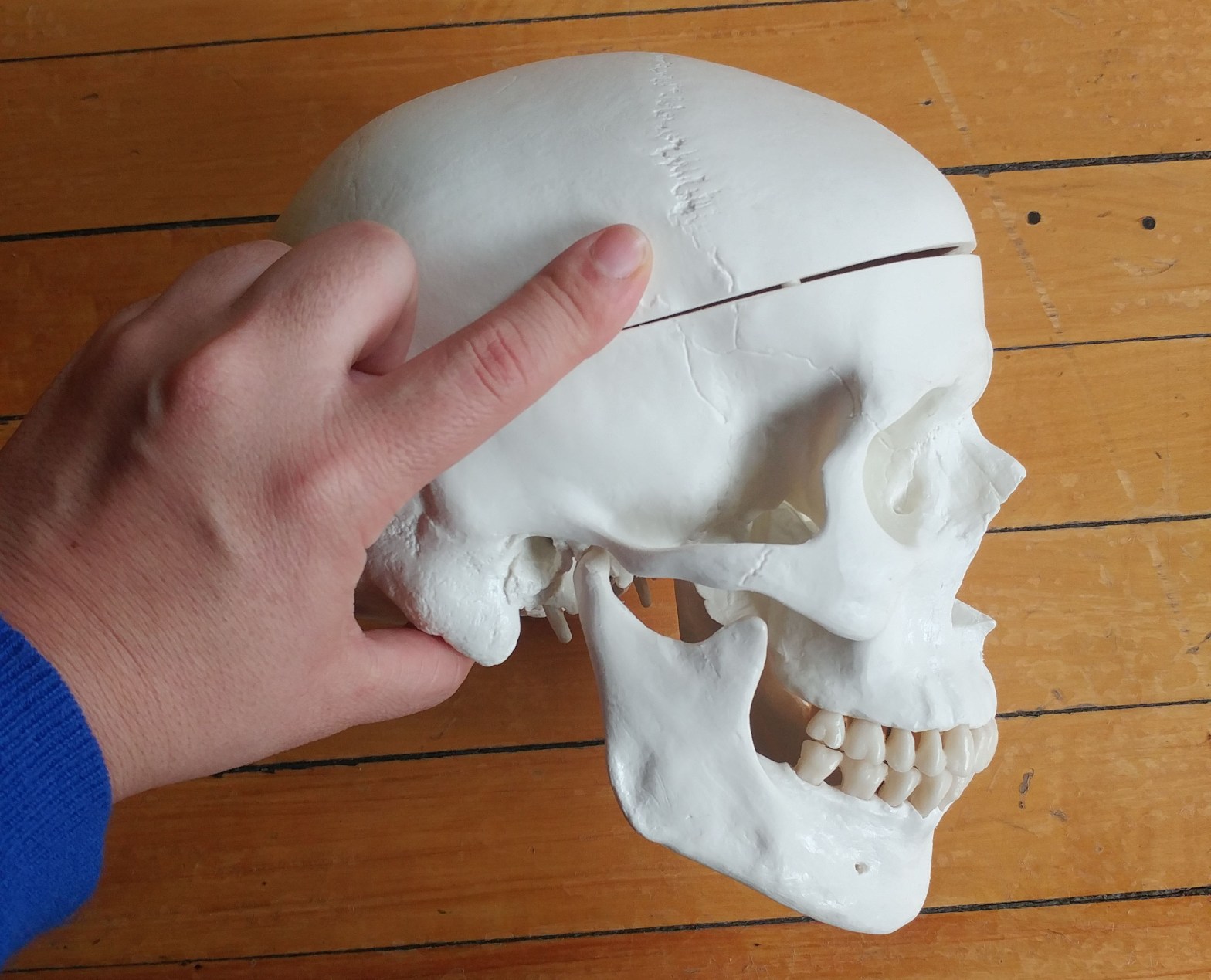
Craniosacral Therapy works with the cranium (your skull) and it’s connection to your sacrum (the back of your pelvis). Let’s start with the skull.

Your skull is miraculous. It is a moving, pulsing structure. You may tend to think of your skull as one piece, like a coconut, but it does in fact have seams or sutures that join the bones of the skull together.  These sutures have a zigzag pattern and the reason for that is that your skull actually moves, expanding and contracting with a rhythm; a pulse that is created as your cerebrospinal fluid circulates. Your whole body rolls within this rhythmic tide, causing not only movement within the skull, but also throughout your whole body.  It travels along the spine to the sacrum; shoulders and arms roll In and out, hips and legs roll in and out, organs rotate around their axis.

Continue reading “The Body’s Intelligence: How Craniosacral Therapy works”

A different way to get outside – Forest Therapy

This post is by Kristina Domsic, one of the facilitators of our upcoming Seeds of Intention: Yoga & Nature Retreat, May 24-26.

One of the things that makes our upcoming Seeds of Intention retreat unique is that participants will get to try out Forest Therapy, also known as Shinrin-yoku, or Forest Bathing, with a certified guide. This is an amazing way to explore the beautiful landscape around Harmony Dawn retreat centre. The landscape of rolling meadow, gardens, and forest around the centre have so much to offer.

When people first hear about the idea of forest therapy, they often have an intuitive sense of some of the ways this practice could be beneficial; since we were young, many of us have heard that fresh air is good for us! When we have felt overwhelmed by stressful situations, loved ones might have suggested we go for a walk to help shake it off and gain some new perspective. That part makes sense.

So, why not just go for a simple walk outside on your own?

Well, going for a walk outside on your own is definitely a good idea. But, there are also some stand-out benefits to joining a guided Forest Therapy session! Here are some of the highlights of what you can expect on our Forest Therapy sessions at the Seeds of Intention Retreat this spring:

1. Time to unplug

Continue reading “A different way to get outside – Forest Therapy”