
Last December I recorded five songs that I sing for students at the end of my classes, while they rest in savasana, a final resting pose. We have been releasing the songs periodically throughout the last year on our blog. You can listen to and download all of them on Soundcloud. This last song is actually a mantra, called the Gayatri Mantra. It is one of the oldest Vedic chants, and this version that I sing is a shortened version of the original.
It is interesting and a bit uncomfortable that I am releasing this song now, after posting a reflection about cultural appropriation and yoga in December. In that post, I wrote, “When I first began teaching yoga six years ago, I was excited about the philosophical content I was learning and eagerly shared my interpretations/understanding of Tantra with my yoga students. I taught my students to sing mantras, and told them stories of Hindu deities. Now, looking back on that, I feel embarrassed. I would describe my early teaching as uninformed cultural misappropriation. Whatever cultural aspects of yoga I was sharing, they had been taught to me by white teachers, some of whom were scholars, but nevertheless, I was taking aspects of Hindu religious culture and teaching them as if they were mine.” Continue reading “Singing Mantra – Continuing the Inquiry into Cultural Appropriation and Yoga by Emma Dines”
 Happy Holidays from all of us at Queen Street Yoga! 2015 was another exciting year for our studio. We celebrated our 10-year anniversary, our first group of yoga teacher trainees graduated and are now teaching all over KW, our teaching and administrative staff grew, and we’ve continued to expand our class schedule and special programming to serve our wonderful community.
 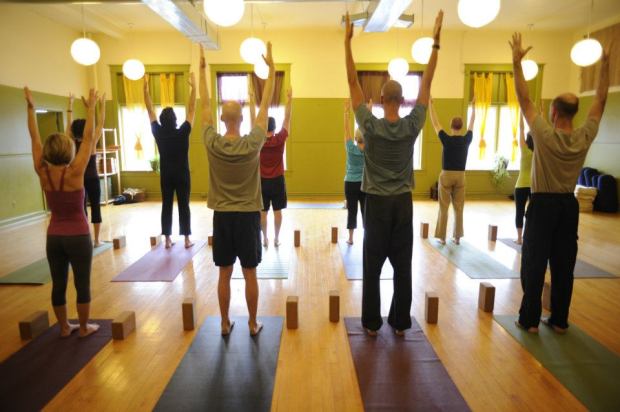 In the last several years, Queen Street Yoga has been looking more deeply into questions of privilege, oppression and cultural (mis)appropriation, and how they show up in the teaching of yoga, and in the experience of yoga studios. We have been examining how yoga was taught to us by mostly white, cis-gendered teachers, and thinking carefully about what it means to be North-American born practitioners of a tradition that has its origins in India. I define cultural (mis)appropriation as instances when members of a dominant culture take elements of a minority culture and use them outside of their original cultural context, often times reducing or commodifying those cultural aspects to “exotic” and meaningless fashion or activities. Cultural appropriation is a complex subject, and people often get defensive when it is mentioned. Recently an article was published in the Ottawa Sun about a yoga class at the University of Ottawa that was purportedly cancelled due to fears that it could be considered cultural appropriation. The Ottawa Sun later printed a retraction and reported that the class was cancelled due to low attendance, but that did not stop the viral media-storm in which many white columnists and writers derided the whole idea that yoga could be considered cultural (mis)appropriation.
 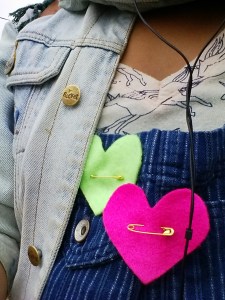 Fast-forward to the present moment, where colourful felt hearts litter every surface of my home, are pinned to every piece of clothing, and stacks of which are stuffed into every pocket and bag. In the past two months I have become a regular giver of hearts. I pin them on parked bicycles, gift them to cashiers, offer them to children and parents, and drop them on my yoga students’ mats.