Yoga for Your Brain

This post is written by Branches teacher Alissa Firth-Eagland. She is passionate about spreading awareness around brain injury, and helping those who have suffered one continue to grow. Alissa can also be found teaching drop-in classes at the Branches, and in our new series, Be Nice to Your Neck & Noggin. You can learn more about her approach on her website.


Each time you step on the mat, slow down intentionally, or sit with mindfulness, you strengthen your brain to its best advantage. As a holistic set of practices, many aspects of yoga (such as mindfulness, gentle movement, and attention to the breath) lend themselves particularly well to supporting the healing and growth of your brain. No matter what is going on with it – whether you are hoping to bolster concussion recovery or calm agitated nerves – yoga is brain medicine.

More good news: any accessible movement, breath work, or meditation is adaptable to a range of brain health challenges and situations: concussion, stroke recovery, mental health challenges, dementia, and chronic pain management.

166, 455 Canadians are impacted by brain injury in Canada each year. That’s one person injured every 3 minutes. Among all types of Traumatic Brain Injuries, concussions are the most common, accounting for approximately 80% to 95% of such injuries.

Concussions are those quick jolts to the brain. People get concussions in all sorts of ways: getting hit in the face by a toddler, walking into a door, fainting, getting bonked on the back of the head by a server carrying drinks by their table. A good shake of the skull and neck can do it. So if you are dealing with a concussion, it doesn’t matter how it happened. It matters only how your body responds to it. For the 10 – 30% of people who develop Post Concussion Syndrome (PCS), the injury typically affects every area of their life. Symptoms may persist for days, weeks, months, or even years after the initial jolt. And to complicate matters, they fluctuate over time.

Concussions often result in widespread brain tissue tearing at the cellular level. After a concussion, sheared neurons never entirely reconnect. But your brain is plastic, and always changing in response to input. Your brain finds ways to make new connections and detours: this is the incredible power of brain plasticity. The more you ask of it, the stronger it gets.

Yoga asks your brain for more positive plasticity, and therefore, increased brain power. Here are just two quick examples of how yoga requests your brain’s plasticity – in movement and in stillness:

  1. learning new things – yoga is a vast, potentially lifelong practice with endless learning opportunities. 
  2. focusing your attention – meditation is scientifically proven to thicken the prefrontal cortex, which is our centre of attention, impulse inhibition, memory, and cognitive flexibility. 

Yoga is also an attainable way to access your breath, which can calm the fight or flight response and settle you into the calmer state of the parasympathetic nervous system. Plus, as a physical activity, yoga boosts neurochemicals that promote brain cell repair and increases blood flow to the brain, prompting growth of new blood vessels. It truly is incredible how many aspects of yoga support the brain. 

But, by far the most important aspect of yoga as it relates to brain health is how adaptable it is to your individual situation and intention. It is accessible to all kinds of people, bodies, environments, and lived experiences.

The best style of yoga for you depends on your unique response to your concussion. So if you decide to try yoga to support your brain health, consider your symptom severity, level of dizziness, and how challenging it might be to leave the house and travel to practice. Your symptoms may fluctuate over time, even from minute to minute. Self assessment is the foundation of all self care. 

Pro Tip #1: You can ride the wave of sensation and symptoms a little, but be aware of how your body responds to avoid triggering a flare up. As your pain shifts, increases, or decreases, take care to honour that and dial the practice up or down accordingly. 

Key aspects to consider as you decide what style of yoga for concussion that you want to try:

  1. Are you symptomatic right now? If it does not exacerbate your symptoms, sit quietly and breathe through your nose or try some chill moves where you flow slowly and gently from one pose to the next. 
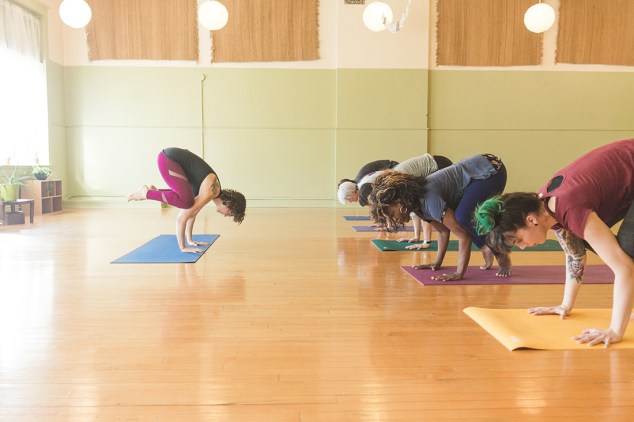
  2. Do you get dizzy easily? If so, you will probably feel worse practicing traditional vinyasa which affects blood pressure. Vinyasa is a popular form of yoga where you flow from one pose to the next including transitions where the head is well below the heart, then quickly brought back up. Rapidly shifting the blood flow from and to the brain can be incredibly disorienting and can cause vertigo or fainting in some people. 
  3. Are you having trouble leaving the house (for any reason)? Try a gentle live class you can do virtually or find a pre-recorded video. This will help you practice without having to drive somewhere, face a group of people, or navigate a new environment while you are recovering. 

Pro Tip #2: If you are practicing with a video, choose one where the instruction is so clear and well-paced that you don’t even need to look at the computer screen and can simply rest your eyes and listen. If the audio is low quality or hard to listen to, it is probably not going to have the beneficial effects you hope for. 

Remember that whether you have had zero concussions or multiple brain injuries, anytime you practice yoga with presence and intention, you are giving your brain a boost. 


If you’re living with post-brain-injury or the fatigue and tension of overworked eyes and neck, we highly recommend our new series, Be Nice to Your Neck & Noggin featured in Branches On Demand.

Adaptive VS Accessible Yoga?

You may have noticed a new phrase we’ve been using in our newsletters and on social media lately – Adaptive Yoga – and wondered, what does that mean, and why are we using it?

Accessibility is a hugely broad term, and can point to the myriad ways that a space or a service intentionally includes individuals who would otherwise experience barriers to access, from financial to cultural to physical. When it comes to ability, a few examples of accessibility are things like wheelchair-accessible ramps, sign-language communication for the deaf and hard-of-hearing, low lighting and softened noise for folks recovering from traumatic brain injuries, and so much more.

At The Branches, we’re choosing to use the word adaptive to set a more distinct focus for physical capacity with regard to mobility. In sum, the intention of Adaptive Yoga is to meet you where you’re at. This is an ethos we’ve aimed to manifest at the studio overall, but we’re choosing to create even more intentional and dedicated spaces for folks who might need or want them.

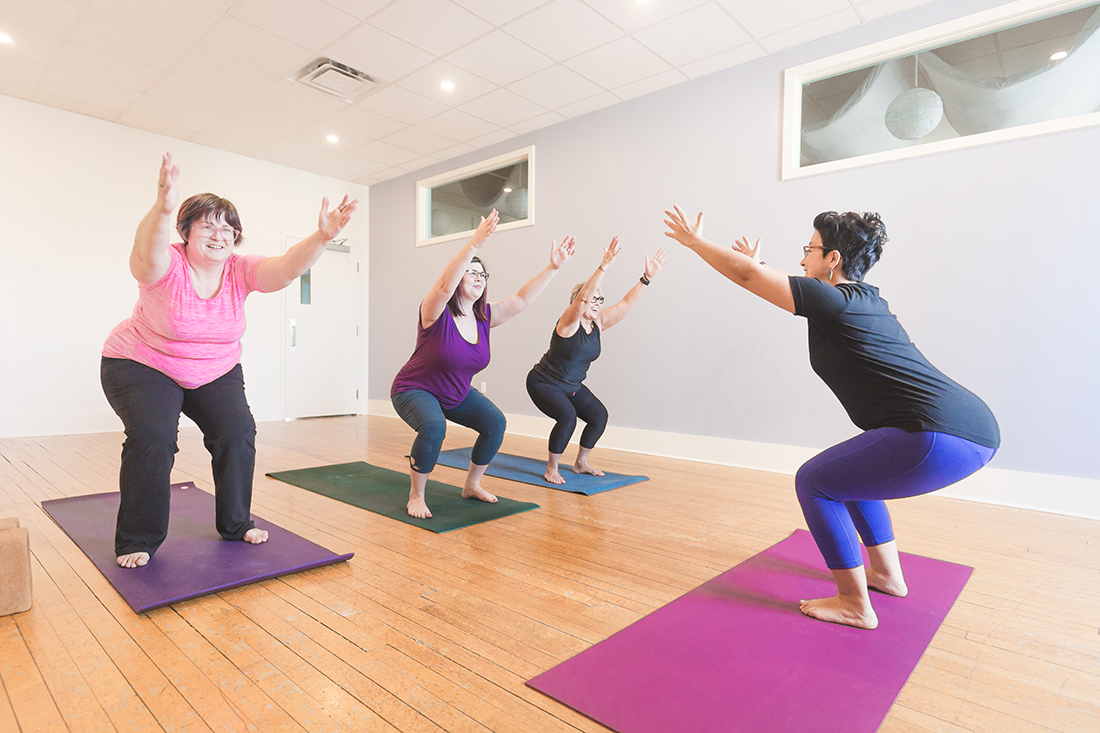
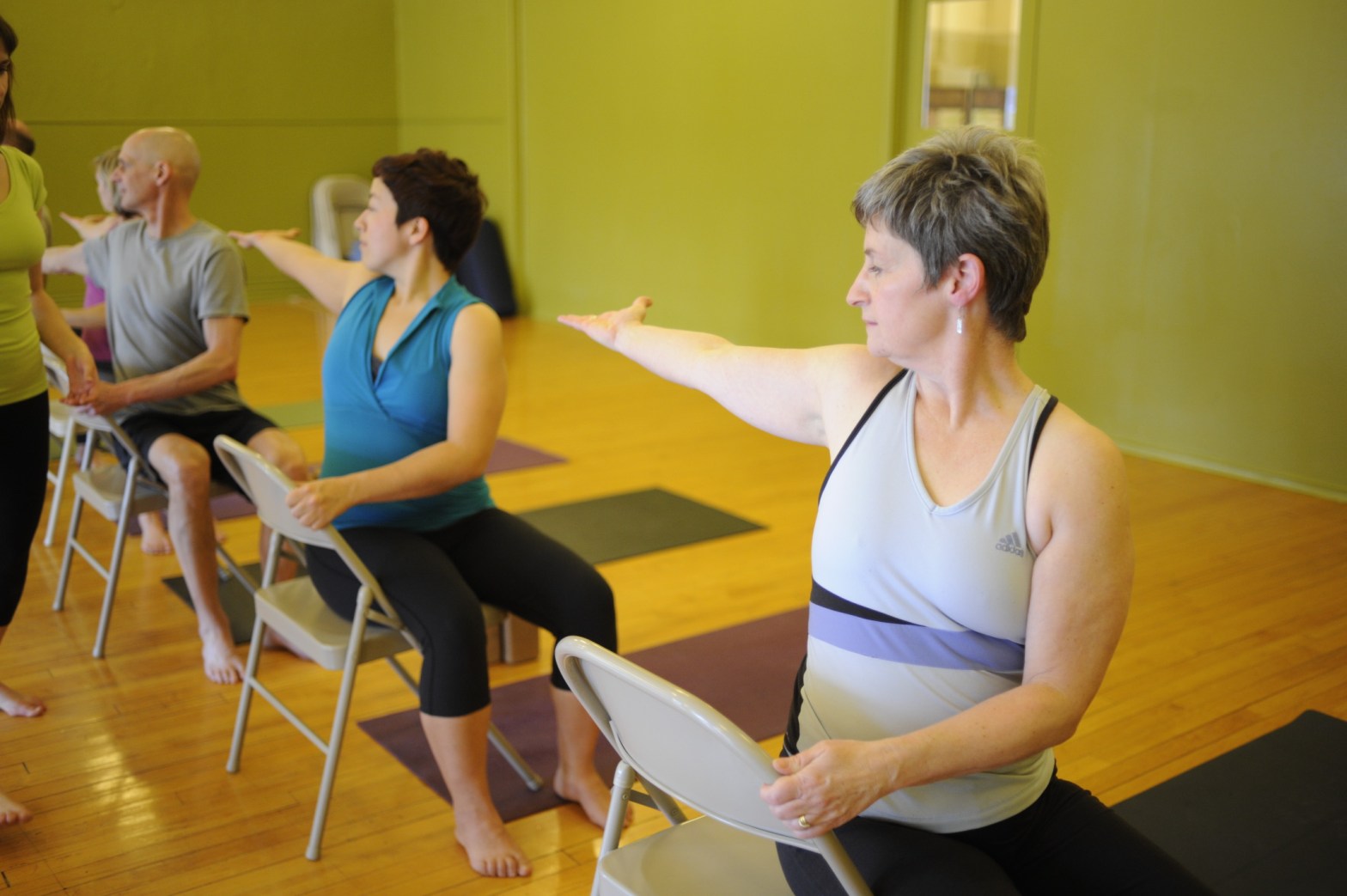
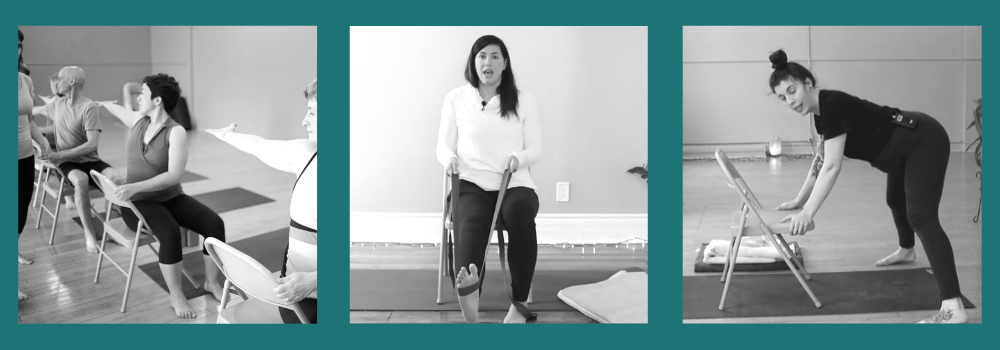
So, rather than teaching one-size-fits all poses and expecting all students to keep up with an intense pace, an Adaptive Yoga class empowers students with a multitude of strategies to adapt yoga poses and pacing to what works for their bodies. This often means using a chair as a key prop, and taking more time for teacher-student interaction than what typically happens in a flow class.

While students at The Branches may already have begun to learn adaptive strategies in some of our drop-in classes, especially Essentials and Slow Flow, we aim to offer more clearly dedicated opportunities for folks to engage with Yoga. One upcoming course, Adaptive Yoga With A Chair, might be a great place for you to practice if you…

  • use a mobility aid
  • have been sedentary for a long time
  • have lost some mobility over the years
  • experienced pain and difficulty moving in yoga classes in the past

The poses and sequences in our Adaptive Yoga courses are designed to adapt a conventional yogasana practice in (at least, but not limited to) the following specific ways:

  1. reducing or eliminating weight-bearing on your knees or wrists/hands
  2. minimizing the number of times you go down to and get up from the floor to once or none
  3. using external support for balance poses and explorations 
  4. relating to yoga props as a tool for growth and empowerment

If you’ve ever felt like flow yoga classes just don’t work for your wrists, knees, body size, or ability, but you do want to challenge your capacity beyond the borders of a gentle-only yoga practice, Adaptive Yoga is a great place to connect your mind and body, empower yourself, and build capacity progressively. Our Adaptive Yoga sessions are taught by an experienced teacher who can skillfully share options with a wide range of body sizes and abilities and help you grow within your own limitations.

You might see yourself or a friend or family member in the above descriptions. We encourage you to take a closer look at the options for Adaptive Yoga at The Branches, to take a leap of faith and sign up for a course, or to pass this blog post on to someone who might benefit from a yoga practice that meets them exactly where they’re at.

Ways to explore Adaptive Yoga at The Branches:

  • Sept 2021: Adaptive Yoga With A Chair – Virtual Course
  • Oct 2021: Adaptive Yoga – In-Studio Course (Please note: our ground floor studio requires 5 steps to entry. We apologize for this lack of accessibility, and continue to work towards our new ramp project.)
  • On-going: Branches On-Demand subscription has a broad selection of practices with an adaptive lens
  • Coming in 2022: Adaptive Yoga 30-Day Challenge!

Here’s our new name, you can take it or leaf it

A Post from Leena Miller Cressman, Queen Street Yoga Owner/Director 

We needed a new name. But how to choose?

After the weighty decision to move from our home of 15 years, 44 Queen Street South, the decision to find a new name was obvious. However, what to rename ourselves ended up feeling like a monumental task. It took several months of brainstorming, testing, and soul-searching before we finally reached a decision. I felt a huge responsibility to rename this studio, since Queen Street Yoga has been a special place for many people for a long time – including me. This task felt akin to renaming a teenager. 

I wanted a name that felt true to who we already are, and would lead us into what we can become. This has been an opportunity to think carefully about why our studio exists. And now, I am proud to introduce you to our new name: The Branches.

We wanted this new name to connect to our values. The branches of Yoga include so much more than just asana (postures). It is meditation, community service, and a spiritual pathway to wholeness. In addition to being a way to care for our bodies, we believe Yoga and movement practices can be a catalyst for social and environmental justice. Yoga practice can help us recognize our interconnectedness. Yoga can give us sustenance to care for ourselves and others. With Yoga as our common ground, we can learn to engage with the world more wholeheartedly. 

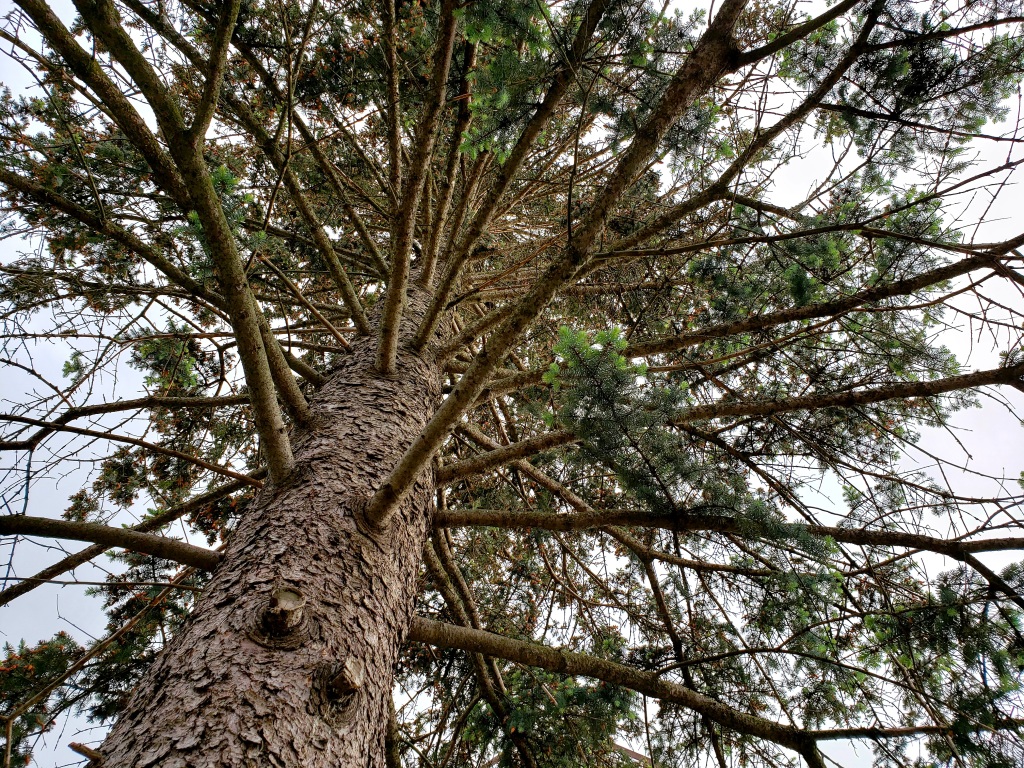
Our studio has been around for 16 years and we hope “The Branches” conjures the image of a huge, mature tree. We’re not a young sapling. We’ve got deep roots, a sturdy trunk, a big canopy, and we’re home to lots of life. The Branches represent the diverse people who have gathered in our community for the past decade and a half, and the many new people we are connecting with in online classes. Our new name speaks to the many people who have graduated from our Yoga Teacher Training to seed their own classes in schools, prisons, community centres, backyards, and seniors’ homes. Our strong branches reach far beyond a physical location.

We’re not a young sapling. We’ve got deep roots, a sturdy trunk, a big canopy, and we’re home to lots of life.

The Branches is a place of growth and nourishment. In our new location, no longer beholden to landlords and threatened by ever-increasing rent prices, we have more freedom to put down roots and create inclusive community space. We are working to build a ramp to make our ground-floor studio accessible. To remove financial barriers, we’re now offering sliding-scale prices for all our classes. We hope that our space can become a hub for community action by offering low-cost meeting rooms. Our new location is easily accessible by public transit, walking and biking. We’re in the middle of major renovations and have invested in a small environmental footprint by eliminating natural gas and retrofitting our building with energy-efficient heating, cooling and insulation. 

Come practice yoga with us outside under the branches of the maple, linden, and spruce trees

So welcome to The Branches. We’re so excited to practice together with you in our brand-new yoga space, whether in person or online. It’s going to be beautiful! This summer, as we await the hopeful resolution of the pandemic and our renovations, come practice yoga with us outside under the branches of the maple, linden, and spruce trees on our spacious back deck. 

P.S. We have a brand new website to match our name launching soon!

Big Body Yoga: Reflections on The “Weight” of Words

This blog post is written by Carol Kennedy, who is joining our staff to teach Yoga for Round Bodies for the Fall 2020 season.

Big, Body, and Yoga are three words that exist as distinct spaces for judgment. A whole gamut of adjectives are ascribed to Yoga, much like our bodies, and the construct of being “big.” This blog is a challenging one to write for me, as these three words, especially in conjunction with one another, conjure up so many emotions and images. 

Yoga has been described as exercise, movement, cult, appropriation, commodity, ritual, sacred, Eastern, and Western, just to name a few – and these descriptions are quite often shifting and morphing at the same time. Yet these descriptions of Yoga, and debates surrounding its definition remain external to us as individuals, allowing space for objectivity. This threshold of objectivity is crossed when the word “body” is connected to Yoga. Our bodies move us; hold our thoughts, our emotions. They nurture us, and can do the most miraculous of things, and they are what contain ‘us’ as embodied whole beings. 

The body is what makes Yoga subjective, and this seems almost redundant when put together. I mean, we all have bodies, and each of us have a dynamic relationship with it, and through it. So, what is Yoga without the embodied human? Is Yoga a tool for the body? Or is the body a tool for Yoga? Continue reading “Big Body Yoga: Reflections on The “Weight” of Words”

Explore Resilience in Your Body & Mind  with an Interactive Yoga Sequence

This post is by one of our wellness practitioners, Natasha Allain. 

As complex beings we process information through multiple lenses: physical, emotional, mental, spiritual. So, what happens when we use multiple lenses to process at the same time, for example when we practice yoga and meditation? Here we can apply what we learn through action, such as yoga, and kinesthetically condition our muscles and our mental thought roads to spaces of resilience.

Below I have paired resilient building lessons with 5 familiar Hatha Yoga postures. Now, this isn’t just any yoga practice. With each pose you can contemplate and explore an aspect of resilience. Through intentional postures, breath, and contemplation, resilience researchers state that it is possible to rewire our brains and guide our bodies towards more resilient responses and behaviours.

Your Yoga for Resilience Sequence

Continue reading “Explore Resilience in Your Body & Mind  with an Interactive Yoga Sequence”

Help! I’m nervous to do a YTT because I worry it might be too physically demanding

Leslie is a lead teacher at Queen Street Yoga, and this year she will be acting as an assistant for our 200-hour Teacher Training Program starting in October 2019. Leslie has lots to say about the program, as she completed it in 2016. Something Leslie is passionate about is encouraging people to both meet their bodies where they are at, and be curious about their bodies’ capacities for change.

At our first YTT info session back in April, someone asked how much physical practice we’d be doing over the training weekends, and whether it would be advanced or athletic practice. On a separate occasion, another regular student who is considering our program asked if we’d get into more complex poses, like eight angle pose during the training.

Some folks might feel a little intimidated by the prospect of intense group practice being a part of the teacher training process. Others are chomping at the bit to learn how to do more complex, demanding shapes. Looking at the list of applicants we’ve already received, I know some of them love to hulk out and feel the burn – they’re the type to sweat it out in Strength & Flow. At the same time, we’ve got other participants who are more into Yoga for Dynamic Aging, and are passionate about the benefits of restorative yoga.

Continue reading “Help! I’m nervous to do a YTT because I worry it might be too physically demanding”

When the Poses Don’t Work – Adaptive & Accessible Yoga

This post is written by Sara F, a graduate of our 200-hour teacher training program. She’s been our a familiar face on Sunday nights, hosting at the front desk during our 6:00pm $5 Basics. Keep your eyes open for Sara on June 1 at 1:00pm for our Yoga in the Park: Pride Edition.


Have you ever been in a yoga class where the teacher instructs a pose, and you either stand/lay there knowing the pose won’t work for your body, or you silently struggle into it and hope it will end soon?
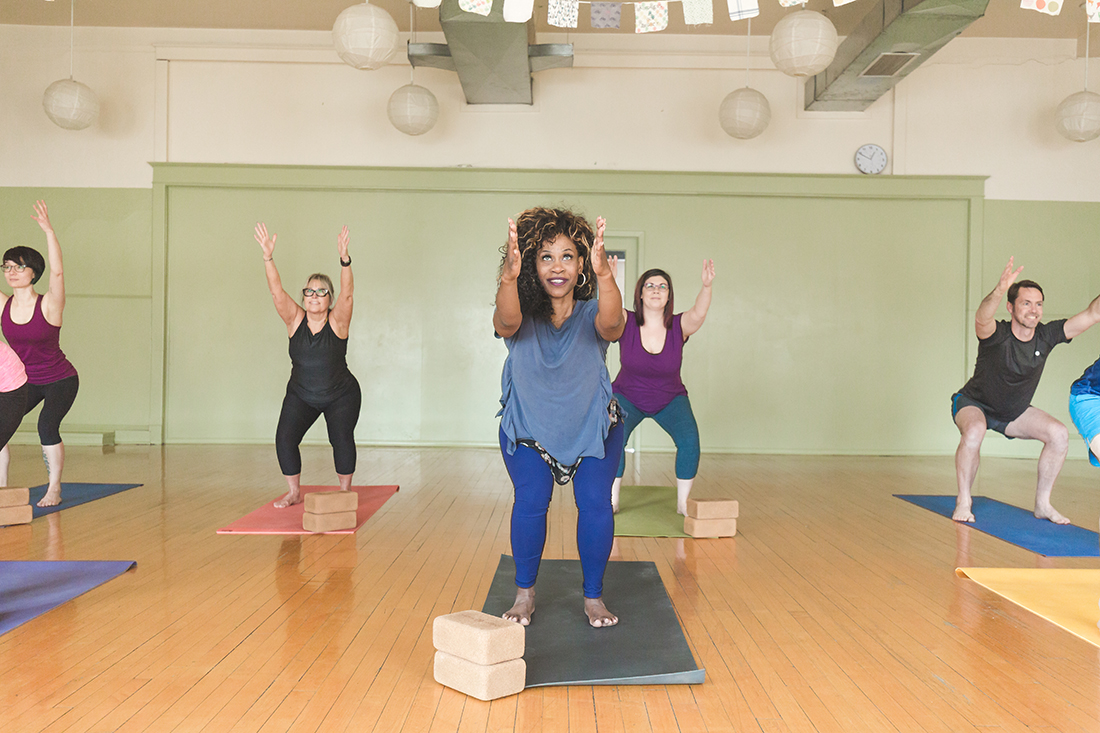
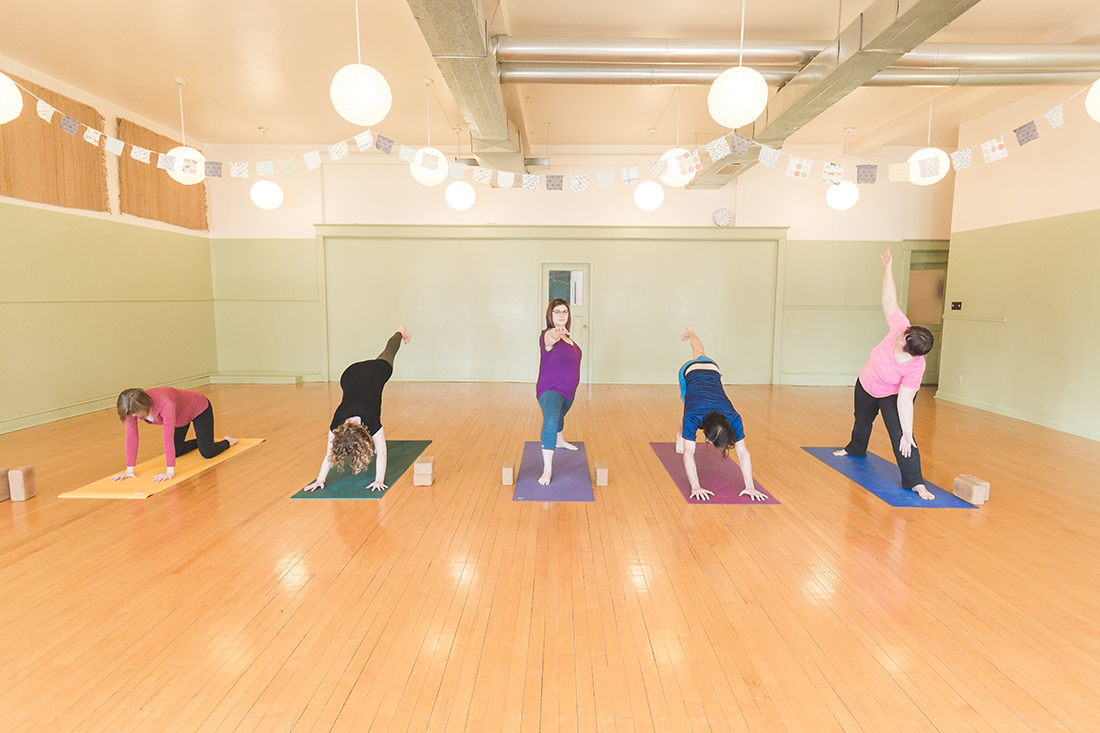
Or, on a more positive note, have you been in a yoga class where the teacher offers variations of a pose, often with different props? If the teacher gave different options, you have experienced accessible or adaptive yoga, which offers solutions that allow people of all abilities and body types to practice and benefit from yoga. At Queen Street Yoga you may have heard teachers refer to pose options as “bus stops,” and how far you ride down the bus route is up to you.

Continue reading “When the Poses Don’t Work – Adaptive & Accessible Yoga”

How our yoga teacher training is going to change your life and fix all of your problems

Actually, it’s not.

And if you’re okay with that, let’s talk. If you could do without the inspirational branding of being a better you, or the aspirational promises of hard and fast transformation, then we can have a real conversation. We can look together at the process of yoga teacher training for what it is; a concentrated time of learning and engaging with yourself and with a community.

A lot of YTT marketing that I see rubs me the wrong way. It seems to promise spiritual, emotional and career transformation in a one-shot deal. And, I get why people are drawn to it. Who doesn’t want a quick fix? Who doesn’t want that promise fulfilled?

Continue reading “How our yoga teacher training is going to change your life and fix all of your problems”

Strong or Flexible – Why Not Both?

When you see the class title Strength & Flow, what feelings or images come up? Does it make you think of a bootcamp class at the gym: grunting and burpees and shouting? Or maybe it brings up an experience of tightness in your body. One of the most commonly cited reasons for coming to yoga that I hear is, “I want to become more flexible.” Those same people often wonder if going to a class focused on strength is going to make them feel more stiff, rather than more flexible. We’ve got news for you: strength is flexibility’s best friend.

First things first though; don’t be nervous to try this class! You should know that Strength & Flow is actually quite doable, and nothing like bootcamp or gym class. The great thing about it is that it’s just as customizable as our other classes. The depth of your squat, the amount you can hinge at your hip, the time you spend time in plank, or the number of push-ups (with knees down if you want!) is up to you. You can sense the balance between fatigue and energy in your body on that day, and act accordingly. (And that’s where it becomes yoga.)

So why not “Flexibility & Flow,” when we know that flexibility is a goal for most people? Flexibility gets singled out as the physical quality that folks most desire. I get that – I began yoga without being able to touch my toes, and I used to fume with frustration and envy in seated poses because there was no way that I could straighten my knees, or tilt my pelvis forward – my back was rounded, my hamstrings felt tight, and that was that.

But: is flexibility all that it’s cracked up to be? And is passive stretching even the best way to feel and move better? You can probably tell that I don’t necessarily think so.

Continue reading “Strong or Flexible – Why Not Both?”

No one wanted to leave

Last night at the end of class, no one wanted to leave.

Everyone rolled over and sat up. We sang Om, acknowledged the land and said Namaste to end.

But nobody moved.

It was 9pm, and the light was starting to fade from the sky. We could hear the class in the next room start to stir, floorboards creaking as people walked back and forth, putting away their props. But in the front studio, it was utterly still.

Some people had their eyes closed. Some kept their hands in a prayer position in front of their hearts. Some people had their heads cocked, like they were trying to hear as clearly as they could the depth and detail of the silence.

Continue reading “No one wanted to leave”