
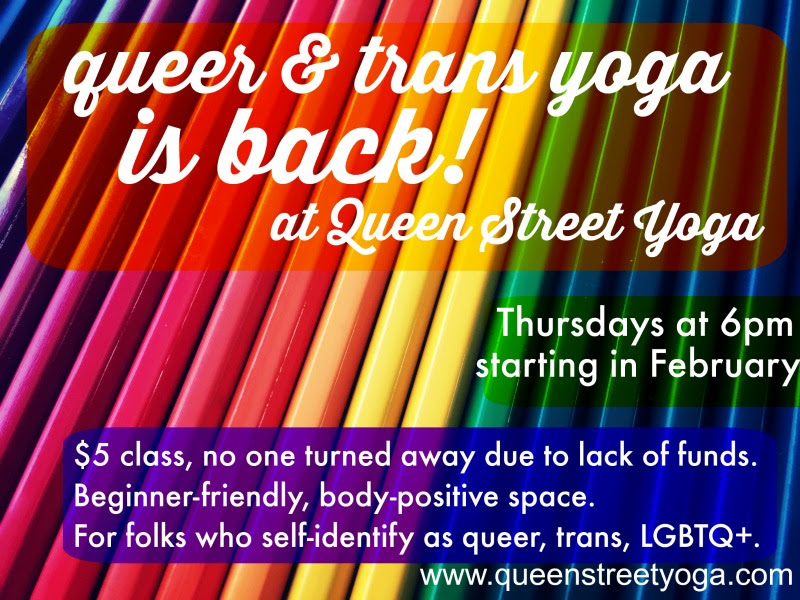
Curious about why we are offering a queer and trans yoga class? The following post was written by Jessica, a long time member of the qsy community as a work trade, and also as a consultant around starting the queer and trans class. Here she explains her perspective on why having a gathering place for queer and trans folks in a yoga studio feels valuable and important. This post was originally published on Jessica’s blog, and has been reposted with her permission. Have a read!
Recently, Queen Street Yoga in Kitchener began offering Queer & Trans Yoga as a part of their weekly yoga class schedule. It is basic level class with a sliding scale monetary donation request, specifically for members of the LGTBQ+ community. The class originally started last year after consultations with local LGTBQ+ community members, but had been put to a pause after the teacher announced her relocation to another city. QSY was passionate and committed to finding a LGTBQ+ identified teacher who would run the class. Last week was the first week of the class resuming, with 14 members of the local LGTBQ+ community joining the class. This started a conversation among my social circle around the question “Why is there a need for Queer & Trans yoga?”. Several individuals questioned me on this, stating that yoga is a practice based on the acceptance and love of all peoples – so why would we need a “special” class for members of the gay community? Isn’t this excluding “straight people” from an inclusive practice?Continue reading “Re-Post: Queer & Trans Yoga: A Reflection on why it is needed and the purpose it provides”
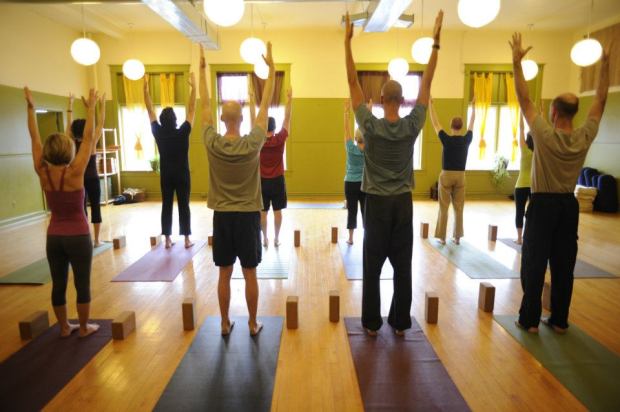 In the last several years, Queen Street Yoga has been looking more deeply into questions of privilege, oppression and cultural (mis)appropriation, and how they show up in the teaching of yoga, and in the experience of yoga studios. We have been examining how yoga was taught to us by mostly white, cis-gendered teachers, and thinking carefully about what it means to be North-American born practitioners of a tradition that has its origins in India. I define cultural (mis)appropriation as instances when members of a dominant culture take elements of a minority culture and use them outside of their original cultural context, often times reducing or commodifying those cultural aspects to “exotic” and meaningless fashion or activities. Cultural appropriation is a complex subject, and people often get defensive when it is mentioned. Recently an article was published in the Ottawa Sun about a yoga class at the University of Ottawa that was purportedly cancelled due to fears that it could be considered cultural appropriation. The Ottawa Sun later printed a retraction and reported that the class was cancelled due to low attendance, but that did not stop the viral media-storm in which many white columnists and writers derided the whole idea that yoga could be considered cultural (mis)appropriation.
 The Branches