5 Unexpected Lessons from my Yoga Nidra Practice

This post was written by Kimberley Luu, who is offering a Trauma-Informed Yoga Nidra Teacher Training through The Branches, starting in January 2026.

Years ago, I committed myself to yoga nidra practice. I had a vision that if I
kept training, I’d eventually never have to deal with this pesky condition
called insomnia again. I thought I would be able to enter conscious, deep
sleep with the snap of my fingers and live vibrantly off less hours of sleep. I
imagined mastering relaxation, but only for the covert purpose of being
“productive”; never missing a day of work due to burnout again.
Today, it’s amusing to reflect on the naivety of these dreams. Indeed, I was
a little off… yet, I feel no inkling of disappointment or regret. I’m no Swami
Rama (the renunciate who shocked scientists with his superhuman rest
abilities), but I did end up learning a lot of other valuable lessons.
  1. Losing consciousness is not a good measure of sleep quality.

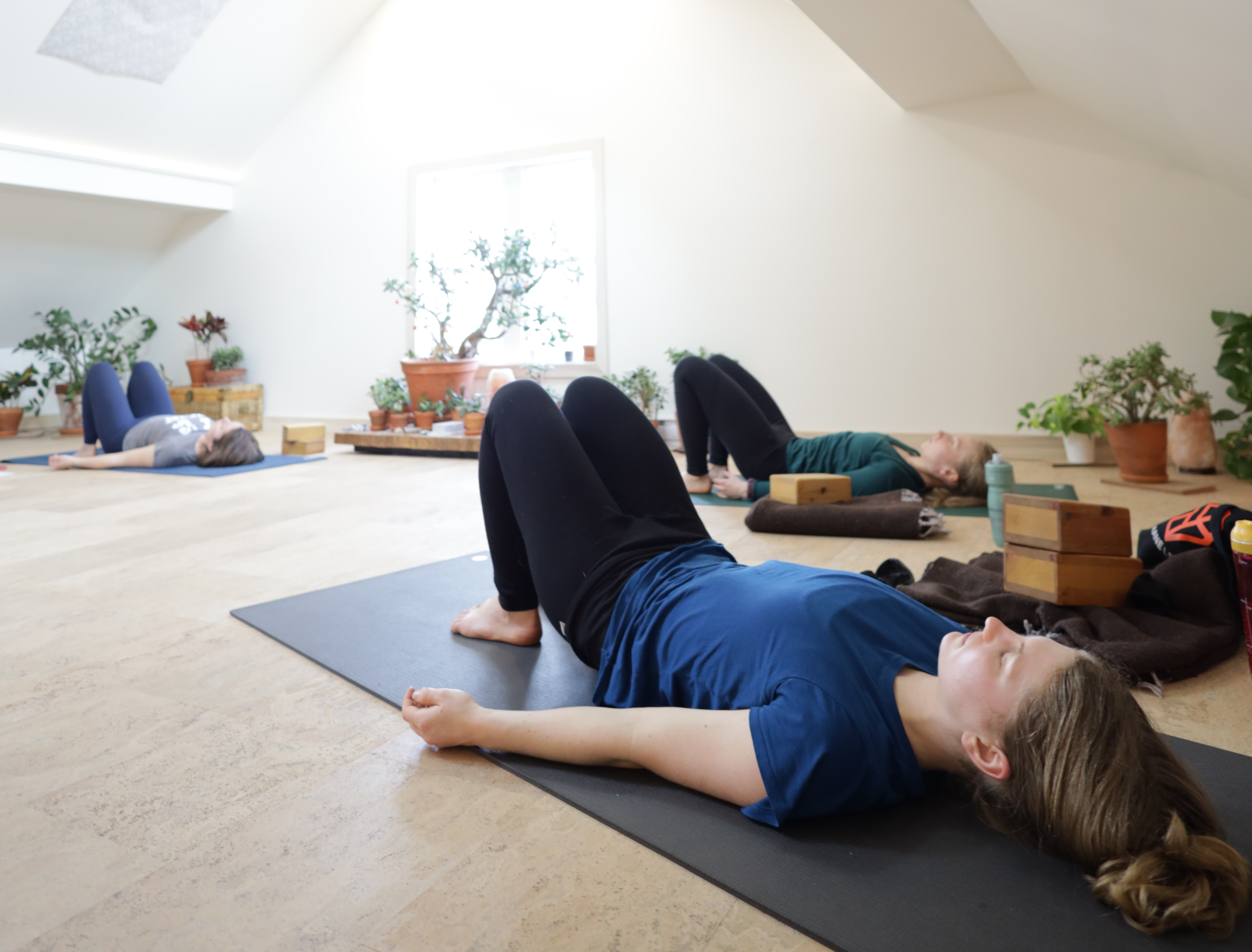
    You can be wide awake and deeply resting. You can also be fast asleep and spiraling in restlessness. 
    This is one of the first statements that Swami Satyananda makes in his foundational book, yet, learning this first hand is something that has taken a huge burden off my shoulders. Regular sleep is important, but I’m no longer as concerned about being completely unconscious for the entire night.

    For instance, if I’m anxious and wide awake for my last couple sleep
    cycles, I engage in a yoga nidra technique which involves broadening awareness, softening the mental grips around thoughts, and letting them unfold in a larger container of acceptance and kindness. 

    Same goes for naps—I just lie down, close my eyes, and broaden
    awareness. It doesn’t matter if I fully clock out. I know in my heart that this is still quality rest.

  2. Experiencing insomnia once in a while is normal and okay.

    During my initial stages of chronic-insomnia recovery, I still felt on edge about its potential return. Even one night of sleeplessness would spike my fears of relapse. But with yoga nidra training embodied, I am now confident that I have the tools to come back to balance, even if I have a bad night or two. I know I’ll be tired for a bit, but that’s okay. I’ve grown greater acceptance that experiencing some insomnia is just a part of being human, and it’s unrealistic to expect otherwise. Life happens, situations happen—stressful ones, and even exciting ones, like the night before my wedding day, when I didn’t sleep a wink! 😉

  3. Attachment to “perfect relaxation” only breeds suffering. 

    Although my initial goals involved “mastering” relaxation, I slowly dropped this when it became clear that this was only creating tension in my body.  What I’ve realized is more important than constant relaxation is the cultivation of spacious awareness. Rather than suppressing our stressful experiences, yoga nidra trains us to embrace all arising perceptions in a broader mental container. We allow all experiences to be as they are—whether that experience is bliss or a stormy mess. This shift in orientation is what’s truly healing and liberating.  So, I’m no longer attached to the experience of relaxation as much as I was before. It’s as fleeting as the wind, but spacious awareness is always here. 

  4. Better than yoga nidra’s benefit of “productivity” is its ability to
    reveal what matters most.

    Yes, yoga nidra can make you productive in the sense of giving you the capacity to do more: it mitigates stress and anxiety, enhances alertness, and refreshes cognitive resources. However, more valuable is its ability to gently reveal what is truly meaningful. By slowly peeling away the layers of conditioning (which are
    often under the influence of modern hustle culture), we come into greater connection with our life purpose(s) and guiding core values.
    Through this process, we may find ourselves gradually shifting from the endless race to the top, towards intentional work that supports what genuinely matters to us.

  5. Practice doesn’t grow more complex over time… it gets
    unbelievably simple.


    One of the aspects of yoga nidra practice that I initially found so helpful was that it provided structured steps on how to chill. This was much more effective than receiving the classically unhelpful advice: “just relax!” My mind craved constant activity, and yoga nidra told me precisely what to focus on, offering various techniques that kept me engaged until it ushered me into deep, conscious rest.

    Yet, as I’ve grown more familiar with this state, it has become increasingly easier to visit again, without having to take so many steps. While it’s still great to be able to lean on those steps whenever I need them, most of the time now I enjoy a simplified practice: resting in my heart space, broadening awareness, and surrendering to what is.

.

Want to explore a deeper relationship with yoga nidra and maybe
even share it with others? Kimberley’s Trauma-informed Yoga Nidra Teacher Training begins with a 6-week Deep Dive course, which provides a supportive container for long-term personal practice.  This is followed by 2 facilitator training weekends, which will equip you with all the tools you’ll need to confidently share yoga nidra from the heart.
Creating a Sensory Friendly Home Yoga Environment

🧘‍♀️ How to Create a Sensory-Friendly Home Yoga Environment for Brain and Nervous System Health by Branches Teacher Alissa Firth-Eagland

Follow-up to Alissa’s post “Yoga for Your Brain” published on The Branches Blog October 2023. 

For folks who may want to manage their symptoms by not reading on a screen but instead watching or listening to a video, click here for a 3 minute video version of this blog: Create a Sensory-Friendly Home Yoga Space | Brain + Nervous System Support

Whether you’re managing post-concussion symptoms, nervous system dysregulation, chronic pain, or everyday sensory overload, your home yoga space can be more than just a corner of the room—it can be a healing refuge.

In Yoga for Your Brain, we explored how yoga supports your brain’s plasticity and recovery. Today, let’s bring that insight home—literally. We’ll look at how to create a sensory-friendly home yoga environment that gently supports your body and brain.

🌿 Why Sensory-Friendly Matters at Home

Many people recovering from brain injuries or living with heightened stress are especially sensitive to sensory input: harsh lights, background noise, tight clothing, or cluttered spaces can be overwhelming. 

In yoga, there can be many goals, including going outside your comfort zone and challenging yourself physically and mentally. This is not that type of practice. Think as cozy as possible! Aim to create conditions that calm you. A sensory-friendly environment helps regulate your nervous system, making it easier to breathe deeply, move mindfully, and truly rest.

🏡 Step-by-Step: Building a Home Practice Space That Soothes

You don’t need a dedicated yoga room. Just a little intention can transform any space into a supportive sanctuary.

✨ 1. Light: Soft and Dim

  • Choose a space with natural light, or use a soft, warm lamp (think salt lamp or dimmable bulb). 
  • Avoid harsh overhead lighting and flickering bulbs. Personally I prefer incandescent bulbs to the newer styles because they seem to vibrate less to my eyes. Some concussion people find it hard to look at candlelight. 
  • Try practicing with an eye mask or soft eye pillow during rest poses.

🔉 2. Sound: Gentle and Controlled

  • Reduce background noise with a white noise machine or fan.
  • You might enjoy practicing with no music, letting your breath be your rhythm.
  • If participating in a virtual class, pick instructors with instructions so clear, you can choose not to watch the video and only listen.

🧘 3. Touch: Comfort is Key

  • Wear soft, breathable, non-restrictive clothing. Bonus points if you wear PJs so you can roll into bed after practice! 
  • Practice on a thick mat. Layer it with a blanket or towel for extra cushion.
  • Gather your props: bolsters, blocks, blankets, straps, or pillows can make poses more comfortable—especially restorative ones.

🧺 4. Declutter: Clear the Visual Field

  • A visually busy room can be overstimulating. Tidy the space before practice if possible. I learned this from my yoga teacher: taking the time to prepare and clean the space gets you in the right frame of mind for practice. It is a form of saucha. For me, sweeping and wiping down the floor before I place my mat is a fave ritual to get ready for yoga. 
  • You don’t need perfection—just a calm corner with a bit of order. Sometimes it is better to practice amongst the dust bunnies than not at all. 
  • A folded blanket, plant, or treasured object can signal “this is a space for care.”

🌀 Tips for Practicing at Home with Sensory Awareness

  • Slow it down. Reduce the pace and number of poses. The slower you move, the more time your brain has to process. Take the time to experience the shape or movement. 
  • Avoid fast vinyasa styles that can spike blood pressure or cause disorientation.
  • Repeat familiar movements. Routine can reduce cognitive load and boost comfort.
  • When you are extra tired, use grounding poses like Child’s, Legs on the Chair, or Constructive Rest Pose (CRP). Liz Koch has a beautifully gentle spine practice in CRP you can do with or without a core ball. 
  • Anchor to your breath by inhaling and exhaling through your nose. This sends the message to your brain that there is no immediate threat. Even a short breath practice can help calm your nervous system.

💻 Setting Up for Online Yoga Without the Overwhelm

If you’re using Branches On Demand or another virtual platform, here’s how to make your screen time supportive:

  • Lower screen brightness and sound to a comfortable level.
  • Headphones or external speakers might sound better than built-in laptop speakers, depending on your sound sensitivity.
  • Choose videos with slow pacing, fewer transitions, and simpler production.
  • Avoid rapidly changing visuals.

🌱 Practice That Feels Like a Gift, Not a Task

Your home practice doesn’t need to be fancy—aim for feeling safe and supported. With a few thoughtful choices, you can create an environment that welcomes your body, calms your senses, and supports your brain in healing.

Start by adjusting just one element: lighting, clothing, background noise—whatever feels most pressing. Your nervous system will notice. Over time, those tiny changes can stack up into a powerful shift.

🧘‍♀️ Ready to Begin?

If you or someone you love are living with concussion or brain injury, I invite you to register for my Yoga for Concussions course with this 10% off Affiliate Code: AFFILIATE10. This course is designed to meet you right where you are—at home, with a tired body, a sensitive system, and a deep need for rest and recovery. 

** If funds are low and the Affiliate price still doesn’t fit your budget, please reach out to alissa@gardenvariety.ca to hear other options. Concussion and head injury can profoundly impact survivors’ capacity to work. No one will be turned away due to a lack of funds. **

+++++++++++++++++++++++++++++++++++++++++++++++++++++++++++++++++

A love letter to death for the Solstice

Quiet friend who has come so far,

feel how your breathing makes more space around you.
Let this darkness be a bell tower
and you the bell. As you ring,

what batters you becomes your strength.
Move back and forth into the change.
What is it like, such intensity of pain?
If the drink is bitter, turn yourself to wine.

In this uncontainable night,
be the mystery at the crossroads of your senses,
the meaning discovered there.

And if the world has ceased to hear you,
say to the silent earth: I flow.
To the rushing water, speak: I am.
– Rainer Maria Rilke
Content Warning: this letter from Leslie contains reflections on personal loss, death in general, and the overall state of the world. [ 8 minute read ]
An Initiation into Intimacy with Death
Today is the Winter Solstice. After the gradual decline of Autumn, the ground is now frozen, the leaves have fallen, we have arrived at peak darkness, the dormant pause of Winter, and the death of the year.

Coincidentally, in just a few more days, it will have been 17 years since the Christmas Eve that my mom suddenly fell so ill that she couldn’t attend any of the holiday family events. And in another month after that, it will have been 17 years since her abrupt passing. I was 21. Since then, the dying of the year is forever tied to the most painful death I have experienced in life so far. Christmas cheer is always complex, and the increasing darkness on the way to the Solstice can sometimes hit me doubly hard.

Nonetheless, over the years, I have come to feel that her death was not just a loss, but also an initiation. Learning to look directly at death and darkness, or even embrace them, has become an important part of cultivating the wholeness that we might be seeking through our yoga practice.

I believe it would be wise to get more intimate with darkness, endings and death. This letter is an invitation for you to consider joining me on that journey.

 Death in Yoga Practice: Savasana
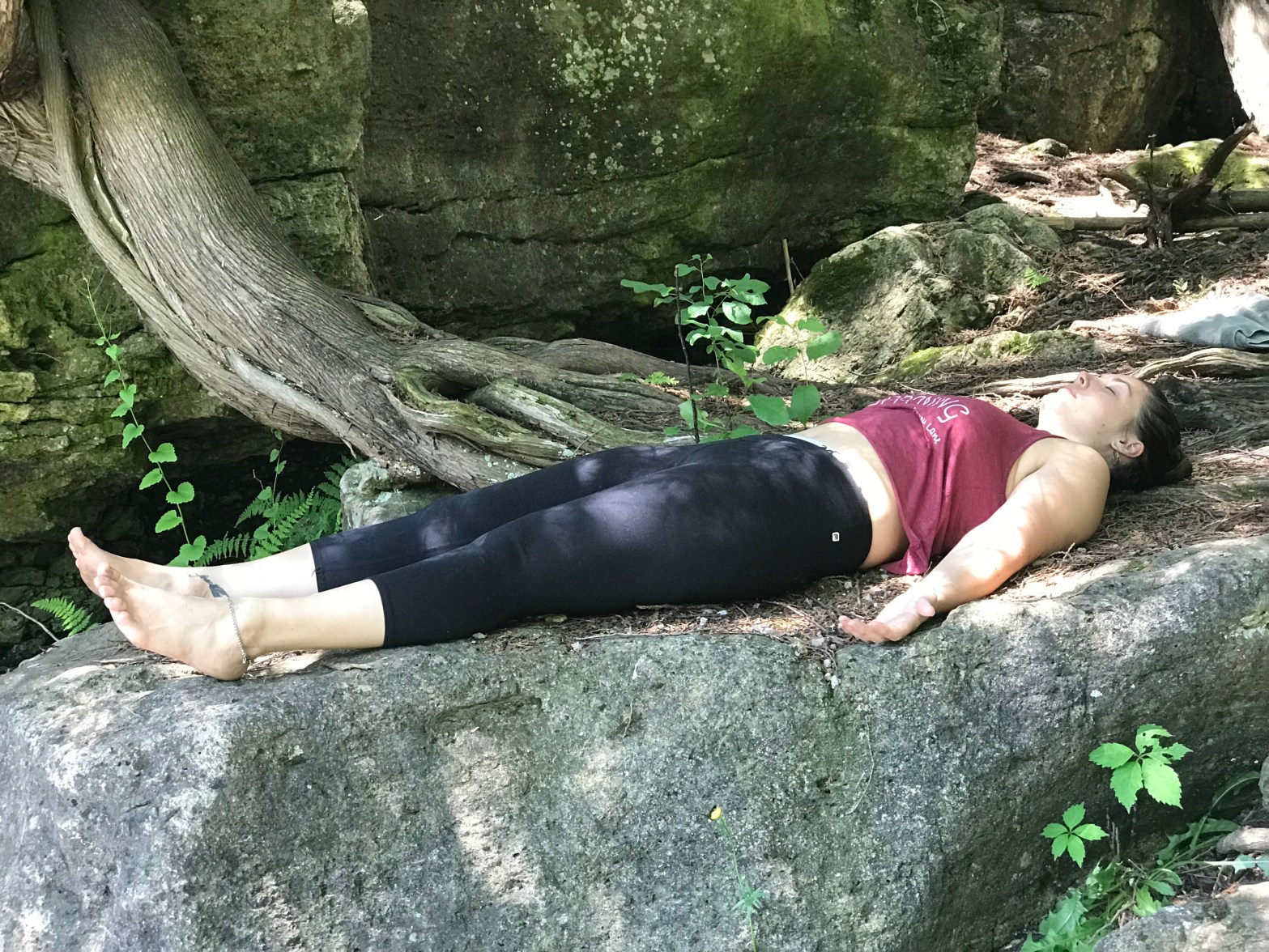
Every time we do a formalized yoga practice on the mat, a cycle ends. Savasana, typically the final posture in an asana practice, is named in Sanskrit from the root word meaning “corpse.” In addition to simply resting, to me, savasana invites us into a symbolic and practical acknowledgment of the ending of a cycle.

During savasana, I observe downward trends like the heat dissipating from my body, my heart rate settling back down, and the subtle decrease in muscle tension. All of this illustrates the natural impermanence of each episode of experience, and by extension, of my life as a whole. By practicing the death-like state of stillness and withdrawal from my external senses, I get an opportunity to contemplate my own transience as an embodied being.

My felt-sense of both pleasant and unpleasant sensations arising and passing away during practice, and especially during savasana, calls me to more fully savour what I find to be sweet, and to take any bitterness in a long view, knowing that all things, good and bad, must pass.

 Death in Every Moment: the Breath
Every time we breathe, a cycle ends. Looking at it on the scale of a lifetime, upon birth, we all kick off the adventure with our first lung-expanding inhale. And at some point, if we are granted the privilege of dying gently, one of our exhales will be our last.

When I have the presence of mind and a moment to focus, I softly and gradually slow my cycles of breath and observe what it’s like as I extend and finish my exhales, lingering with my attention in the empty dormancy of the after-exhale, the tiny endings at regular intervals. You might try this for yourself as you fall asleep at night, as you settle at the beginning of your yoga practice, or as you wait a moment before you transition to school or work or home.

Practices like savasana or simple breath awareness nudge me to acknowledge the fact that my time in this human body is limited. When I can connect to this truth, it brightens and strengthens my appreciation for life, and cracks me open to a deeper connection to its beauty. When I am brave enough to embrace these mini-deaths, the encounters spark the questions, What if this moment were my last one? Could I make peace with the life I’ve lived so far? If not, how can I live better?

 Death and The Pain of the World
Integrating the grief from a loved one’s death is one thing. Attuning to the reality of your own death is another. Beyond that, there is a third call that I think would be wise to explore, which is facing the pain, death and loss of living entities, human or non-human, all around the world.

Reading that, maybe your mind jumps to the several humanitarian crises transpiring across the globe due to supremacy-driven political ideologies, or exploitative labour practices in service of more capital for shareholders. I know some of you will have immediately thought of our animal relatives, or the larger interconnected web of being that includes all living things, and the animate, ensouled world where rocks and rivers have personhood, too.

It is dark out there, but I believe that bravely witnessing the darkness has the potency to light up a fire in our hearts. An interview I watched recently was summed up by the host, Daniel Schmachtenberger, like this,

“When we are actually open to the beauty of reality, there’s a sense of awe, and a gratitude, and a humility that comes with that. But when we’re open to the beauty-of-reality being harmed, which is in the factory farm, and on the war field, we also feel the suffering of others, such that it’s overwhelming. And the overwhelm in the suffering, and the overwhelm in the beauty are related, because if the reality wasn’t beautiful, you wouldn’t care. And both of them make you transcend your small self, and both of them motivate a sacred obligation – the protective impulse.” 

Just because death is inevitable doesn’t mean that we should ignore injustices that steal life or cut it short. I call on the truth of what Dare Carasquillo calls The Non-Dual Sacred, which they describe as “an ethos that holds nothing to be permanent, yet chooses kindness and collective wellbeing in each moment.”

 Loving Kindness at the Death of the Year
This time of year, the annual death of the light with all its complications, has begun to feel like a familiar friend. It gives me solace to be reminded that endings – deaths – are just as much a part of existence as beginnings or births. Upon the Solstice, I’m reflecting by marking my wins, joys and achievements, but also mourning losses, grieving missed opportunities, and mindfully releasing failures. Looking back, can you see all that transpired, including the parts that were difficult, sad, or unresolved? What better way to enter the new year than integrating all aspects of reality – dark and light.

Looking ahead, soon we will all feel the cyclical return of the light – the rebirth of the year. This past the month, at The Branches we’ve been emphasizing loving kindness, and offered a gentle introduction to metta practice – a practice of cultivating positive regard and universal friendliness to all beings. We think of this as the emotional foundation upon which caring action is based.

If this letter has touched you, I invite you to connect to the awe and appreciation for all life, perhaps through death contemplation, or through metta. When you connect to the beauty of the world, what protective impulse do you feel called to act upon? Which aspect of collective wellbeing does your heart sing for you to support? If your yoga practice is the site of deepening interrelationship with the world, let this darkness be a bell tower.

See you in your next savasana,
Leslie


Sources
 In this letter, I’m drawing from reflections on the talks and writings of Dare CarasquilloThe Emerald PodcastDaniel SchmachtenbergerThe Numinous Podcast, the poem “Let This Darkness Be a Bell Tower” by Rainer Maria Rilke (translation by Joanna Macy and Anita Barrows. Source: On Being “A Wild Love for the World“), and probably many more.

Yoga as Refuge and Resistance

A few weeks ago, Leena and I went to a climate change support group. The event alternated between conversations in pairs and as a whole group. We talked about our love and appreciation of nature and our pain and worry at seeing the climate crisis evolve. We ended by envisioning new actions we could take, as individuals and as communities. 
I thought I would leave the group feeling sad and overwhelmed, but instead I left energized and upbeat. I felt relieved to be sitting in a room of people talking about the crisis, rather than avoiding it. 

And it brought Leena and I back to wondering what the practice of yoga can be at this time. If there can be a place for yoga to be a part of the change we want to see, rather than carrying on like it’s business as usual. 

Yoga is a business, and Queen Street Yoga exists within capitalism. Yoga can be viewed as a tool of capitalism, a way to keep the cogs in the machine going. Yoga can help reduce stress in the workforce so everyone can keep consuming and the machine of big business can continue, unchecked. 

Continue reading “Yoga as Refuge and Resistance”

Explore Resilience in Your Body & Mind  with an Interactive Yoga Sequence

This post is by one of our wellness practitioners, Natasha Allain. 

As complex beings we process information through multiple lenses: physical, emotional, mental, spiritual. So, what happens when we use multiple lenses to process at the same time, for example when we practice yoga and meditation? Here we can apply what we learn through action, such as yoga, and kinesthetically condition our muscles and our mental thought roads to spaces of resilience.

Below I have paired resilient building lessons with 5 familiar Hatha Yoga postures. Now, this isn’t just any yoga practice. With each pose you can contemplate and explore an aspect of resilience. Through intentional postures, breath, and contemplation, resilience researchers state that it is possible to rewire our brains and guide our bodies towards more resilient responses and behaviours.

Your Yoga for Resilience Sequence

Continue reading “Explore Resilience in Your Body & Mind  with an Interactive Yoga Sequence”

Your body and mind are not a problem to be solved

We’ve all done it. Declared a new path forward (“No more facebook, I am going to read a book instead!”) only to find ourselves, hours later, back in the habit. Scrolling, barely present, and regretting it later.
It’s not your fault. There are literally millions of dollars being poured into making smartphone apps, television shows, and sugary/salty foods addictive. It’s big business. Manipulating human habits is an enormous business.

We are a small business. We want to make space for people to connect with their bodies, examine the habits of their mind and movement, and learn to care for themselves in our overly busy world.

It’s hard to compete with big business. And we don’t really want to. We are not interested in manipulating people into yoga and meditation. We refuse to do it. Many marketing strategies suggesting that to grow your business, you need to create a problem for people, and tell them how you are going to solve it. (We recently saw a website for meditation that wanted you to click on “10 ways you are messing up your mindfulness practice”. Yuck.)

Continue reading “Your body and mind are not a problem to be solved”

Don’t Tell Me to Relax: Body Positivity & Mindfulness

The other day, someone told me to relax.

I was feeling worked up, and they were feeling impatient with me. So their shortcut to harmony was to tell me to “relax!”

You can imagine how that went.

I didn’t lash out at them, but I did feel hurt. I wasn’t trying to be dramatic, but I had real feelings about the situation. And being told to relax was a quick dismissal of my feelings, rather than an acknowledgement of them.

I have this same thought about the phrase “Love your body,” which is a phrase I don’t really use, especially not when I am teaching yoga. I don’t think it’s bad, I just think it’s on the same end of the spectrum as “relax.” It is an instruction that, while well-intentioned, might miss the point. Telling someone (even yourself) to “love your body” may not acknowledge the real and complex experience that you have with your body. That it might be hard to love your body when you feel that the world has been telling you it’s ugly, dysfunctional, or bad your whole life. It might be hard to love your body if your body is the site of trauma. It might be hard to love your body if your body is in pain a lot of the time, or experiences anxiety or depression.

What I wish my friend had asked me (instead of telling me to relax) was simply “What’s going on?” Taking a moment to acknowledge my feelings might have made a huge difference in how I was able to be present.

Continue reading “Don’t Tell Me to Relax: Body Positivity & Mindfulness”

Mindfulness in the New York Times

Mindfulness in the New York Times

In Mindfulness, a Method to Sharpen Focus and Open Minds

Jessica Kourkounis for The New York Times

Michael Baime, director of the Penn Program for Mindfulness teaches a class in mindfulness and meditation.

LIKE most people, I have my share of tension and anxiety. And I’m happy to find ways to cope that don’t involve illegal drugs. So when the term mindfulness began cropping up everywhere, I became intrigued.Continue reading “Mindfulness in the New York Times”