
5 Unexpected Lessons from my Yoga Nidra Practice

This post was written by Kimberley Luu, who is offering a Trauma-Informed Yoga Nidra Teacher Training through The Branches, starting in January 2026.

Years ago, I committed myself to yoga nidra practice. I had a vision that if I
kept training, I’d eventually never have to deal with this pesky condition
called insomnia again. I thought I would be able to enter conscious, deep
sleep with the snap of my fingers and live vibrantly off less hours of sleep. I
imagined mastering relaxation, but only for the covert purpose of being
“productive”; never missing a day of work due to burnout again.
Today, it’s amusing to reflect on the naivety of these dreams. Indeed, I was
a little off… yet, I feel no inkling of disappointment or regret. I’m no Swami
Rama (the renunciate who shocked scientists with his superhuman rest
abilities), but I did end up learning a lot of other valuable lessons.
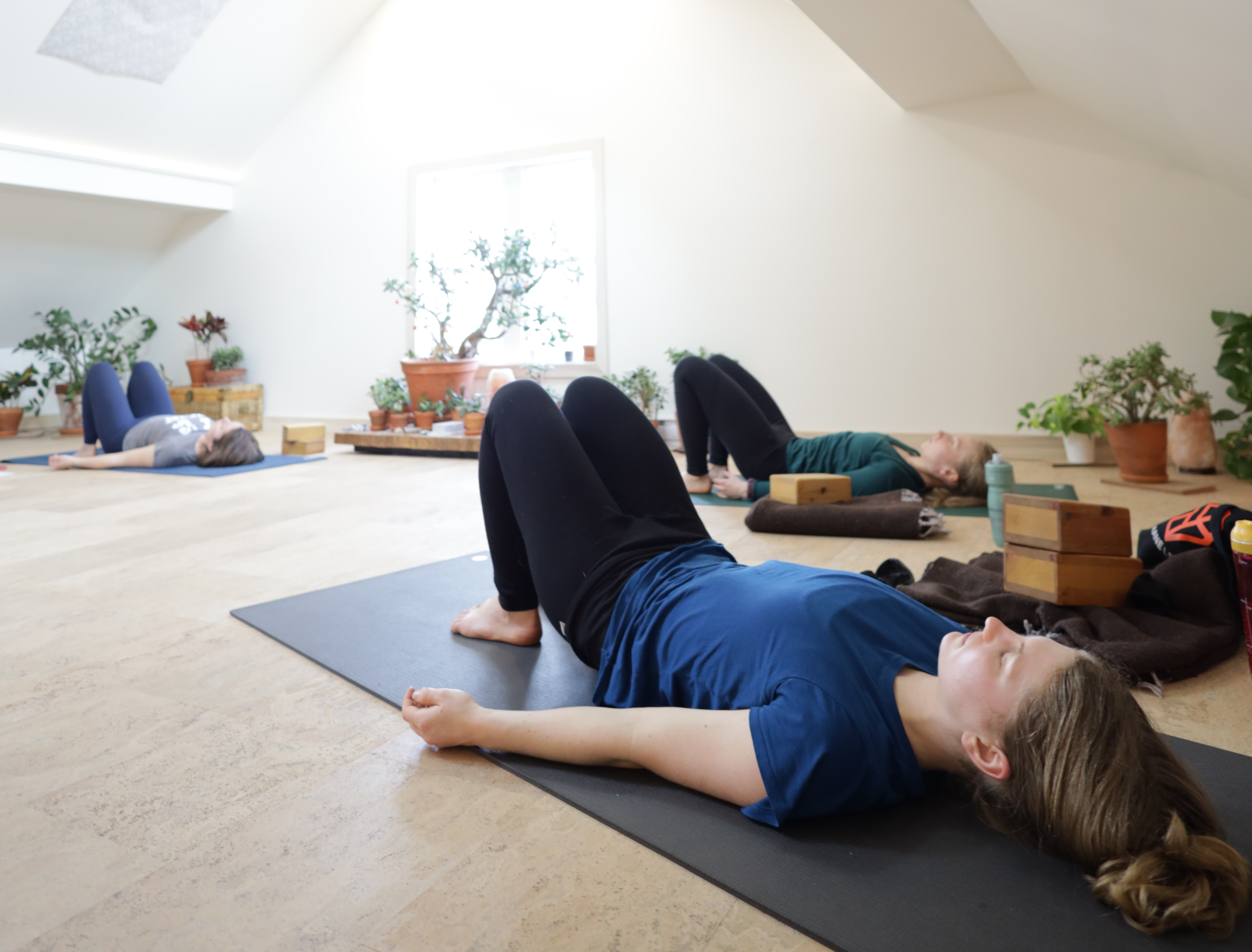
  1. Losing consciousness is not a good measure of sleep quality.

    You can be wide awake and deeply resting. You can also be fast asleep and spiraling in restlessness. 
    This is one of the first statements that Swami Satyananda makes in his foundational book, yet, learning this first hand is something that has taken a huge burden off my shoulders. Regular sleep is important, but I’m no longer as concerned about being completely unconscious for the entire night.

    For instance, if I’m anxious and wide awake for my last couple sleep
    cycles, I engage in a yoga nidra technique which involves broadening awareness, softening the mental grips around thoughts, and letting them unfold in a larger container of acceptance and kindness. 

    Same goes for naps—I just lie down, close my eyes, and broaden
    awareness. It doesn’t matter if I fully clock out. I know in my heart that this is still quality rest.

  2. Experiencing insomnia once in a while is normal and okay.

    During my initial stages of chronic-insomnia recovery, I still felt on edge about its potential return. Even one night of sleeplessness would spike my fears of relapse. But with yoga nidra training embodied, I am now confident that I have the tools to come back to balance, even if I have a bad night or two. I know I’ll be tired for a bit, but that’s okay. I’ve grown greater acceptance that experiencing some insomnia is just a part of being human, and it’s unrealistic to expect otherwise. Life happens, situations happen—stressful ones, and even exciting ones, like the night before my wedding day, when I didn’t sleep a wink! 😉

  3. Attachment to “perfect relaxation” only breeds suffering. 

    Although my initial goals involved “mastering” relaxation, I slowly dropped this when it became clear that this was only creating tension in my body.  What I’ve realized is more important than constant relaxation is the cultivation of spacious awareness. Rather than suppressing our stressful experiences, yoga nidra trains us to embrace all arising perceptions in a broader mental container. We allow all experiences to be as they are—whether that experience is bliss or a stormy mess. This shift in orientation is what’s truly healing and liberating.  So, I’m no longer attached to the experience of relaxation as much as I was before. It’s as fleeting as the wind, but spacious awareness is always here. 

  4. Better than yoga nidra’s benefit of “productivity” is its ability to
    reveal what matters most.

    Yes, yoga nidra can make you productive in the sense of giving you the capacity to do more: it mitigates stress and anxiety, enhances alertness, and refreshes cognitive resources. However, more valuable is its ability to gently reveal what is truly meaningful. By slowly peeling away the layers of conditioning (which are
    often under the influence of modern hustle culture), we come into greater connection with our life purpose(s) and guiding core values.
    Through this process, we may find ourselves gradually shifting from the endless race to the top, towards intentional work that supports what genuinely matters to us.

  5. Practice doesn’t grow more complex over time… it gets
    unbelievably simple.


    One of the aspects of yoga nidra practice that I initially found so helpful was that it provided structured steps on how to chill. This was much more effective than receiving the classically unhelpful advice: “just relax!” My mind craved constant activity, and yoga nidra told me precisely what to focus on, offering various techniques that kept me engaged until it ushered me into deep, conscious rest.

    Yet, as I’ve grown more familiar with this state, it has become increasingly easier to visit again, without having to take so many steps. While it’s still great to be able to lean on those steps whenever I need them, most of the time now I enjoy a simplified practice: resting in my heart space, broadening awareness, and surrendering to what is.

.

Want to explore a deeper relationship with yoga nidra and maybe
even share it with others? Kimberley’s Trauma-informed Yoga Nidra Teacher Training begins with a 6-week Deep Dive course, which provides a supportive container for long-term personal practice.  This is followed by 2 facilitator training weekends, which will equip you with all the tools you’ll need to confidently share yoga nidra from the heart.

when sleep hygiene isn’t enough

This post was written by Branches teacher Kimberley Luu. Kimberley offers Yoga Nidra courses, workshops and Yoga Nidra facilitator training (details coming soon!) through The Branches.

It had been 2 weeks of running off 0-2 hours of sleep per night when I visited the doctor’s office.

Within 10 minutes, I was sent home with a list of sleep hygiene tips and a prescription for sleep meds.

I followed the doctor’s orders to a T. Yet, sleep was still elusive.

Over the next 4 months, subsequent visits to different doctors continued to leave me frustrated and confused. I’d go home with more sleep hygiene lists and prescription variations.

I followed almost every recommendation with minimal improvement. My whole body grew exhausted and numb.

At this time, I was in the middle of my grad studies in public health and this experience made me reflect on the incompleteness of sleep care in our current medical system.

It’s not that the conventional approaches aren’t important—sleep-wise behavior is essential and medication can be lifesaving in some cases. It’s just that for some folks, they aren’t enough.

For me, the missing element was yoga nidra.

It was such an effective resource that came into my life. Little by little, in conjunction with my current plan, it helped me feel rested and whole again.

Not only was I getting more hours of sleep—my mental health improved, I relied less on medication, and to my surprise, I gained insight into why I wasn’t sleeping.

In other words, the self-awareness that yoga nidra provided helped me discern the broader life changes I needed to make to find peace and sleep well again.

As a yoga nidra facilitator now, it’s been incredibly meaningful to help fill this gap in sleep care. It never gets old, hearing long-term insomnia sufferers report that they just had their first restful sleep in months.

In my upcoming workshop, Yoga Nidra for Better Sleep, you’ll learn how to precisely apply yoga nidra and other supportive therapeutic yoga tools to optimize your sleep.

We’ll get in touch with our body’s natural circadian rhythm and sleep cycles in order to harness yoga nidra most effectively.

Lastly, you’ll receive 1-year access to Restoring Rhythmic Sleep: five on-demand yoga practice videos for supporting your rest and vitality throughout the day and night.

Sleep not your forte? It’s not mine either. But yoga nidra is here to help.

Register here for Kimberley’s workshop, Yoga Nidra for Better Sleep, coming up on Sunday Sept 28.

My two postpartum saving graces

Hello, Emma sharing today.

When my first baby was 6 months old, I heard the word “matrescence” for the first time, and my brain lit up with recognition. Matrescence is the idea that becoming a mother is a process, much like the process of adolescence, which is becoming a teenager or young adult. Just like adolescence, matrescence doesn’t happen overnight, it can be awkward and confusing to go through, and there can be big impacts on one’s body.

I gobbled up everything I could find on matrescence, particularly the work of Jessie Herald, a women’s coach and doula who does a lot of writing and offers wonderful programming on this topic. Jessie believes that the process of becoming a mother, of making that complete identity shift, takes 2-3 years minimum. Hearing that was such a relief. At that 6 month postpartum point, I felt completely adrift. I felt like my body was falling apart, I had so many conflicting feelings about mothering, and I couldn’t remember what brought me joy (this was also during pandemic lockdowns so that was definitely a compounding factor).

Fast forward to now; that first baby is three and a half, my second baby is 16 months, and I am feeling stronger and happier than I have in quite a few years. I have reconnected with my body and I feel a new sense of groundedness in myself. I attribute this experience of groundedness to two things: community and strength training.

One thing that was really different about my second maternity leave, compared to my first, was the presence of in-person community. Because of COVID lockdowns, my first baby and I were alone most of the time. But during my second maternity leave, I met mamas in the Parent & Peanut class at The Branches, at the library, and in the park. Unlike during lockdown, this time I was able to host mamas and babies at my house, and the drop-in space in my living room became a weekly event. The group of moms that showed up became such a supportive and nurturing community. Week after week we’d connect about the huge range of issues affecting us: the politics of healthcare and childcare, the misogyny of our overculture and how evident it is when you become a mother, the challenges of self-image postpartum, and the many anxieties of raising children in a world descending into climate chaos. I feel like my identity as a mom was strengthened and challenged in those conversations. And I continue to see and experience others growing into their own unique identities as mothers alongside me.

Returning to strength training was also a community effort. My body felt like such a mess postpartum, I’d been struggling with really painful plantar fasciitis for years, and when I picked up my baby it often felt like my insides were going to fall out. Attending Nicole’s Strength Essentials class and getting her suggestions and advice about how to slowly rebuild my core strength was really reassuring. When I returned to work at The Branches I played around with the kettlebells on my lunch breaks, and got lots of tips and tricks from Leena and Leslie, who are always down to talk shop when it comes to strength training. I am lifting weights 2-3 times a week now, and it has made such a difference to my day to day. My foot pain is almost completely gone and my body feels capable and agile again. This makes my yoga practice more enjoyable, which makes my teaching more connected and lively. I am so relieved to be able to enjoy being in my body again.

Matrescence is a radical life change, and I am just now beginning to appreciate the many more processes of change in my future. Life changes don’t quit; they arrive whether you expect them or not. For now, I am feeling bolstered by community and a trust in my returning strength. When I think about it, community and embodiment practices seem like a great recipe for supporting ourselves through life changes. I guess that’s why I made this my life’s work. I am grateful to be rediscovering this and seeing it anew.

One thing I am so thrilled that The Branches is now offering is Postnatal Yoga with one of our favorite human beings, Lisa Beraldo. Lisa is an amazing convenor of community, and her prenatal and parent and baby classes are lifelines for many folks in our community. Postnatal Yoga is a place to gently reconnect with your body and meet others at a similar point in their journey of becoming a parent.

Whether you are, pre-, post- or never-gonna-partum, I hope to see you around class or in the neighbourhood. In-person community is my favourite thing in the world and I’m overjoyed that it’s possible to gather so regularly again.

Emma 


Programs I Mentioned:


Strength Essentials is a drop-in class for those who are new to strength building to learn exercises that use body weight, resistance bands, dumbbells and kettlebells. Everyone works at their own challenge level and beginners are highly encouraged to check it out.Mondays at 10:00am & 4:15pmThursdays at 9:00am
 Postnatal Yoga is a 6 week course appropriate for anyone who’s given birth (by any method) and who is at least 6 months post-partum. Focus is on healing, soothing and strengthening your body while connecting in community with others on the same journey.next session starts July 8

Everybody has trauma & how yoga helped with mine

This post is by one of our core teachers, Leslie. 

If it weren’t for yoga, I would never have re-learned to enjoy my body.

As a child and teen, I was heavily involved in physical activity, but in my post-secondary years I succumbed to a sedentary lifestyle. The workload of university was overwhelming, but my total lack of movement or exercise occured, in large part, because of a string of traumas. These events left me feeling disconnected from my body, and more often than not, fearful and self-loathing.

Even though I knew it would help me, I resisted all physical activity. Sports were no longer any fun, and going the gym to “work out” seemed not only boring, but overly aspirational. Moving my body felt difficult, pointless, and unpleasant. Any movement or exertion which made me aware of my body, brought with it reminders of my trauma, and the pain that still lived within me.

In my final year of university, a friend convinced me to try a yoga class in the campus athletic centre. I was seduced by the mystery around yoga, and since it was the adventurous thing to do, I decided to join her. I still remember how the instructor led us through a soft and slow-paced class with careful instruction and plenty of room to be a beginner. I’ll admit it: I was hooked.

Continue reading “Everybody has trauma & how yoga helped with mine”

Reblogged: Why teach yoga to Thugs?

This post originally appeared here. Meaghan Johnson, former QSY owner, worked with Shannon Braden a social worker and a QSY student on this great initiative

I’ve been asked this question. Not these “exact’ words, but it certainly felt that way when I was asked to ‘provide a rationale’ as to why we use yoga as part of our programs at inREACH, a street gang prevention program in Waterloo Region. Here’s the rationale I gave… which also seems to be backed up by a lot of good solid evidence.

All of the youth we work with at inREACH have deficits in the area of emotion regulation. In its most problematic form this may result in anger and aggression which can cause them to come into conflict with the law; less obviously, but just as seriously, many of the same youth suffer from chronic anxiety and depression. Continue reading “Reblogged: Why teach yoga to Thugs?”