5 Unexpected Lessons from my Yoga Nidra Practice

This post was written by Kimberley Luu, who is offering a Trauma-Informed Yoga Nidra Teacher Training through The Branches, starting in January 2026.

Years ago, I committed myself to yoga nidra practice. I had a vision that if I
kept training, I’d eventually never have to deal with this pesky condition
called insomnia again. I thought I would be able to enter conscious, deep
sleep with the snap of my fingers and live vibrantly off less hours of sleep. I
imagined mastering relaxation, but only for the covert purpose of being
“productive”; never missing a day of work due to burnout again.
Today, it’s amusing to reflect on the naivety of these dreams. Indeed, I was
a little off… yet, I feel no inkling of disappointment or regret. I’m no Swami
Rama (the renunciate who shocked scientists with his superhuman rest
abilities), but I did end up learning a lot of other valuable lessons.
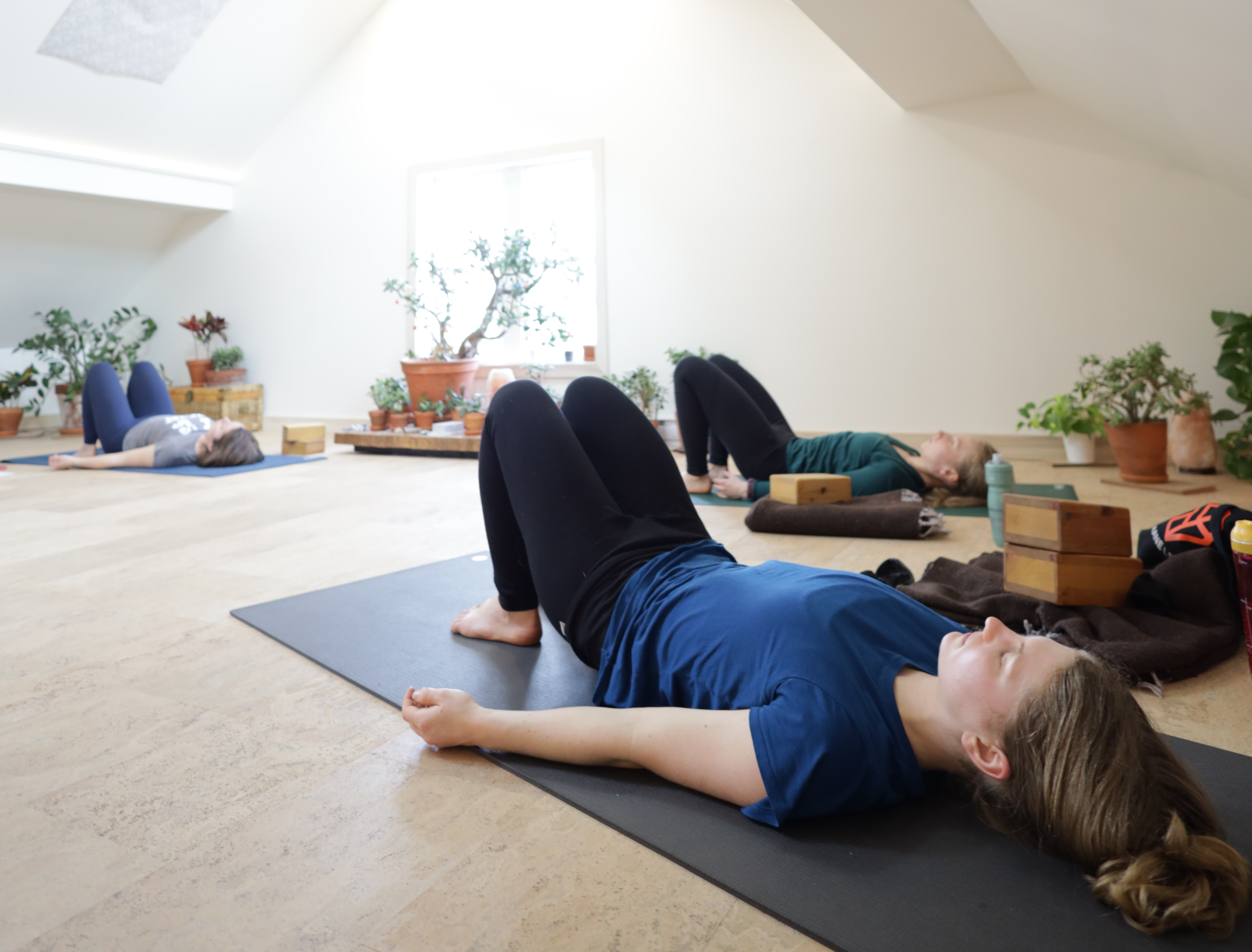
  1. Losing consciousness is not a good measure of sleep quality.

    You can be wide awake and deeply resting. You can also be fast asleep and spiraling in restlessness. 
    This is one of the first statements that Swami Satyananda makes in his foundational book, yet, learning this first hand is something that has taken a huge burden off my shoulders. Regular sleep is important, but I’m no longer as concerned about being completely unconscious for the entire night.

    For instance, if I’m anxious and wide awake for my last couple sleep
    cycles, I engage in a yoga nidra technique which involves broadening awareness, softening the mental grips around thoughts, and letting them unfold in a larger container of acceptance and kindness. 

    Same goes for naps—I just lie down, close my eyes, and broaden
    awareness. It doesn’t matter if I fully clock out. I know in my heart that this is still quality rest.

  2. Experiencing insomnia once in a while is normal and okay.

    During my initial stages of chronic-insomnia recovery, I still felt on edge about its potential return. Even one night of sleeplessness would spike my fears of relapse. But with yoga nidra training embodied, I am now confident that I have the tools to come back to balance, even if I have a bad night or two. I know I’ll be tired for a bit, but that’s okay. I’ve grown greater acceptance that experiencing some insomnia is just a part of being human, and it’s unrealistic to expect otherwise. Life happens, situations happen—stressful ones, and even exciting ones, like the night before my wedding day, when I didn’t sleep a wink! 😉

  3. Attachment to “perfect relaxation” only breeds suffering. 

    Although my initial goals involved “mastering” relaxation, I slowly dropped this when it became clear that this was only creating tension in my body.  What I’ve realized is more important than constant relaxation is the cultivation of spacious awareness. Rather than suppressing our stressful experiences, yoga nidra trains us to embrace all arising perceptions in a broader mental container. We allow all experiences to be as they are—whether that experience is bliss or a stormy mess. This shift in orientation is what’s truly healing and liberating.  So, I’m no longer attached to the experience of relaxation as much as I was before. It’s as fleeting as the wind, but spacious awareness is always here. 

  4. Better than yoga nidra’s benefit of “productivity” is its ability to
    reveal what matters most.

    Yes, yoga nidra can make you productive in the sense of giving you the capacity to do more: it mitigates stress and anxiety, enhances alertness, and refreshes cognitive resources. However, more valuable is its ability to gently reveal what is truly meaningful. By slowly peeling away the layers of conditioning (which are
    often under the influence of modern hustle culture), we come into greater connection with our life purpose(s) and guiding core values.
    Through this process, we may find ourselves gradually shifting from the endless race to the top, towards intentional work that supports what genuinely matters to us.

  5. Practice doesn’t grow more complex over time… it gets
    unbelievably simple.


    One of the aspects of yoga nidra practice that I initially found so helpful was that it provided structured steps on how to chill. This was much more effective than receiving the classically unhelpful advice: “just relax!” My mind craved constant activity, and yoga nidra told me precisely what to focus on, offering various techniques that kept me engaged until it ushered me into deep, conscious rest.

    Yet, as I’ve grown more familiar with this state, it has become increasingly easier to visit again, without having to take so many steps. While it’s still great to be able to lean on those steps whenever I need them, most of the time now I enjoy a simplified practice: resting in my heart space, broadening awareness, and surrendering to what is.

.

Want to explore a deeper relationship with yoga nidra and maybe
even share it with others? Kimberley’s Trauma-informed Yoga Nidra Teacher Training begins with a 6-week Deep Dive course, which provides a supportive container for long-term personal practice.  This is followed by 2 facilitator training weekends, which will equip you with all the tools you’ll need to confidently share yoga nidra from the heart.
when sleep hygiene isn’t enough

This post was written by Branches teacher Kimberley Luu. Kimberley offers Yoga Nidra courses, workshops and Yoga Nidra facilitator training (details coming soon!) through The Branches.

It had been 2 weeks of running off 0-2 hours of sleep per night when I visited the doctor’s office.

Within 10 minutes, I was sent home with a list of sleep hygiene tips and a prescription for sleep meds.

I followed the doctor’s orders to a T. Yet, sleep was still elusive.

Over the next 4 months, subsequent visits to different doctors continued to leave me frustrated and confused. I’d go home with more sleep hygiene lists and prescription variations.

I followed almost every recommendation with minimal improvement. My whole body grew exhausted and numb.

At this time, I was in the middle of my grad studies in public health and this experience made me reflect on the incompleteness of sleep care in our current medical system.

It’s not that the conventional approaches aren’t important—sleep-wise behavior is essential and medication can be lifesaving in some cases. It’s just that for some folks, they aren’t enough.

For me, the missing element was yoga nidra.

It was such an effective resource that came into my life. Little by little, in conjunction with my current plan, it helped me feel rested and whole again.

Not only was I getting more hours of sleep—my mental health improved, I relied less on medication, and to my surprise, I gained insight into why I wasn’t sleeping.

In other words, the self-awareness that yoga nidra provided helped me discern the broader life changes I needed to make to find peace and sleep well again.

As a yoga nidra facilitator now, it’s been incredibly meaningful to help fill this gap in sleep care. It never gets old, hearing long-term insomnia sufferers report that they just had their first restful sleep in months.

In my upcoming workshop, Yoga Nidra for Better Sleep, you’ll learn how to precisely apply yoga nidra and other supportive therapeutic yoga tools to optimize your sleep.

We’ll get in touch with our body’s natural circadian rhythm and sleep cycles in order to harness yoga nidra most effectively.

Lastly, you’ll receive 1-year access to Restoring Rhythmic Sleep: five on-demand yoga practice videos for supporting your rest and vitality throughout the day and night.

Sleep not your forte? It’s not mine either. But yoga nidra is here to help.

Register here for Kimberley’s workshop, Yoga Nidra for Better Sleep, coming up on Sunday Sept 28.

Creating a Sensory Friendly Home Yoga Environment

🧘‍♀️ How to Create a Sensory-Friendly Home Yoga Environment for Brain and Nervous System Health by Branches Teacher Alissa Firth-Eagland

Follow-up to Alissa’s post “Yoga for Your Brain” published on The Branches Blog October 2023. 

For folks who may want to manage their symptoms by not reading on a screen but instead watching or listening to a video, click here for a 3 minute video version of this blog: Create a Sensory-Friendly Home Yoga Space | Brain + Nervous System Support

Whether you’re managing post-concussion symptoms, nervous system dysregulation, chronic pain, or everyday sensory overload, your home yoga space can be more than just a corner of the room—it can be a healing refuge.

In Yoga for Your Brain, we explored how yoga supports your brain’s plasticity and recovery. Today, let’s bring that insight home—literally. We’ll look at how to create a sensory-friendly home yoga environment that gently supports your body and brain.

🌿 Why Sensory-Friendly Matters at Home

Many people recovering from brain injuries or living with heightened stress are especially sensitive to sensory input: harsh lights, background noise, tight clothing, or cluttered spaces can be overwhelming. 

In yoga, there can be many goals, including going outside your comfort zone and challenging yourself physically and mentally. This is not that type of practice. Think as cozy as possible! Aim to create conditions that calm you. A sensory-friendly environment helps regulate your nervous system, making it easier to breathe deeply, move mindfully, and truly rest.

🏡 Step-by-Step: Building a Home Practice Space That Soothes

You don’t need a dedicated yoga room. Just a little intention can transform any space into a supportive sanctuary.

✨ 1. Light: Soft and Dim

  • Choose a space with natural light, or use a soft, warm lamp (think salt lamp or dimmable bulb). 
  • Avoid harsh overhead lighting and flickering bulbs. Personally I prefer incandescent bulbs to the newer styles because they seem to vibrate less to my eyes. Some concussion people find it hard to look at candlelight. 
  • Try practicing with an eye mask or soft eye pillow during rest poses.

🔉 2. Sound: Gentle and Controlled

  • Reduce background noise with a white noise machine or fan.
  • You might enjoy practicing with no music, letting your breath be your rhythm.
  • If participating in a virtual class, pick instructors with instructions so clear, you can choose not to watch the video and only listen.

🧘 3. Touch: Comfort is Key

  • Wear soft, breathable, non-restrictive clothing. Bonus points if you wear PJs so you can roll into bed after practice! 
  • Practice on a thick mat. Layer it with a blanket or towel for extra cushion.
  • Gather your props: bolsters, blocks, blankets, straps, or pillows can make poses more comfortable—especially restorative ones.

🧺 4. Declutter: Clear the Visual Field

  • A visually busy room can be overstimulating. Tidy the space before practice if possible. I learned this from my yoga teacher: taking the time to prepare and clean the space gets you in the right frame of mind for practice. It is a form of saucha. For me, sweeping and wiping down the floor before I place my mat is a fave ritual to get ready for yoga. 
  • You don’t need perfection—just a calm corner with a bit of order. Sometimes it is better to practice amongst the dust bunnies than not at all. 
  • A folded blanket, plant, or treasured object can signal “this is a space for care.”

🌀 Tips for Practicing at Home with Sensory Awareness

  • Slow it down. Reduce the pace and number of poses. The slower you move, the more time your brain has to process. Take the time to experience the shape or movement. 
  • Avoid fast vinyasa styles that can spike blood pressure or cause disorientation.
  • Repeat familiar movements. Routine can reduce cognitive load and boost comfort.
  • When you are extra tired, use grounding poses like Child’s, Legs on the Chair, or Constructive Rest Pose (CRP). Liz Koch has a beautifully gentle spine practice in CRP you can do with or without a core ball. 
  • Anchor to your breath by inhaling and exhaling through your nose. This sends the message to your brain that there is no immediate threat. Even a short breath practice can help calm your nervous system.

💻 Setting Up for Online Yoga Without the Overwhelm

If you’re using Branches On Demand or another virtual platform, here’s how to make your screen time supportive:

  • Lower screen brightness and sound to a comfortable level.
  • Headphones or external speakers might sound better than built-in laptop speakers, depending on your sound sensitivity.
  • Choose videos with slow pacing, fewer transitions, and simpler production.
  • Avoid rapidly changing visuals.

🌱 Practice That Feels Like a Gift, Not a Task

Your home practice doesn’t need to be fancy—aim for feeling safe and supported. With a few thoughtful choices, you can create an environment that welcomes your body, calms your senses, and supports your brain in healing.

Start by adjusting just one element: lighting, clothing, background noise—whatever feels most pressing. Your nervous system will notice. Over time, those tiny changes can stack up into a powerful shift.

🧘‍♀️ Ready to Begin?

If you or someone you love are living with concussion or brain injury, I invite you to register for my Yoga for Concussions course with this 10% off Affiliate Code: AFFILIATE10. This course is designed to meet you right where you are—at home, with a tired body, a sensitive system, and a deep need for rest and recovery. 

** If funds are low and the Affiliate price still doesn’t fit your budget, please reach out to alissa@gardenvariety.ca to hear other options. Concussion and head injury can profoundly impact survivors’ capacity to work. No one will be turned away due to a lack of funds. **

+++++++++++++++++++++++++++++++++++++++++++++++++++++++++++++++++

Your yoga teacher has problems too

Levi Larivee (he/they) is a grad of our 2023-2024 YTT program. Levi is Community Inclusion & Outreach Worker and a yoga teacher currently living in B.C. 

When I first started practicing, I would stare at the person at the front of the room who seemed to be moving so peacefully and seamlessly through poses I couldn’t figure out. I would do them backwards and respond in silly ways to cueing- then look up to the front of the room and be so embarrassed that I wasn’t doing what everyone else was. My face would get red, then I would stumble even more, lose my breathe, and just sit down on my mat because I couldn’t catch up. After class I would joke and make light of how embarrassed and hurt I was so no one could tell how ashamed I was that I couldn’t keep up in a yoga class. Everyone who could move through the poses, keep their breathe, not be sweating incessantly, I felt lesser than. Watching them move so gracefully, I just knew that they had made it to the otherside. The side of life where tough things stop touching you, stop hurting you. The side where no one has unhealthy coping mechanisms and never eats deep-fried food. Everyone loves them, they never have any problems because they’re so “zen” that nothing can penetrate their meditative bubble.

I truly believed that my yoga teachers lived like that. I would have done anything to be on the other side. Well imagine my surprise when I found out that my yoga teachers were human beings, too. They weren’t Gods. They eat “too much” cake sometimes (if that’s even possible), cry when days don’t turn out how they expected, get a little bit too mad some days. They have problems too. Now I am a yoga teacher, and I still eat fast food, get grumpy when I haven’t slept, and have some bad habits that I cant seem to kick. Sometimes I’m even too stressed to meditate, imagine that!

All of this to say, yoga teachers are just people. Yes, it is a really cool job, and probably do our best to be mindful and present in our lives, but its progress not perfection. I am more than happy to still have my fair share of hardships in life, and oh-so-grateful to have a life beyond that that has been cultivated by trying to choose healthier ways of being. I’ve also learned how to show myself love when I don’t do the “healthier” things, or when I lose my temper. There is always tomorrow.

A yoga practice is an additive, it is just one delicious slice of the much bigger pie. I’ll admit, yoga definitely helps me deal more effectively and respond more compassionately, but life didn’t stop “life-ing” just because I seem super zen in my one hour yoga class. My point is, I would have saved myself alot of aching if I hadn’t assumed that my yoga teachers were all-knowing, supreme beings that had mastered how to “do” life. There is no otherside, the grass is greener where you water it. I wish I could go back and tell myself that!

But I can tell you- be gentle with yourself. No one ever stops making mistakes, no one is super calm and flowy and spiritual 100% of the time. It’s okay to not know everything. It is so nice when people are authentically themselves, because it shows people that it is super okay and encouraged for you to be exactly that. Yourself! It’s so much easier to be human when we can tell and show each other just how valued we are, on every step of the road. Lots of love, always, from your friendly neighborhood yoga teacher.

-Levi

Levi is a grad of our 2023-2024 YTT program

Connected to community

Rachel Smiley (they/them) is a grad of our 2024, 250-Hour YTT. They teach at The Move Room in Hamilton Ontario. Rachel organizes Rainbow Moves, the Move Room’s weekly queer community class.

For many queer and trans folks, the body can feel like a mystery, or something we disconnectfrom out of necessity. In a world that still regularly commits violence against queer & trans people, disconnection is an act of self-protection, but when we do this we lose out on experiencing the wholeness of our own beings. 

Our bodies are the only things that stay with us our entire lives; they work for us even when we don’t ask them to; they are the only things over which we have true autonomy. It’s within the context of mindfulness and embodiment practices that I have realized deep truths in my own life. Mindful embodiment practices such as yoga allow me to connect to my body, ask myself what I need, and then give myself exactly that, with compassion.

Communal experiences like moving, laughing, eating together shift us towards a greater sense of ease and connection with those around us. These are all experiences of the body; being disconnected from the body, therefore, prevents us from full participation. This is an oft-touted argument for the benefits of affinity spaces. Affinity spaces allow people to let their guards down, to connect over shared joys & struggles, to swap stories and share knowledge. They exist for all sorts of intersections and groups of people: new parents, religious groups, racialized folks, newcomers to Canada, hobbyists, and, of course, LGBTQ groups. Affinity spaces can take all sorts of different forms, from peer support groups to themed nights at bars to potlucks to yoga classes.

For queer and trans folks, gay bars have long existed to serve the purpose of safe/r space to gather, dance, seek information, or just be in community with each other without fear of violence or harassment. As queer liberation movements progress, we see this desire to gather in community take shape in other forms; no longer are we relegated only to dark, underground clubs. For many of us, there’s a real need to gather without the social pressure to drink, or simply a desire to experience a different kind of embodiment. As I look around where I live today in Hamilton, I see queer people organizing sports leagues, drawing nights, and clay workshops, in addition to dance parties and peer support groups.

Since January 2023, I have been organizing Rainbow Moves, a series of yoga & movement classes for queer folks at my home studio, The Move Room. I moved to Hamilton shortly before lockdowns began, and by the time 2023 came around I hadn’t had the opportunity to build queer community in the way I had in Toronto. At the time, no one else was organizing queer yoga classes in the city, and I had been a teacher with The Move Room for about a year. I knew I didn’t want to do it alone, so I invited several other queer movement instructors to join a rotating roster with me. Although this was a decision partly made for practical reasons, I have found that when I share the stage with other instructors, I’m not only able to give voice to different kinds of queer folks, but I’m also able to come into the role of participant. My hope is we are able to collaboratively weave together our own community offering, rather than it being the vision of one specific person.

When I participate in queer gatherings around my city, I grow my connection to my community. As I grow my connection to my community, I feel even more bolstered and protected. I’m able to walk in the world more bravely, because I know my people have my back. When I witness, or am party to, homophobia and transphobia, I feel protected by my community. Taking part in my community has allowed me to expand my window of tolerance for difficult situations. Being able to stay connected to my body in difficult situations means that I’m able to choose words and actions that feel in accordance with my truth. I’m better able to act with integrity, care, compassion, and loving kindness, even towards those who have wronged me. Most importantly, staying in connection with my body means that I’m better able to act with integrity, care, compassion, and loving kindness towards the only person with whom I’m in a lifelong relationship: myself.

Hip Openers / World Openers!

Clare Hitchens (she/her) is a grad of our 2024 250-Hour Yoga Teacher Training. You might meet Clare staffing our front desk some evenings, and occasionally subbing for TBY classes!

I did my first yoga practice with a physiotherapist when I was healing from a lower back injury caused by my dog bolting after a squirrel while attached to me. One day I went to see her shortly after I’d been in a car accident. Although I wasn’t injured, I was in shock, and she noticed that and offered to lead me in a yoga practice. At the end of that practice, I sat and wept, and she quietly left the room for a few minutes. When I recovered, she offered that a yoga practice can provide that kind of release of emotions, and probably for the first time I made the connection between mind and body, understanding a bit better how intertwined they are.

Once I started a regular yoga practice it became abundantly clear how it could affect my mood, and how important it was for regulating my emotions and managing daily stress along with helping me feel stronger in my body. However, there were aspects of yoga that I did not expect, and those are what I want to talk about in this post. I’m going to talk about hip openers, and I will put in a warning here about fat shaming language and sexist comments. Many of us have tight hips. We sit in office chairs, and we barely move for hours during the day. I’ve heard people proclaim their tight hips to me with what seems like pride, which is interesting. Children raised as girls and young women are taught very specific things, contradictory things, about their hips and thighs. For one, at least for my age group, we were taught to always sit with our legstogether, not to cross our knees, but only our ankles, never to sit wide legged. “Put your legs together!” could be snapped by one’s mother at any time. For another, hips were seen as places we could gain weight, and that was a thing to be avoided. Think of the saying, “a moment on the lips, a lifetime on the hips.” We said that to each other all. the. time. and thought nothing of it. Denying ourselves delicious food was accepted as normal practice to avoid weight gain. Contrasting all that would be people who made comments about someone having “good childbearing hips,” which was admiration for a wide set of hips with room for a baby. Appropriate use of a female body! Layer on sexist comments such as one made to me by a male co-worker when I was pregnant with my third child. He suggested I wasn’t taking my birth control properly and I might do better to hold the pill between my knees. So, wait, should I have good childbearing hips, or should I not have sex so I don’t get pregnant?? That’s the climate I grew up in, and I was unprepared for the effect of hip openers on my life.

In my early days of yoga it took me a while to get comfortable doing something as simple as a wide legged forward fold, never mind a reclined butterfly, in which my knees were spread wide, my ankles bound together, and my body in a very open position. It felt positively immoral! The more I practiced, however, the more I wanted those poses. Deep squats, hip rotations, a wide legged child’s pose! Gradually these poses began to feel empowering—there was a freedom in them that I craved, permission to put my body parts in any shape I chose to. And even more gradually they began to feel like second nature. What this has translated to in life outside yoga is much more comfort living in the body that I inhabit. I no longer obsess about how I look in my clothes, how I look when I’m exercising or dancing or eating, how somebody else might perceive me at any given time. I’m still human, and I still have moments of anxiety, but the freedom given to me in yoga to move my body into shapes that I choose, whenever I want, has made an impact on my life far beyond the mat. 

barefoot bliss

(This post comes to you from Wendy – pictured below on the right – Operations Manager, strength & yoga teacher, and resident-barefoot-shoe-enthusiast, at the Branches)


I have always loved to walk barefoot outside. I enjoy the tactile stimulation I feel when walking on different surfaces. I walk barefoot so I can feel the burn of hot pavement in the summer and the gentle sharpness of blades of grass; the cool squishiness of walking through the mud and the grittiness between my toes when walking in the sand. 

Barefoot shoes (also called minimal shoes) allow me a little bit of that sensory stimulation when I can’t (or shouldn’t) walk barefoot. It means I can still feel the bumpiness underneath the grass, the sharp pebbles at the edge of a dirt road. Does it hurt sometimes? Sure! I’ve landed on a few rocks while running that sent a few choice words streaming out of my mouth. But those experiences never made me want to switch back to the relative void of sensation I felt when walking in thick-soled shoes. 

I initially started wearing barefoot/minimal shoes because I was experiencing knee pain and trying to find a way to improve it. I had heard minimal shoes might help, so I decided to give them a try. However, as soon as I started walking in that first pair of barefoot sneakers, I no longer really cared if they cured my knee pain – it just felt so good to walk in them! 

Those shoes were the first pair of shoes that I didn’t have to ‘break in.’ My feet didn’t feel like they were being squished. I didn’t have to deal with the pain and irritation of blisters and calluses, in fact, I could actually wiggle my toes! Over time my knee pain did improve, but the reason I keep wearing barefoot shoes has more to do with the connectedness I felt with my body and the world around me. 

I used to have a nice pair of ‘technical’ hiking boots that I invested in because I thought they were what I needed to be able to hike ‘safely.’ Ironically, I’ve had fewer injuries since I switched to minimal hiking boots. My balance is better, and my feet and ankles are stronger now that they can move more freely. I can both feel and respond better to the changes in the ground beneath me. I can feel the curves and edges of rocks as I walk across them, and I can respond with more agility to those small changes in balance, bending my feet and ankles to ‘grip’ the rocks as I go. Thick soled shoes take a lot of that sensory information away, leaving me feeling like I’m teetering while trying to balance on rocks, and stumbling as my foot leans too far off an edge it can’t feel. There’s a disconnect between what’s happening underneath me and what my body is doing in traditional hiking boots. That connectedness means I’m actually more confident hiking in minimal shoes because I slip and fall less often. 

The connectedness to my body and the world around me is what has ultimately made me a barefoot shoe convert, and now, something of a proselytizer! I want everyone to experience the gentle invigoration of walking with more sensation and agility. Switching to barefoot shoes is something of a process – for most people a good amount of preparation is needed to build up the foot and ankle strength needed to enjoy wearing minimal shoes. If you’re interested in the (eventual) hedonism of barefoot shoes, start your journey with me at my Free Your Feet workshop, a staple offering that we host every year or two at the Branches.

Looking forward to walking in the mud sometime soon,
Wendy

let’s talk about perimenopause and heavy lifting

(A note from Branches’ teacher, Nicole, a perimenopausal gal who is passionate about the benefits of progressive overload!)


If you’ve been online lately, and especially if you’re perimenopausal, you may have noticed that menopause(!) is having a moment. As a perimenopausal woman who didn’t even know this was a thing until a few years ago, I’m relieved that this topic is finally being discussed in public forums. I’m also frustrated that it has taken as long as it has to reach the mainstream, considering about half the population will experience this life-altering transition.

If you haven’t been following the “meno-sphere,” I’ll briefly catch you up! One of the hottest topics at the moment is strength training, and specifically lifting heavy. This is essential for perimenopausal and postmenopausal people to build or maintain muscle mass and especially bone mineral density. The conversation around what exactly constitutes lifting heavy has exploded online as this can, understandably, be a point of confusion.

I love this conversation because strength work is my lane. I created and developed the Strength Essentials class over the last few years at The Branches. I’ve gotten super-passionate about both strength training and self-advocacy in my perimenopausal journey, and I find myself at the intersection where one pursuit (strength training) can help me through the other (perimenopause). Here are a few things that I think are important to think about when considering what lifting heavy means. 

1. Using weights that feel hard, doesn’t necessarily equate to lifting heavy. Rather, lifting heavy falls into a category of near-maximal effort. For example, if you build up to using weight that you can lift for a maximum of 5 repetitions (or fewer!) and no more, you are working in the heavy zone! (And just to be extra clear, you don’t have to lift in the heavy zone for every single set – or even as part of every workout –  to make progress.)  

The next one is less technical but something to really contemplate and consider. Which is…

2. You are stronger than you think.

Not only have I learned this to be true about myself, but I’ve become more aware of how pervasive it is for people — especially women — to underestimate their physical capabilities.

Let me illustrate with this quick real-life example. You may have noticed that Leena bought us a barbell; I couldn’t have been more excited or surprised! The day it arrived, she texted me with a photo and said “Christmas came early!” I was pumped

Prior to the barbell arriving, our heaviest single weight was a 35 pound kettlebell — and while more experienced participants had long since built the confidence to use it, many newer students were of the mindset that it was just too heavy for them. 

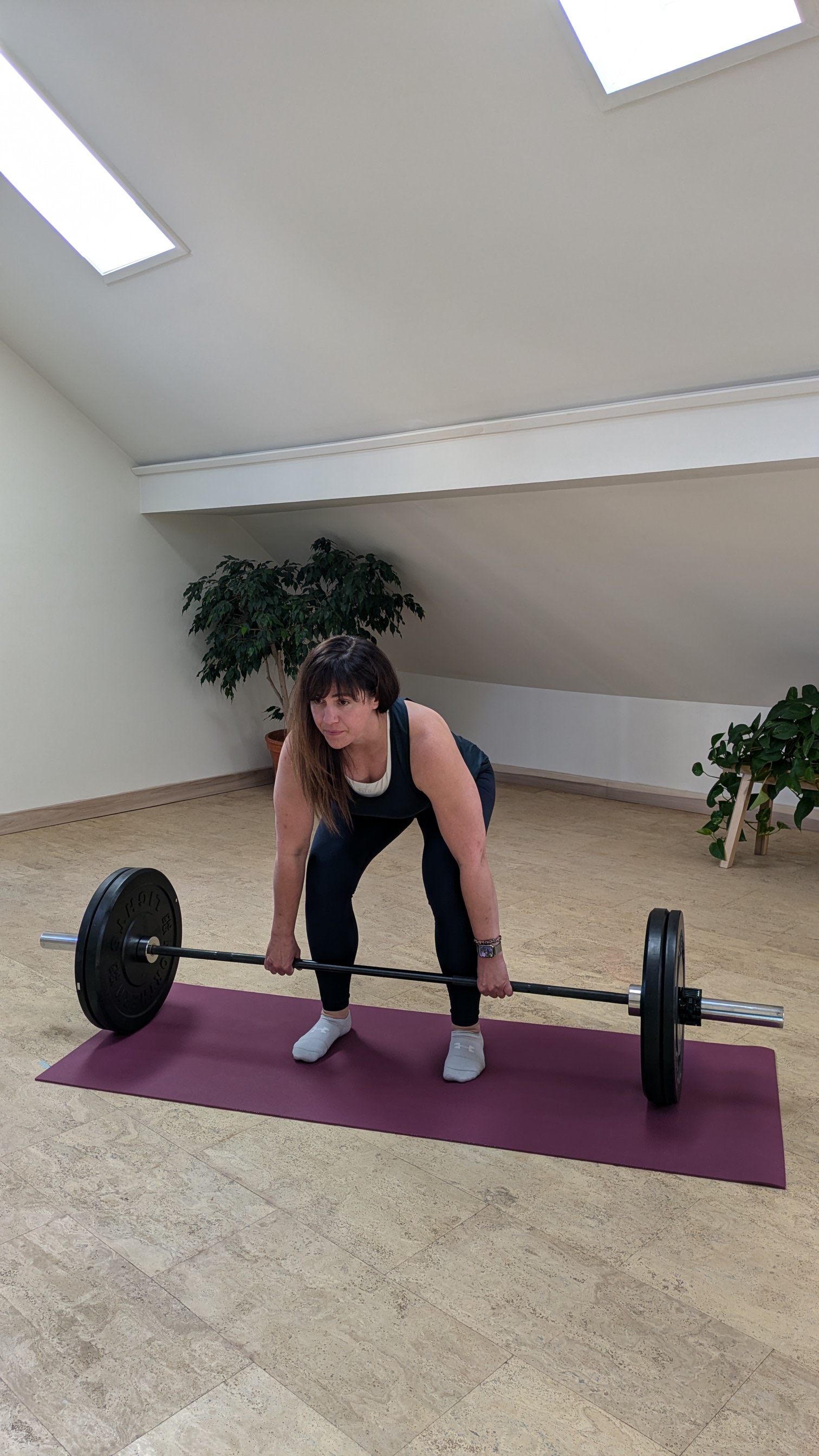
Imagine my delight when folks were stepping up to deadlift the bar which is 35 pounds on its own— plus 20 pounds (or more) with plates — on day one! The ‘bar’ to entry (pun intended) equaled the former heaviest weight in the room, and people were blowing right past their preconceived limitations on the first try. 

So how do we go from getting started to lifting heavy? My suggestion is to begin with weights that feel do-able but challenging, and then increase the weight incrementally over time. When a given weight starts to feel too easy, bump it up by a little. You’ll get better at knowing when to do this with practice. Generally speaking, you’ll use relatively heavier weights for lower-body work (think large muscle groups) than you will for upper-body work (smaller muscle groups).

Remind yourself that building strength isn’t a sprint! And, to yield the bone-building benefits of strength work during mid-life (and beyond), we need to be lifting the heaviest weight possible that we can manage with control and confidence. You don’t have to start “lifting heavy” from day one but you do need to increase the loads you’re lifting systematically over time to get stronger (AKA progressive overload). Getting stronger leads to increased independence as we age, and allows us to do more of the things we want to do, with self-assurance, today. 

The hard work of building strength is gratifying in itself but the benefits really seal the deal! And while everyone’s journey is unique, here are some of the quality-of-life enhancements that I’ve personally experienced through consistent training: 

  • Better moods, energy, and an outlet for stress reduction
  • A sense of personal satisfaction from striving for –  and achieving – performance goals
  • Socializing and good times with like-minded folks 
  • Perimenopause symptom management (it’s not a fix-all but it helps me in a big way)
  • Increased muscle mass 

I would love to hear if these ideas resonate with you and learn more about your foray into strength work — or, to hear what’s troubling you about getting started or keeping up with it. And if you want to join me for Strength Essentials, we’re lifting heavy every Monday and Thursday. 

Cheering you on in your strength and/or perimenopause journey,

Nicole 

I’m finally not intimidated anymore

Hello, Wendy here. So, I’ve dabbled in strength training at several points in my life. And each time my motivation would eventually decline, or I’d reach a point where I just felt too intimidated and confused to know how to progress. Sound familiar to any of you?

Strength Training for Longevity and Healthspan

As I enter my mid-life journey, I’m learning how valuable resistance training can be for maintaining mobility and strength as we age. For folks who will go through menopause, and especially folks like me with a long family history of osteoporosis, strength training can also help increase bone density and prevent osteoporosis, (this article does a really good job of summing that up if you’re interested). Based on these life stages, I have been feeling really motivated to find a way to add resistance training back into my life.

Recently, I decided to start on my own again, and it was great… for a while. I was learning a lot, getting stronger, and I felt good in my body – all things that kept me interested. But, inevitably, I would get busy or tired and skip a session, or two, then three, and my motivation would begin to wane. 

Finding the Right Coach & Community

One thing I’ve learned about myself (and still have a hard time accepting), is that no matter how much I want to do things on my own, I really need other people in order to stay motivated. But all of my past ‘gym’ experiences had been unpleasant. I either got a bunch of unwanted advice, or unwanted commentary that made me not want to be in those spaces. I needed MY people – people who would lift each other up.

Enter Strength Essentials…

From the first time I walked into Nicole’s Strength Essentials class I was struck by just how supportive it felt. It was such a radical departure from the intimidating experiences I had in the past. Nicole presented things in such an easy to understand, accessible way. We learned lots of options of how to progress, and Nicole was there to help folks to find ways to make things work for their body. It was so refreshing to not feel intimidated to ask questions or to ask for advice. With the number of questions I hear each time I’m there, it’s obvious other folks feel the same way.

The Camaraderie Effect

The instruction in Strength Essentials is wonderful (thanks Nicole!), but I’m also blown away by the community of support that has formed among the participants in the class. We celebrate each other’s triumphs, and share lots of laughter to help get through the challenges. I often hear folks encouraging each other (“You got this!”), or commiserating after a particularly hard set (“Wow, that was a hard one!”). We joke about how there’s no way we can do another round of pushups (why are they so hard?!), but then we all look at each other and do it anyway.

I’ve found a group of people who are there to learn and to take care of their bodies. No one is in class to show off or to ‘prove’ themselves to anyone, so it feels so much more welcoming than my previous experiences. I finally found MY people – and I keep going back because of them.

Sound like your people, too? Come join us for casual weight lifting with friends in Strength Essentials – I think you might love it! Just be prepared to laugh a lot 🙂

With enthusiasm,
Wendy

Competing with grandmas?

Leslie here.

You know that feeling when the reality of your limitations hits you smack across the face? When presented with a new challenge you can’t overcome (yet, or ever), I call that getting humbled. Getting humbled can offer us a lesson in acceptance and equanimity, and it can also motivate us to try harder.

When we stack up against others, sometimes we are humbled by our peers, or by those who retain the gifts of their youth, and sometimes… we get humbled by our elders.

And when I was the ripe young age of 22, an entire society of grandmas humbled me with nothing less than their commendable squat form.

I was living in South Korea, testing my teaching ambitions in an English-immersion kindergarten. Not only could my 5 year-old students drop down into and hang out in easeful and cozy squats like their little toddler siblings, but so could their parents, and even their grandparents.

Ajummas – Korean grandmas – could be found casually squatting to rest, socialize, gather herbs, connect with their grandkids, do house chores, and simply move in response to their own desires and demands of daily life.

As someone with aspirations towards physical health and freedom of movement, I was both mystified by my own incapacity to squat as well as they could, and motivated to get on their level. 

There is some evidence showing that the typical bone structure of folks of East Asian descent supports the deep joint positions required for a squat. This fact, combined with not having grown up in a squat-normative culture, makes me unsure that I’ll ever quite match their ease, but that hasn’t stopped me from trying! Now at 38, my squat is more comfortable and closer to a resting position than ever.

Part of what makes squatting doable is hip mobility. My days as a foreign English teacher in Korea were formative in many ways, but one is that I will never take hip mobility for granted again – it really is a use-it-or-lose-it game. 

To that end, if your hips are feeling stiff and sore, or you realize that your hips don’t move as well as you’d like them to, I highly recommend our series Hip Mobility May. It’s got all my best ideas on how to directly improve your experience of your hip joints – both the feeling and the function.

Try it! And I’ll see you in a squat sometime soon 🙂 

Hip Mobility May can be found inside Branches On Demand, our streaming service. You can join for FREE for your first 7 days, then it’s $25/month after that, with no minimum commitment. All the content from Hip Mobility May will be live from May 1 – June 15. Each month, BOD subscribers get access to a new series. Check it out!