Connected to community

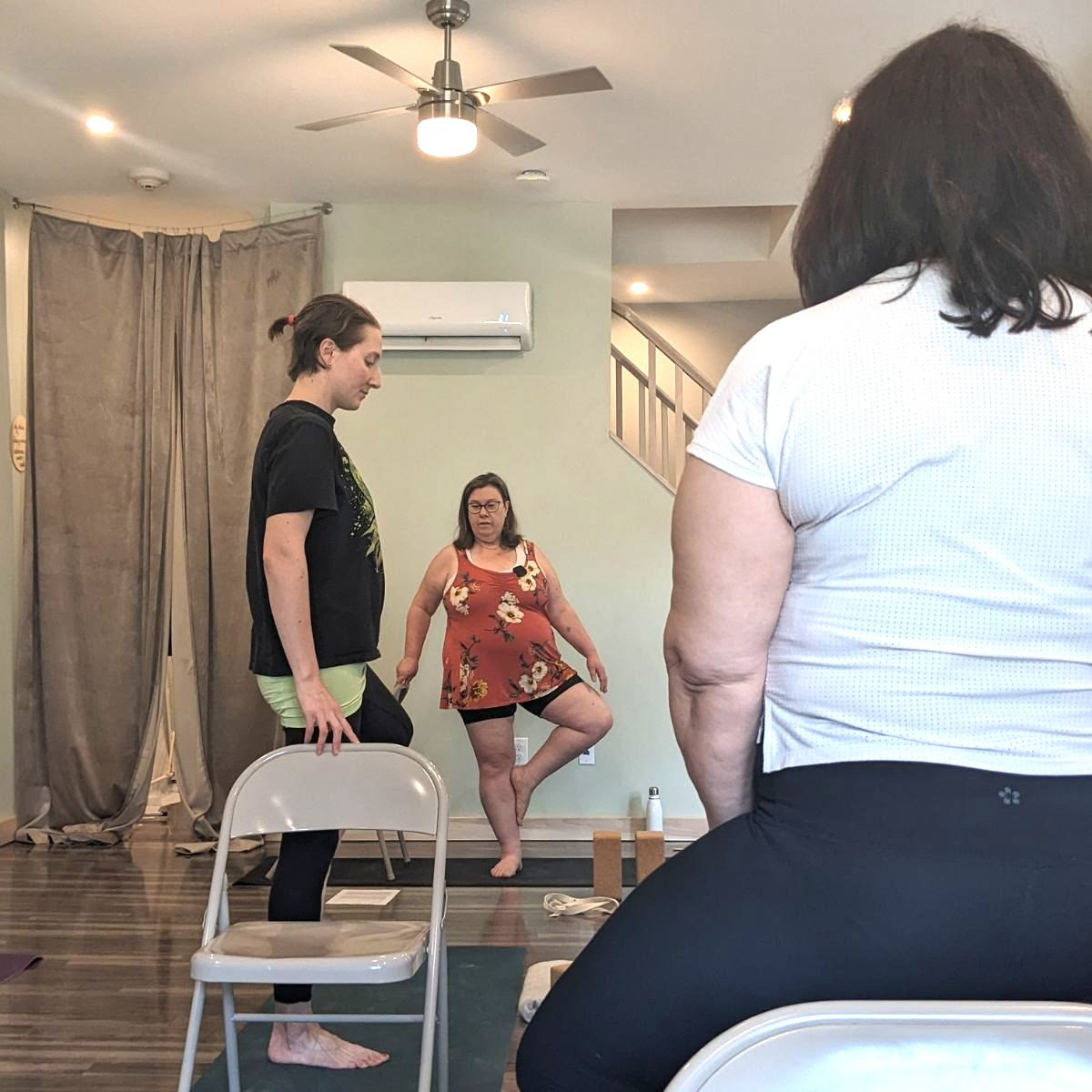
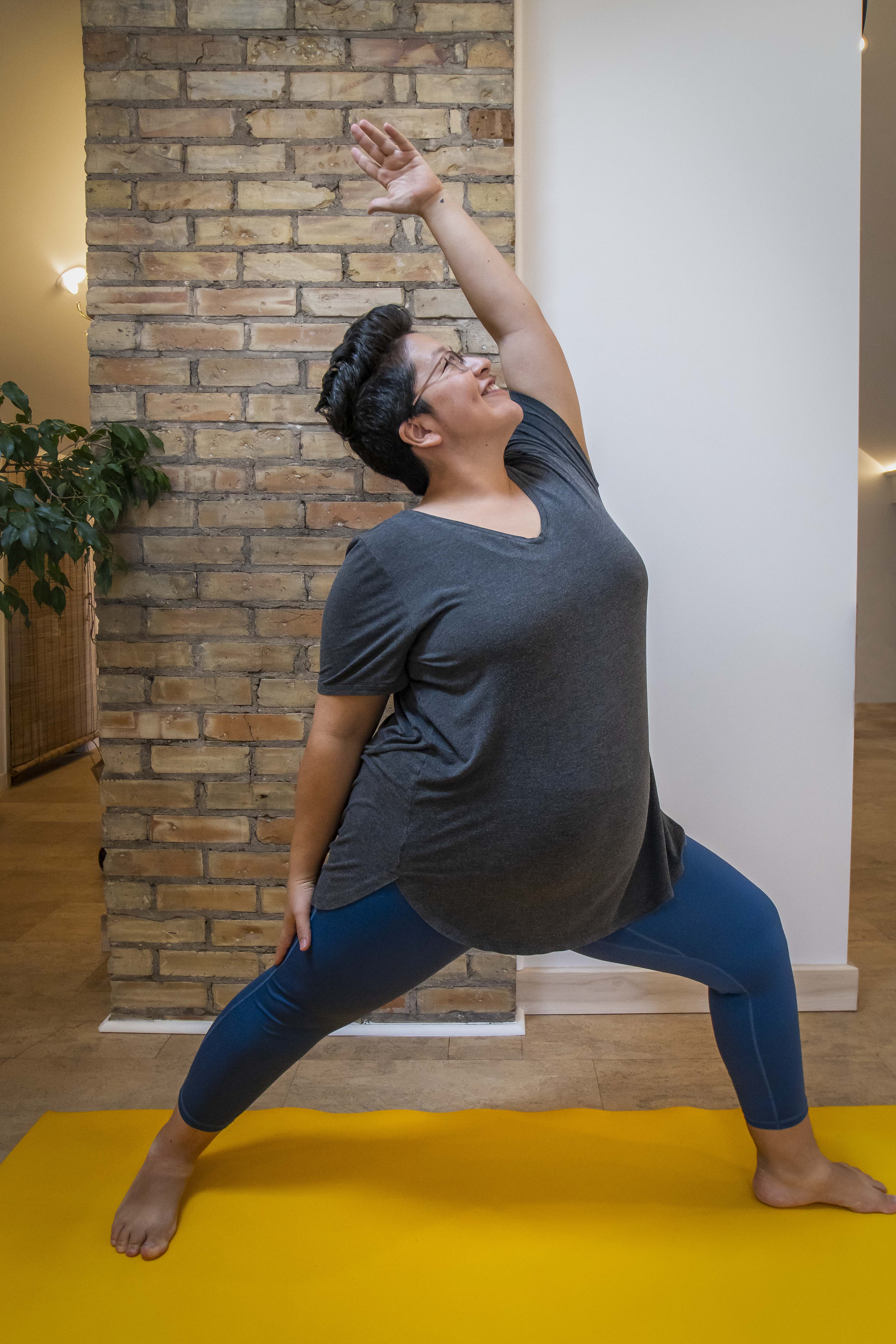
Rachel Smiley (they/them) is a grad of our 2024, 250-Hour YTT. They teach at The Move Room in Hamilton Ontario. Rachel organizes Rainbow Moves, the Move Room’s weekly queer community class.

For many queer and trans folks, the body can feel like a mystery, or something we disconnectfrom out of necessity. In a world that still regularly commits violence against queer & trans people, disconnection is an act of self-protection, but when we do this we lose out on experiencing the wholeness of our own beings. 

Our bodies are the only things that stay with us our entire lives; they work for us even when we don’t ask them to; they are the only things over which we have true autonomy. It’s within the context of mindfulness and embodiment practices that I have realized deep truths in my own life. Mindful embodiment practices such as yoga allow me to connect to my body, ask myself what I need, and then give myself exactly that, with compassion.

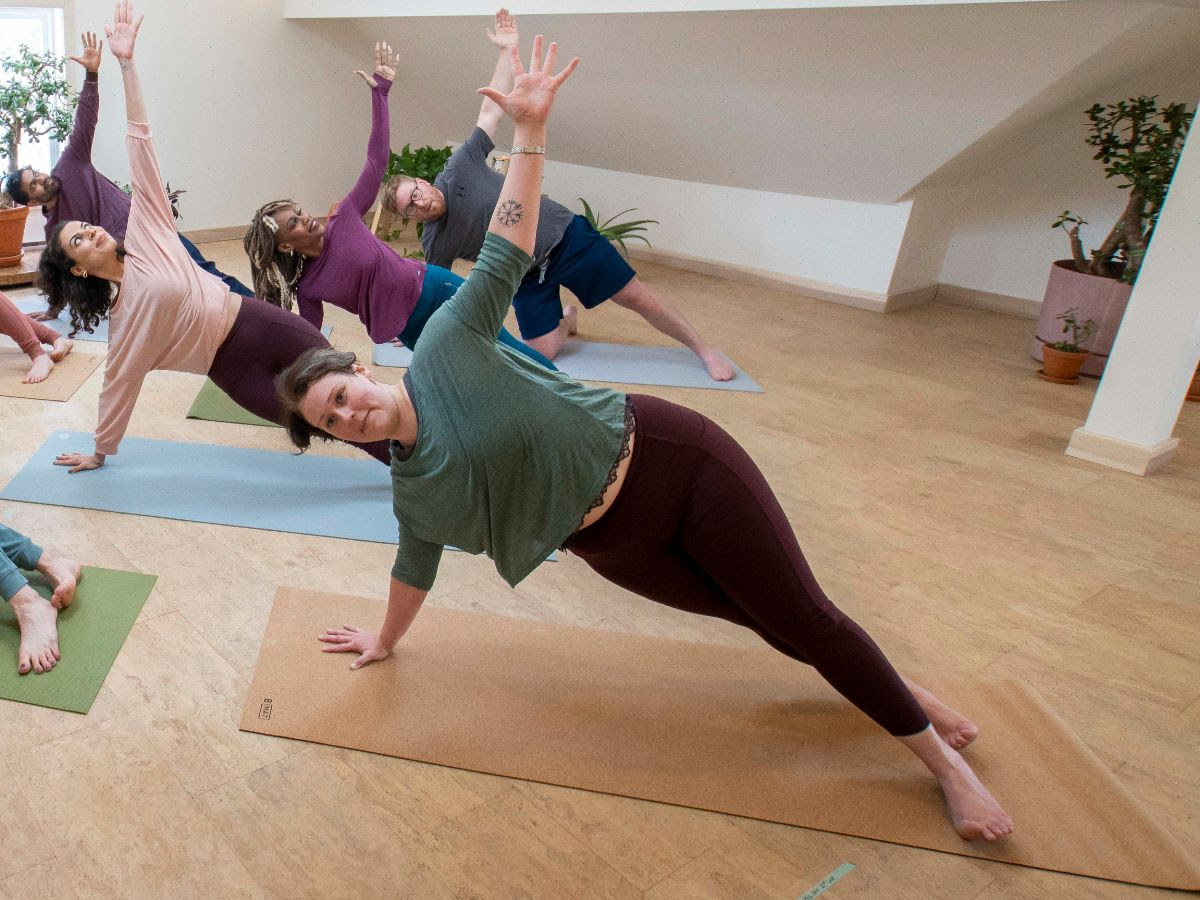
Communal experiences like moving, laughing, eating together shift us towards a greater sense of ease and connection with those around us. These are all experiences of the body; being disconnected from the body, therefore, prevents us from full participation. This is an oft-touted argument for the benefits of affinity spaces. Affinity spaces allow people to let their guards down, to connect over shared joys & struggles, to swap stories and share knowledge. They exist for all sorts of intersections and groups of people: new parents, religious groups, racialized folks, newcomers to Canada, hobbyists, and, of course, LGBTQ groups. Affinity spaces can take all sorts of different forms, from peer support groups to themed nights at bars to potlucks to yoga classes.

For queer and trans folks, gay bars have long existed to serve the purpose of safe/r space to gather, dance, seek information, or just be in community with each other without fear of violence or harassment. As queer liberation movements progress, we see this desire to gather in community take shape in other forms; no longer are we relegated only to dark, underground clubs. For many of us, there’s a real need to gather without the social pressure to drink, or simply a desire to experience a different kind of embodiment. As I look around where I live today in Hamilton, I see queer people organizing sports leagues, drawing nights, and clay workshops, in addition to dance parties and peer support groups.

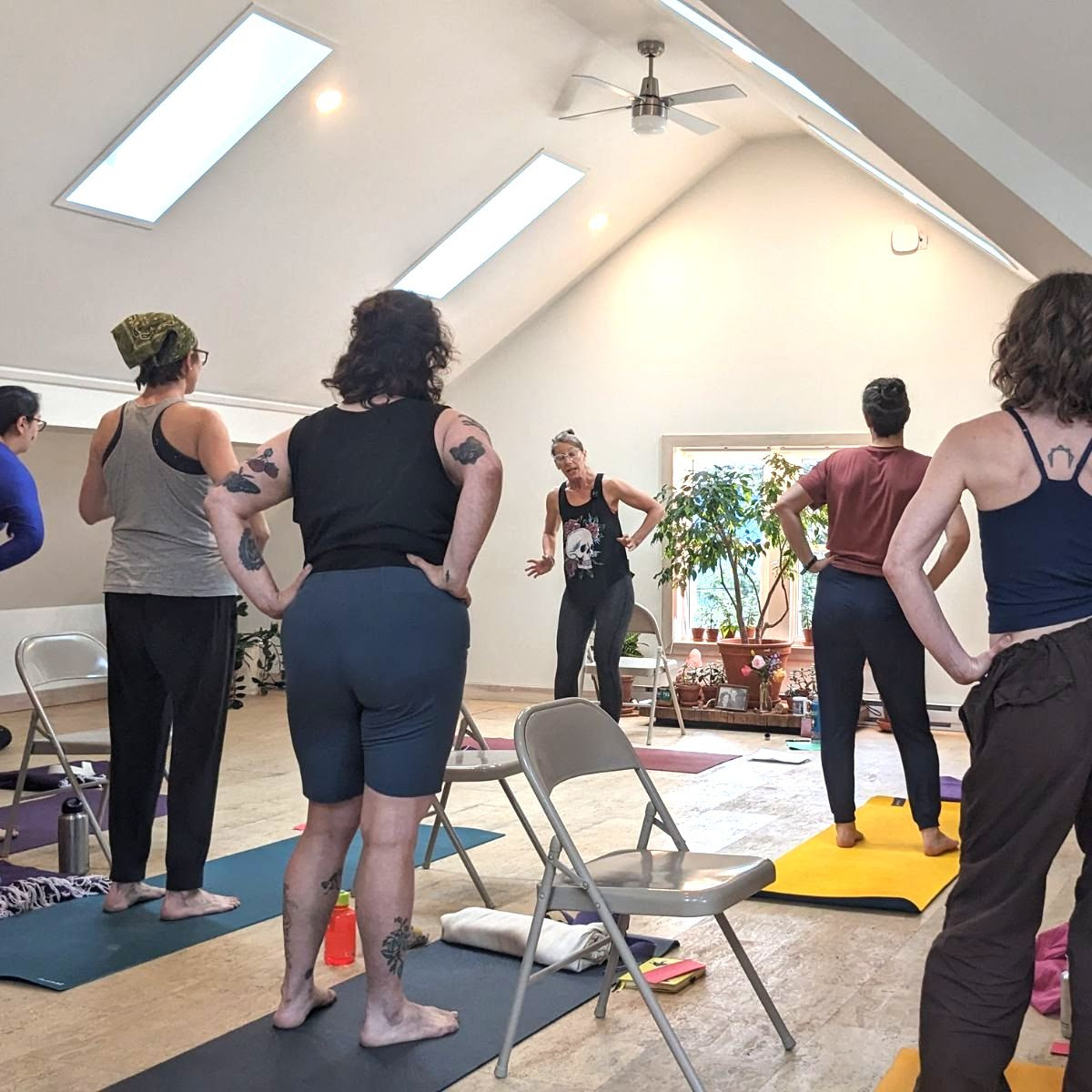
Since January 2023, I have been organizing Rainbow Moves, a series of yoga & movement classes for queer folks at my home studio, The Move Room. I moved to Hamilton shortly before lockdowns began, and by the time 2023 came around I hadn’t had the opportunity to build queer community in the way I had in Toronto. At the time, no one else was organizing queer yoga classes in the city, and I had been a teacher with The Move Room for about a year. I knew I didn’t want to do it alone, so I invited several other queer movement instructors to join a rotating roster with me. Although this was a decision partly made for practical reasons, I have found that when I share the stage with other instructors, I’m not only able to give voice to different kinds of queer folks, but I’m also able to come into the role of participant. My hope is we are able to collaboratively weave together our own community offering, rather than it being the vision of one specific person.

When I participate in queer gatherings around my city, I grow my connection to my community. As I grow my connection to my community, I feel even more bolstered and protected. I’m able to walk in the world more bravely, because I know my people have my back. When I witness, or am party to, homophobia and transphobia, I feel protected by my community. Taking part in my community has allowed me to expand my window of tolerance for difficult situations. Being able to stay connected to my body in difficult situations means that I’m able to choose words and actions that feel in accordance with my truth. I’m better able to act with integrity, care, compassion, and loving kindness, even towards those who have wronged me. Most importantly, staying in connection with my body means that I’m better able to act with integrity, care, compassion, and loving kindness towards the only person with whom I’m in a lifelong relationship: myself.

staying grounded during a trade war

(We have Emma to thank for putting together this timely piece of writing, and including practical resources for coping during this stressful time)


At The Branches, we frame our yoga practice as a way to nurture self care and build our inner resilience so that we can work for a better world. I have been contemplating this “mission statement” of ours in the past few weeks. It feels like a catalytic moment to put our practice into practice. We don’t know what life will look like with the looming tariff war. There is a great deal of uncertainty we all face at this moment in time. And, the curiosity, embodiment and inner connection we practice in yoga can be part of how we face that uncertainty. 

Can we approach this difficult time the way we might approach a difficult pose in a class? Can we stay attentive to our breath and feel the ground beneath us? Can we find the moments of lightness amidst the challenge? 

I have found it really difficult to read the news recently without spiraling into anxiety and fear. But I have been reminding myself that the way I hold my body and the way I choose to breathe can help me stay grounded. I am also reminding myself that reaching out for connection, and talking to others that share similar concerns is also deeply helpful. 

I wanted to share a few resources that are helping me stay grounded, and that are reminding me of the bigger picture. 

The first is a printable PDF created by Leslie, one of our studio directors. It is called the Autonomic Nervous System Toolkit. You might have come across it already; it contains a bunch of techniques for bringing yourself and your nervous system back to the present moment. When I read the news, the threat-detection part of my nervous system can go into overdrive and I can feel my mind and heart racing a mile a minute. This toolkit is for that moment, so you can come back to yourself and decide what makes sense to do next. 

The second resource is a very practical article about how to buy Canadian during this economic stalemate with the US. The author details what all the terminology means (how Made in Canada is different from terms like 100% Canadian) and encourages us to make changes in a range of sectors (not just groceries but service providers, entertainment, social media). It is rousing and encouraging and thoughtful. I hope you give it a read. 

And lastly, this resource is about how to stay grounded in the Trump era. It is a long form article, written by a career activist. It gives a great deal of practical suggestions for how to approach change in your own sphere of influence and community, while keeping an eye on the larger powers. I came across it a few months ago and I keep coming back to it again and again. It is really helpful to read the thoughts and ideas of someone who has spent their life working for positive change, and who is not naive about how slowly that change comes about. 

Thank you for being part of a community that cares about the world. Our yoga practice could easily be a way that we escape from or ignore the difficulties of the world. Instead we hope that yoga practice can be a place of refuge that allows us reprieve, so we can then return to our work in the world, renewed and more prepared to act with thoughtfulness, care and compassion. 

With care,
Emma

make bodies neutral again

(This post comes to you from the brain of Emma Dines, studio co-director and teacher)


I have been thinking a lot recently about how I came to have a fairly positive relationship with my body as a kid and teenager, and how that led to my work at The Branches. 

I think a lot of it had to do with my mom. 

My mom grew up on a farm with two older brothers who called her “fat”, which affected her sense of self for a long time. When she had me, my mom was determined that me and my siblings would feel differently about our bodies. She was vigilant (and my dad was too) about never commenting on or talking about our bodies in a negative way. I still got the fatphobic messaging of mainstream culture from TV and school, but my childhood home was my first experience of Body Neutrality. 

I am so proud that Body Neutrality (and Body Positivity) are core values of The Branches, and that they shape how we teach our classes. Our teachers are careful not to use language that privilege some bodies over others — that insinuates that being stronger or more flexible is “better”, more desirable or even the goal of yoga. Our teachers use language that attempts to acknowledge, inform, respect and celebrate a range of different bodies and needs. We are careful about our language because most of the world is not, and we want to be a safe space for people to feel into, experience and learn from and in their bodies. 

My body has gone through a lot of changes in the last few years. I had two kids, I turned forty, the hormonal changes of perimenopause are coming for me and the body I taught yoga with for 10 years has changed. I’ve done a lot of work to reconnect with my changing body, and to replace my internalized fatphobia with Body Neutrality. One thing I am grateful for, and that I think comes from so many years of integrating Body Neutrality into my teaching, is that when I am teaching, I am so rarely self conscious about my body shape or size. My body becomes a tool to explain spinal movement or joint centration. Any fixation on what I look like evaporates. I really hope that is a shared experience in my classes. I hope that when people are moving and breathing in my class, they have an experience of their bodies that is so much more vast and varied than just what they look like. 

I’m so grateful to my mom for cutting out the noise in my childhood and giving me space to hear myself. And now, with kiddos of my own, I am intent on sharing Body Neutrality and Body Positivity with them. 

Some amazing resources I’ve found that are inspiring and radicalizing me on these topics are the Maintenance Phase podcast and the book Fat Talk: Parenting in the Age of Diet Culture by Virginia Sole-Smith. I also continue to love The Body is not an Apology by Sonya Renee Taylor.

I honestly cannot shut up about all of them (ask me about the BMI! Ask me!!) and would love to chat further about all of this, so don’t be a stranger. Catch me after class or shoot me a note anytime. 

I also re-vamped a printable journaling prompt on Growing Body Neutrality/Positivity. If you want to spend a little time reflecting on this, print it out and give some of this a think. 

Sending you warmth on this cold January day,
Emma

my relationship to darkness

(A seasonal reflection from Branches’ co-director & teacher, Emma)


As the winter solstice approaches, I am contemplating my relationship to darkness.
 
Three years ago near the start of winter, I gathered with a group of ten women about this very topic. We sat in a circle and each took a turn answering the question “What is your relationship to darkness?” 
 

As each person answered, we slowly crossed over the border of friendship into the space of intimates. We became more fully human to one another. We gave one another the great honour of bearing witness to some of our deepest pain. We also got to see one another embodying incredible strength or hard-won healing. The pain or difficulty wasn’t necessarily finished or over (as we know that’s not how grief or trauma works) but hearing others articulate how darkness had been part of shaping them was breathtaking.


Darkness is part of the human experience. Whether that is the literal darkness of night, or the metaphorical darkness of harm, loss, grief and pain, we all carry our knowledge of darkness with us.


And if that is true, the opposite is also true. We are all affected and shaped by light; by the beauty that we are and that we see. By the love we have received, and that we have learned to give. By the light of day, by warmth and summertime. Darkness and light are both an intrinsic part of our life on this earth. 
 

As we head into the longest nights of the year, I can feel the darkness calling me. And when I feel the metaphorical darkness arising too strongly, when grief or rage become too much, I lean into my felt sense of darkness. The sometimes magical feeling of being outside on a quiet, snowy night. The twinkling of stars that are only visible because of the darkness. The soft darkness at the end of an evening yoga practice. I remember I can be held by darkness, not only challenged by it. 

I have honed my relationship to darkness through my yoga practice; perhaps you have too. I have returned from places of deep sadness by coming to my mat again and again. I have also learned to be with darkness by walking with others at The Branches; in the talking circles of our yoga teacher training communities, and different groups gathering for yoga retreats and workshops over the years. 

The darkness of winter and night is regenerative, and cyclical, and there are many ways we make our ways through it. In community with others; with our plethora of practices (therapy, yoga, art, meditation, dog walking, you name it). We make it through the darkness with the long arc of time and the (hopefully) even longer arc of love.

As the year draws to a close, I hope you are finding connection to yourself and community. On behalf of Leena, Wendy, Nicole and all the teachers and staff at The Branches, we wish you a season of rest, renewal and delight.

Solstice blessings, 
Emma 
 

P.S. Sitting in circle is something we do in our Yoga Teacher Training programs, and something I have both led and participated in in a wide range of contexts over the last fifteen years. If learning how to gather people in community and conversation is of interest to you, I hope to share my experience with this and mentor others to start their own circles in a workshop format in the coming spring. Do be in touch if that’s something you want to hear more about. 

Committing to joy in times of crisis

Hi there, Emma here today.

I have read many essays and articles by climate activists with the message that to address the climate crisis, we must choose things that both have impact, and bring us joy. Because without joy, we will not be able to sustain our commitment to the crisis. 

We need joy as an anchor for our commitment.  

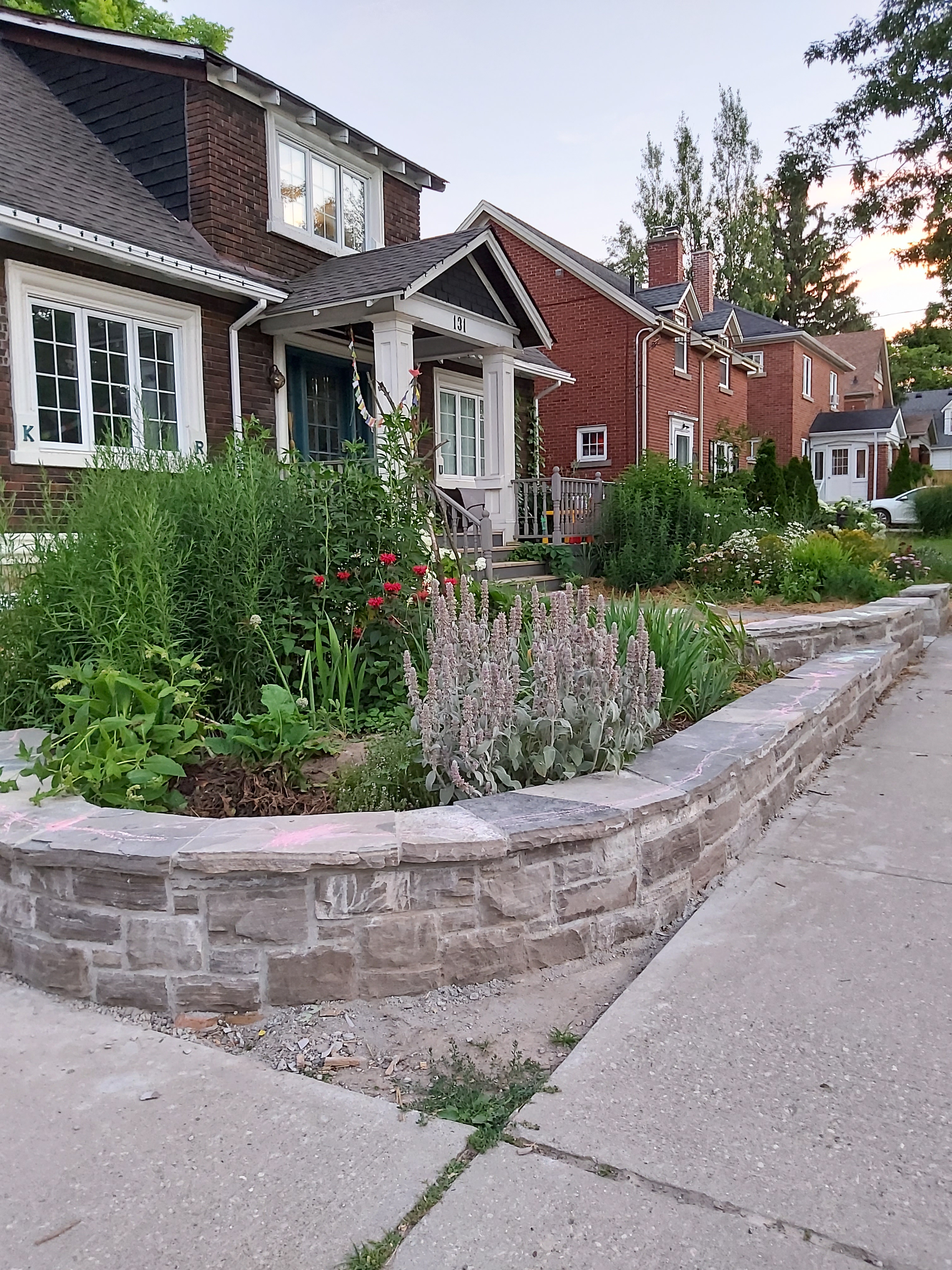
Gardens are a source of great joy for me. My own garden is a site of solace, a place to connect with the earth and notice the pace of growth. It is a place to practice nurturance and attention. When I step outside my door to colourful new blooms, or the graceful twining of a bean plant up a pole, I am infused with joy. It fulfills so many of the values that I hold; to live in more connection with the land, to contribute to a healthier ecosystem by feeding bird and bee populations, and to share beauty with others. I’m so grateful to greet the garden outside The Branches on my way to work, seeing the bulbs pop up in the spring, and the berry bushes and trees begin to bear fruit.


Leena worked hard on planting the front garden of The Branches with native plants and shrubs a few summers ago. I vaguely knew that native plants were “good for the environment” but I didn’t have a good grasp on the importance and impact of native plants until I attended an info night on native plants in my neighbourhood. And what I learned that night drastically changed my thinking (and my garden). 

A mix of native and non-native plants

I had always thought that any sort of garden with flowers and trees could feed birds and butterflies and contribute to a healthier ecosystem. What I learned was that most of the ornamental flowers and trees that we commonly see in gardens are not nutritionally appropriate for this region’s animal and insect populations. Plants native to our bio-region (meaning that they co-evolved with the birds and insects in this area) have the best and in some cases only nutrition able to sustain certain species. There are certain butterflies and birds that are dying out because the plants they need to survive have been replaced either by grass lawns or by non-nutritive but popular flowers and shrubs.

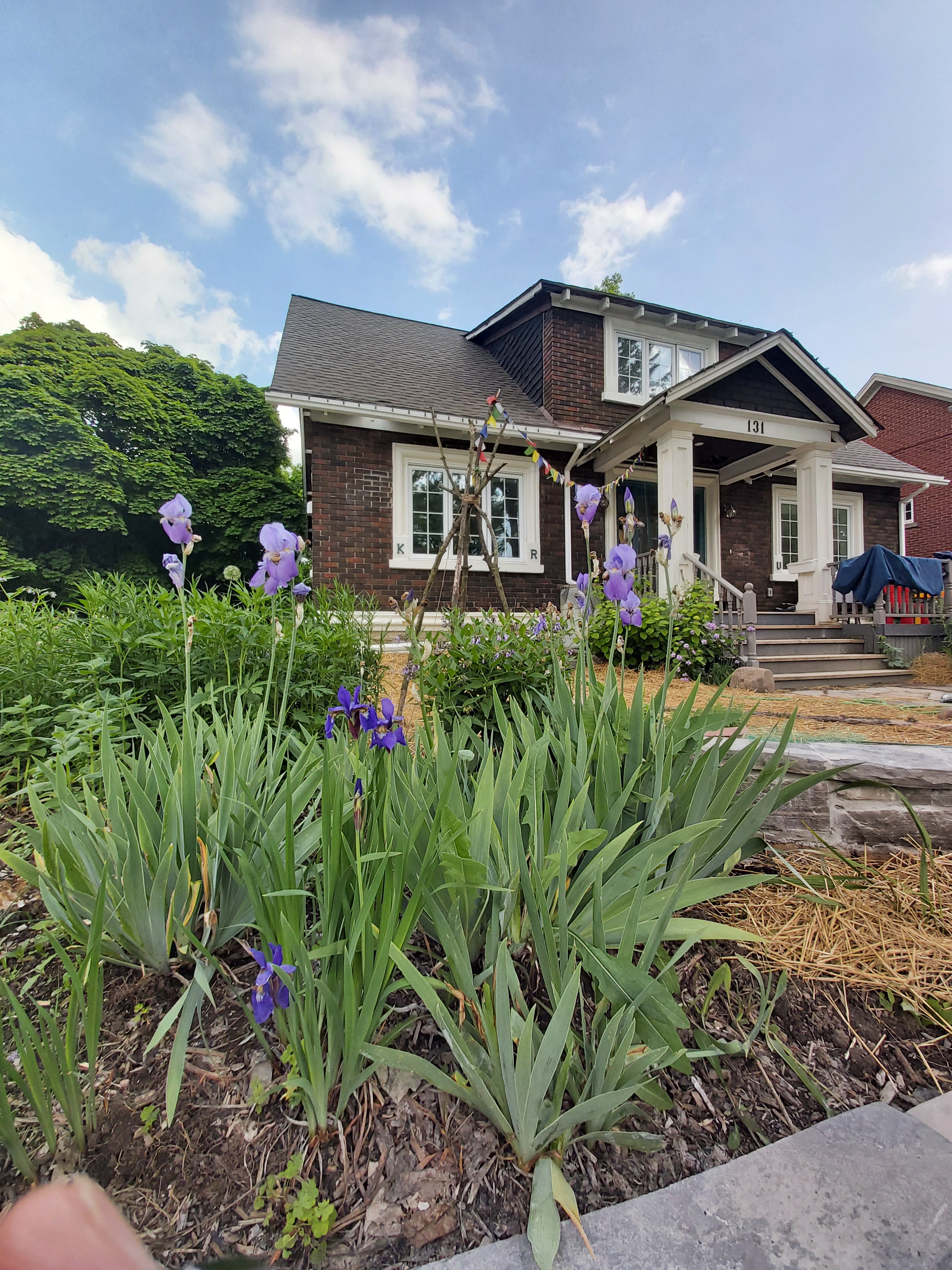
Non-native Irises out front of my house

I thought of the flowers in my garden and realized that while they were beautiful they were also nutritionally empty for the wider ecosystem.

The other important piece I learned that night was about how much land in the city of Kitchener-Waterloo is privately owned, and how much of that privately owned land has the potential to host native species. So much of the land (that is not paved by roads and driveways or occupied by buildings) is covered by grass, which gives zero nutrition to the wider ecosystem, and is also incredibly taxing on the ecosystem as it requires water to stay green. If even a small amount of that privately owned land was converted to native plants, shrubs and trees, it could greatly contribute to the resurgence of local fragile insect populations.

After the event, I marched home and looked at my garden. I looked at the grass on the boulevard, and the non-native perennials I had planted. I saw how much potential this small bit of land had, and I committed myself to converting as much of it as possible to native plants and shrubs.

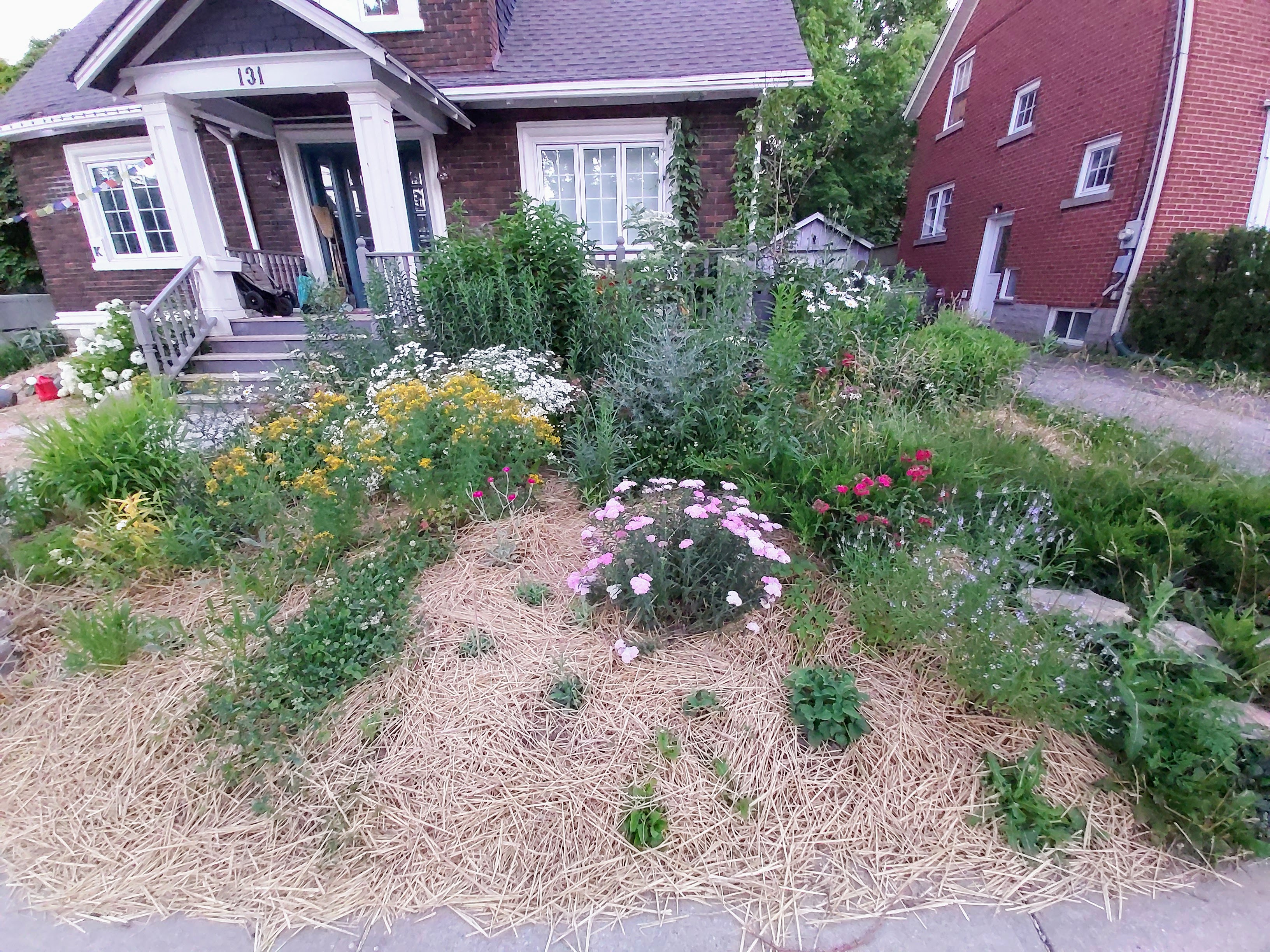
Many native plants in here, small but growing! Pearly everlasting, wild strawberry, narrow leaf vervain, lancelead coreopsis, feverfew, butterfly milkweed, liatris, aster


Tending to and enlarging the native plant population in my home garden is one small way that I am attending to the climate crisis. When I feel overwhelmed by the scale of the challenge, I am heartened to remember that nurturing gardens on privately owned land is actually a huge point of leverage in the ecosystem of a city. I also hold alongside that, an awareness of the privilege I have in owning land and the complicated and problematic nature of land ownership.

I am not satisfied with confining this commitment to my own garden. I am dreaming and scheming about how I might re-naturalize parts of the school yard where my son will start JK in September, or how I might get a grant to install native plants outside the Kitchener Public Library.

At The Branches, we are also dreaming about how we might spread more awareness about native plants to our community (this newsletter is one step), and get more native plants into the gardens of our members. Stay tuned for ways you can get involved in that next spring.

With joy,
Emma

Want to learn more about or order some native plants?
My fave resources are:
https://onplants.ca/
https://www.nativeplants.ca/
https://reepgreen.ca/bloom-in-box/ (Closed for 2024, but a good program to know about)


Why we stopped trying so hard (to get all the likes on Instagram)

Emma and Leslie here!

Depending on your personal relationship to social media, you might have noticed that for a while there, The Branches was on an absolute blitz of creating original, silly, opinionated, and informative content, especially on Instagram.

People would sometimes approach us in public spaces to say stuff like, “Oh my goodness, you guys are so funny on Instagram!” or, “I love your posts! I’m going to come to class one day!” 

Despite the fun of making silly videos or the adrenaline of sharing hot takes, we’ve always had a rather ambivalent relationship with Instagram. As a business, we felt compelled to use it in order to compete for people’s attention and maybe someday their studentship. As community leaders, we felt conflicted about using it, since social media has become increasingly addictive, and degrades our own presence and attention – the exact thing we hope to strengthen through the practices we teach.

As our content production increased at QSY/The Branches, we were increasingly taking personal breaks from social media for our own mental health. Each of us found that being on Instagram caused us to overconsume content, leading to feelings of comparison and competition, or simply wasted time. For work, it led to constantly thinking about the algorithm, about how any and everything could be turned into a post or a reel. It caused us to question how we should be showing up on the platform – do we engage in the “performative wellbeing” in the form of positive affirmations, fancy poses, or colourful meals that prove how “deep,” our practices are or “healthy” we are in the eyes of potential students? Or do we overshare intimate facts and experiences from our healing journeys to appear “authentic” and “relatable” (and to do better with an algorithm that rewards drama?)

This focus on creating and maintaining a particular kind of online business persona took time away from going deeper into the embodiment practices that we love to share. It pulled our attention into performing on and for a tiny screen, and away from the rich experience of moving through the world with presence, relating to others with mindful awareness, and taking meaningful action towards the world we want to live in.

If you’ve been reading our newsletter long enough, you’ll know we’re not ignorant to the other side of the coin. Of course social media has its benefits, like the democratization of news, space to organize for social justice, some potential for useful learning, and perhaps obviously, more accessible social connection with communities near and far.

Anyway, you might also have noticed that at some point, we just… stopped trying so hard. And we more or less stopped posting on our individual accounts, too. We’ve wondered from a curious perspective, but we’ve also lamented from an exasperated perspective: does sustainable success really require studios and/or teachers to self-promote on social media?

In the end, we don’t really want to play the game of Instagram. We don’t like what it does to our brains or to our creativity, confining it to a tiny box, and consumed in an endless scroll. We want to be thinking about how we show up in community with others, not how we can articulate that in a post. We want to practice presence as we teach, not make reels about our teaching.

We’d love to hear back from you – how do you relate to your own use of social media? Are you using it to follow yoga teachers, or your favourite local businesses? Are you on there as a teacher or creator, hoping to find success? How do you protect your mental wellbeing while engaging?

In community,

Emma and Leslie

Introducing our 2024 graduates!

Congratulations to our 2023-2024 Yoga Teacher Training graduates!

The end of the Yoga Teacher Training program is invariably bittersweet. It’s a relief to complete such a big journey, but it’s also a big bummer to say goodbye.

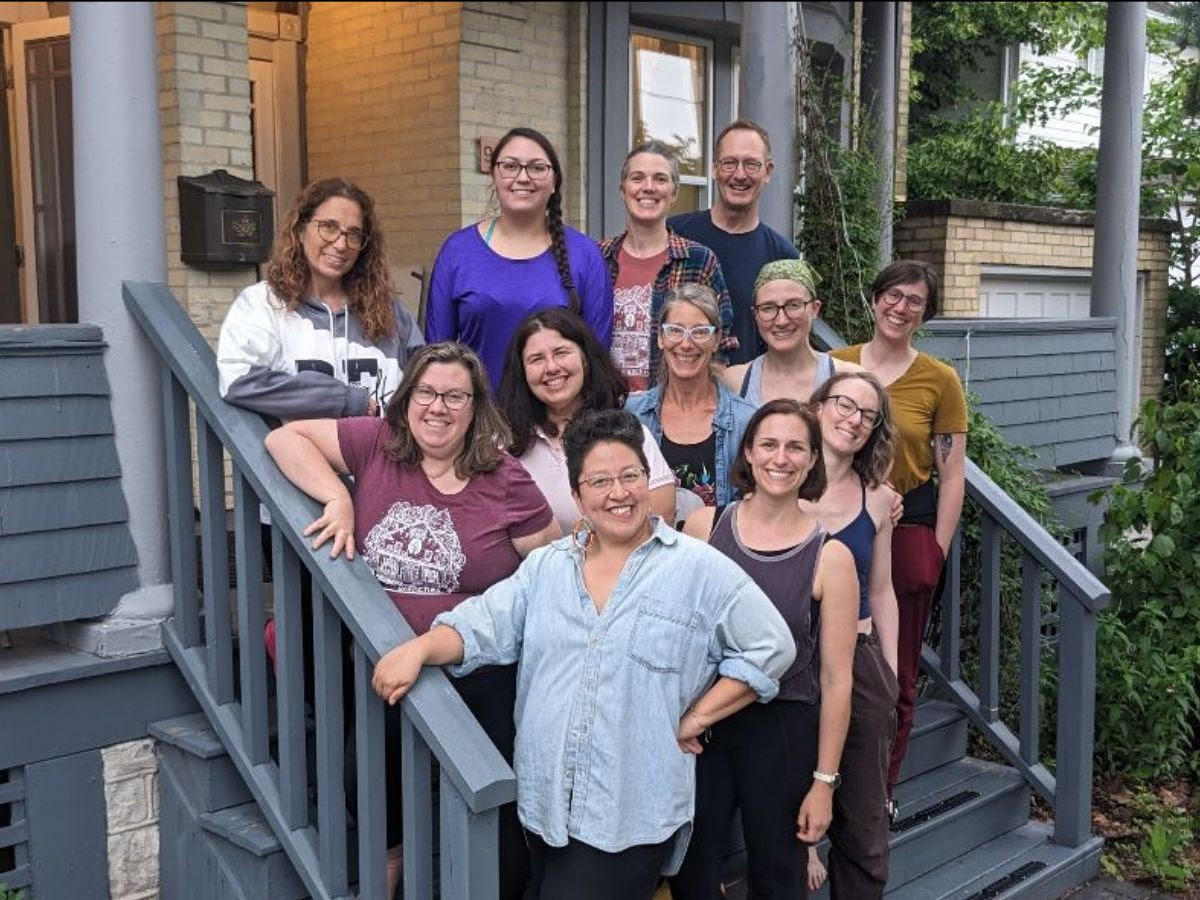
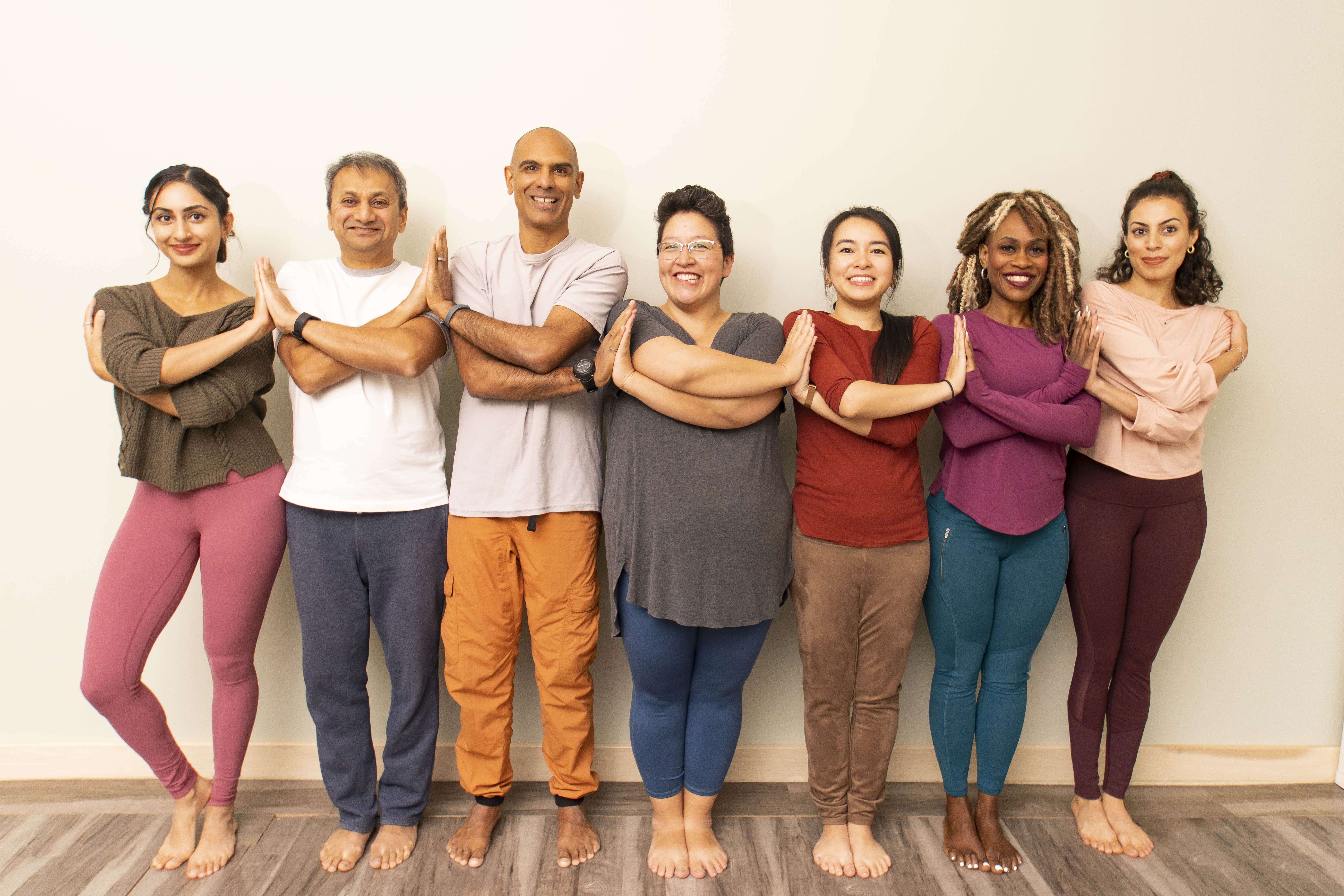
Pictured here are a handful of the newly-initiated teachers: a mix of people who were already sharing yoga in movement and wellness spaces, or who have new-found passion for teaching, and some who’ll continue to prioritize their own evolutionary relationship with yoga. Program directors Leena and Emma were continuously impressed by the maturity and thoughtfulness of this group.

Photo Highlights from Final YTT Weekend

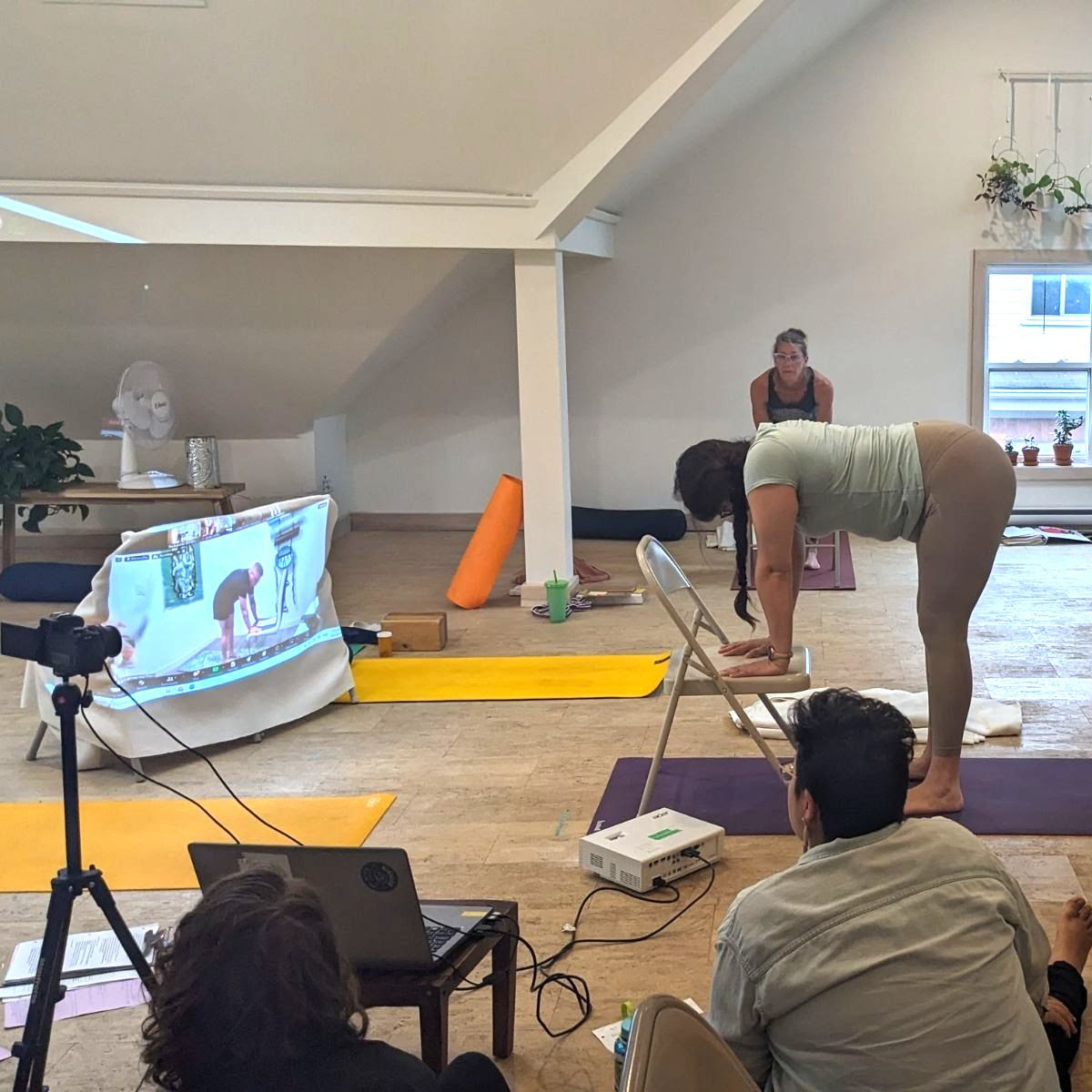
Below are some highlights from our grads’ teaching initiations. We were blessed with virtual lessons from our BC participants, and an in-person visit from our Hamilton participant!

The initiations are the capstone creative project of the program: 30 minutes of solo teaching, with a mission: an intention to serve a specific population, highlight a specific action, and communicate a specific learning goal. 

All teacher-trainees give and receive feedback on one another’s teaching, according to hard and soft skills they’ve been honing over the course of the program.

Everyone made huge improvements, and we are super-duper proud of them.

WANT TO DO OUR NEXT YTT?

Here are some pathways to participation.

Our next full 250-hour Yoga Teacher Training will take place through the 2025-2026 academic year. It’s a long time to wait, but we think it’s worth it.

That said, there are a couple of things you can do in the meantime to:
 a) test out our vibe and make sure it’s a good fit
b) get ready for a big experiential learning journey

Option 1: Prep Program
The perfect toe-dip that you can do anytime.
Get:
-a 20 Class-Pass 
-10 Introductory YTT lessons in our online portal
-If you do the full YTT, we will deduct Prep fees from tuition, making the Prep Program free.

Option 2: Restorative YTT

A 45-hour training that runs over the winter 2024-2025.
Includes
-three weekend intensives
-Yoga Alliance credits
-a deep dive into intentional rest
-Can be done before, after, or totally separate from the full 250-hour YTT.

I’m finally not intimidated anymore

Hello, Wendy here. So, I’ve dabbled in strength training at several points in my life. And each time my motivation would eventually decline, or I’d reach a point where I just felt too intimidated and confused to know how to progress. Sound familiar to any of you?

Strength Training for Longevity and Healthspan

As I enter my mid-life journey, I’m learning how valuable resistance training can be for maintaining mobility and strength as we age. For folks who will go through menopause, and especially folks like me with a long family history of osteoporosis, strength training can also help increase bone density and prevent osteoporosis, (this article does a really good job of summing that up if you’re interested). Based on these life stages, I have been feeling really motivated to find a way to add resistance training back into my life.

Recently, I decided to start on my own again, and it was great… for a while. I was learning a lot, getting stronger, and I felt good in my body – all things that kept me interested. But, inevitably, I would get busy or tired and skip a session, or two, then three, and my motivation would begin to wane. 

Finding the Right Coach & Community

One thing I’ve learned about myself (and still have a hard time accepting), is that no matter how much I want to do things on my own, I really need other people in order to stay motivated. But all of my past ‘gym’ experiences had been unpleasant. I either got a bunch of unwanted advice, or unwanted commentary that made me not want to be in those spaces. I needed MY people – people who would lift each other up.

Enter Strength Essentials…

From the first time I walked into Nicole’s Strength Essentials class I was struck by just how supportive it felt. It was such a radical departure from the intimidating experiences I had in the past. Nicole presented things in such an easy to understand, accessible way. We learned lots of options of how to progress, and Nicole was there to help folks to find ways to make things work for their body. It was so refreshing to not feel intimidated to ask questions or to ask for advice. With the number of questions I hear each time I’m there, it’s obvious other folks feel the same way.

The Camaraderie Effect

The instruction in Strength Essentials is wonderful (thanks Nicole!), but I’m also blown away by the community of support that has formed among the participants in the class. We celebrate each other’s triumphs, and share lots of laughter to help get through the challenges. I often hear folks encouraging each other (“You got this!”), or commiserating after a particularly hard set (“Wow, that was a hard one!”). We joke about how there’s no way we can do another round of pushups (why are they so hard?!), but then we all look at each other and do it anyway.

I’ve found a group of people who are there to learn and to take care of their bodies. No one is in class to show off or to ‘prove’ themselves to anyone, so it feels so much more welcoming than my previous experiences. I finally found MY people – and I keep going back because of them.

Sound like your people, too? Come join us for casual weight lifting with friends in Strength Essentials – I think you might love it! Just be prepared to laugh a lot 🙂

With enthusiasm,
Wendy

Can Joy and Grief Co-exist?

A personal reflection from Branches Co-Director, Leena Miller-Cressman

It’s my most sincere hope that you can find our classes or events to be a soft place to land, whether it’s back in community or back in your body, and that you can re-realize the joy of practicing together.

Leena Miller-Cressman

You may have noticed that the studio has been busy this past month! We’ve added some classes, and the schedule is feeling more full after such lean times in the thick of the pandemic. Hooray!

None of this is to pretend that our healthcare system is okay or that COVID is gone, but we sure are glad that many people are feeling up for in-person classes. The contrast between this January and the one from 2022 has me feeling reflective…

The Marathon We Didn’t Know We Were Starting

Looking back, even though our classes weren’t busy, the pandemic was the busiest time of my life. For example, I started making sourdough bread years ago (before having kids) and I just made it again for the first time the other week. Unlike some folks who got into it during the pandemic, I had absolutely no time for a cozy and nourishing habit like baking my own bread. Like so many parents, I was juggling work and childcare while schools and daycares closed and opened, and closed again. And I was also hustling more than ever to keep the studio afloat through pivot after pivot.

Over this period, there wasn’t time to slow down, reflect, feel or to grieve what was happening. I just kept moving forward. These days I don’t think too hard about whether I would have gone ahead with everything had I known how long it would all take. But thanks to so much hard work from our whole dream-team, a deeply supportive community, and vital government small business supports, here we are – finally.

When Joy Shines A Light On Grief

The other weekend, a lovely group of 14 people gathered at the Branches for the first of two Deeply Chill Restorative Immersions. In the closing circle, a number of participants remarked on how healing it was for them to be in a group again. One participant shared afterwards, “My heart is overflowing from the wonderful group of humans who shared practice, space and stories. The way TBY co-creates community is unlike anything I’ve ever experienced.”

Hearing this, it’s impossible to put my gratitude into words – having folks come together in our new studio home ignites my sense of purpose. But the joy I felt from hosting a group of people moving and breathing together was also tinted with melancholy. It felt a little more complex because it was in such high contrast with what it was like during the times we were isolated from one another.

One year ago, we were grappling with a stark sense of emptiness (literal and figurative) during the shut-downs associated with the Omicron wave. Re-encountering vibrant togetherness one year later has revealed the hidden grief that I didn’t have time to process when I was too busy moving forward. It all became quite clear when this song popped up in a playlist and I started crying!

Anyone Else Still Feeling the Effects?

Realizing how much we missed something only after glimpsing it again is such a bittersweet gift. For me, finally giving those emotions some airtime is helping me let go of tension, land in my body more fully, and move forward in a more wholehearted way. Are any of you still working through the changes of these past few years?

It’s my most sincere hope that you can find our classes or events to be a soft place to land, whether it’s back in community or back in your body, and that you can re-realize the joy of practicing together.


Next week we’ll be sharing all the details of our annual Community Week, so stay tuned for info on how you can join in!

With care,
Leena

Noticing Our Confinement

A Story About Outdoor Cats & The Enneagram

This is a guest post by Tamara Shantz, Spiritual Director and Enneagram Teacher. Tamara’s work centres on “practicing incarnation,” with the Enneagram as a key piece of the puzzle.

Our cat Izzy is NOT an indoor cat. 

When we first took Izzy and her brother Alex in six years ago, they had been living as outdoor cats for at least a year. We hoped to transition them to being fully indoors, but after months of constant crying and complaining, we caved, and allowed Izzy and Alex to move freely between inside and outside.

Alex died really unexpectedly the other summer, and we were so devastated. As we grieved Alex, we were also trying to figure out what to do about Izzy. There was a possibility that Alex had died from exposure to rat poison, so until we got the results from an autopsy, we decided to keep Izzy inside. 

One day of her confinement, she spent about 8 hours loudly petitioning to be let outside. There was nothing pleasant about Izzy’s confinement for anyone in the household. Thankfully, in the end, rat poison was not the cause of Alex’s death and we decided to return to Izzy’s usual state of roaming freely between our indoor and outdoor spaces. 

Protection or Imprisonment?

This experience with Izzy got me thinking about the idea of protection. I’m sure any parents (of human or fur babies) can relate to the choice-making we do for the protection of our vulnerable charges, even when they conflict with the desires of the one we seek to protect.

I have no doubt that Izzy did not feel protected. She felt imprisoned. Like many protective acts or barriers in the world, it really depends on perspective.

What one person sees as an act of protection, for another, is an act of confinement.

We can find this dynamic within ourselves as well. 

The Wisdom of Enneagram

The Enneagram is a tool for self awareness that describes 9 basic personality structures. It sees your personality as a collection of coping strategies – defence mechanisms that develop in order to keep yourself safe. Especially when we are children, at our most vulnerable, we need to learn how to protect ourselves in the world. We begin to create a tough outer layer to defend the tender parts of our truest selves. 

And so Ones begin to perfect themselves, Twos start to shower others with care and kindness, Threes get busy, and so on. Each one of us believing that these strategies will keep us safe; will bring us love.

Nothing Is Inherently Wrong

What I have found to be so beautiful about working with the Enneagram is that this development process isn’t seen as something that has gone wrong, or that these protective layers are to be judged in any way. 

It has been incredibly liberating to be introduced to the Enneagram’s perspective on human development where there is nothing inherently wrong. The structures of our Enneagram type, the ways that we have tried to protect ourselves are necessary, natural, and good.

There is beauty, love, and power at work in the formation of our personalities.

From Protection to Protest

Just as our choice to confine Izzy was rooted in love, it was still confining!

Even as our personality formation is essential and marked by love, these same traits and structures that have protected us can also begin to chafe. They begin to feel confining. 

Like Izzy, I have found myself at the closed windows of my being, loudly protesting my confinement. 

This is where meaningful work with the Enneagram really begins. 

One of the purposes of learning about your Enneagram type is to begin to see these various coping strategies clearly, to notice when they become activated, and to develop the freedom to let these habitual patterns go. 

I find my home at point Nine on the Enneagram. One of my primary coping strategies has been to numb out, dissociating from physical sensation and retreat into my daydreams.

For many years this was a necessary habit to keep me safe. But as I moved into adulthood, I began to realize how this numbness also was its own prison, and work with this limitation. My confinement is much clearer and more temporary than it used to be.

Letting Ourselves Be Outdoor Cats

We were a bit anxious when we ended Izzy’s confinement, but we do have some tools we use to keep her (and the birds) safe: a bright, rainbow clown collar and bell, neighbours who keep an eye out for her, and an early ‘bedtime’. 

The Enneagram can provide these tools for each of our own processes by helping us to become acquainted with our unique confinement, and offering practices to help us feel supported as we risk venturing outside of our protective walls.

Curious? It won’t kill ya! Join us for a workshop to dive in: The Enneagram: Nine Journeys of the Soul on February 10 and 11. Registration here.

You can learn more about Tamara and her work on her website.