Formerly Queen Street Yoga
Yoga & movement. Rooted in community.
We’re here to create a better world with Yoga as our common ground. We lead down-to-earth classes, expert teacher training, and an engaged intergenerational community.
We opened our doors in 2005, and have become known for our highly experienced teachers, our innovative approach to movement, and our efforts in community care and social justice. Our aim is to make the practices of yoga and meditation more inclusive, more accessible, and more relevant for your day-to-day life.
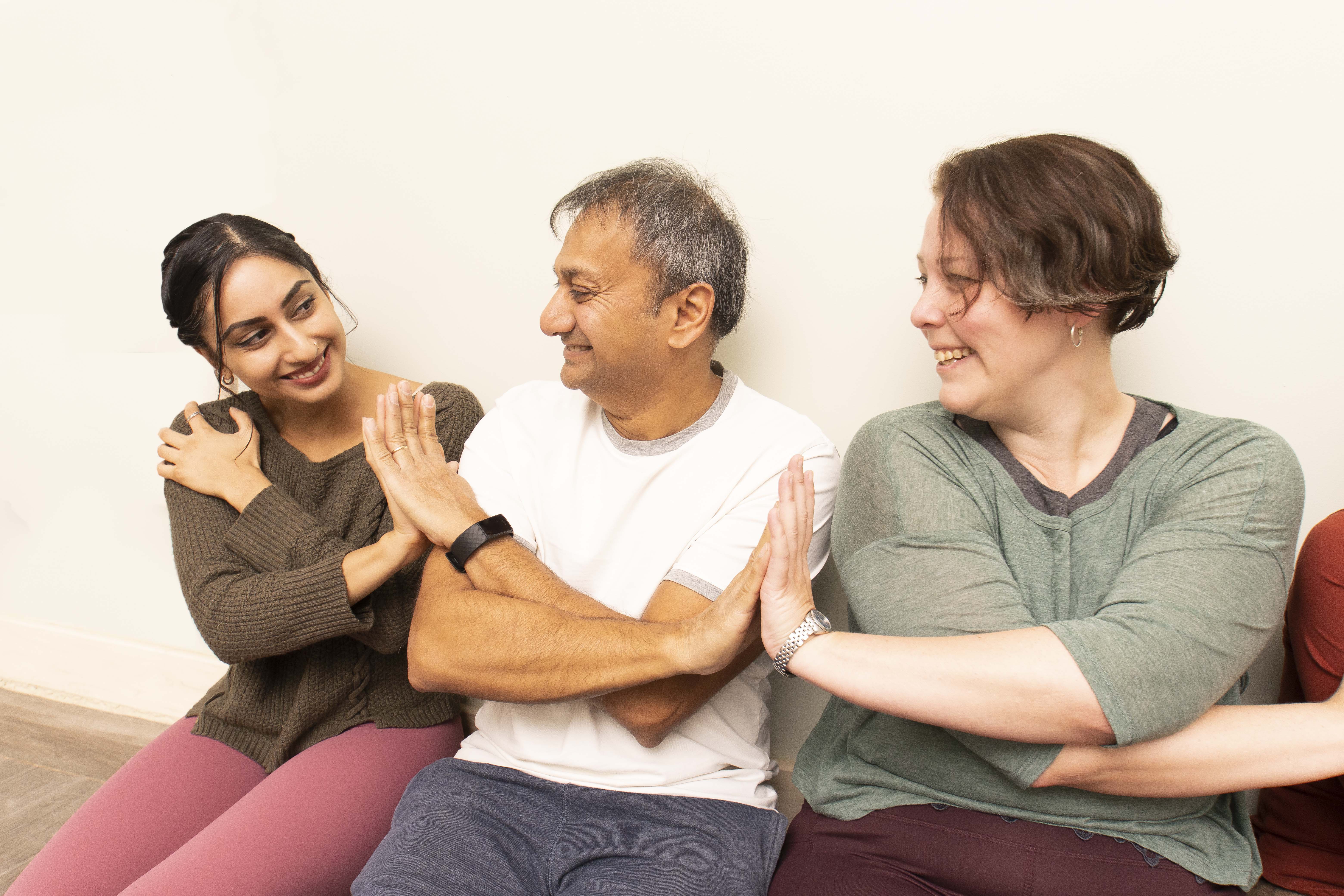
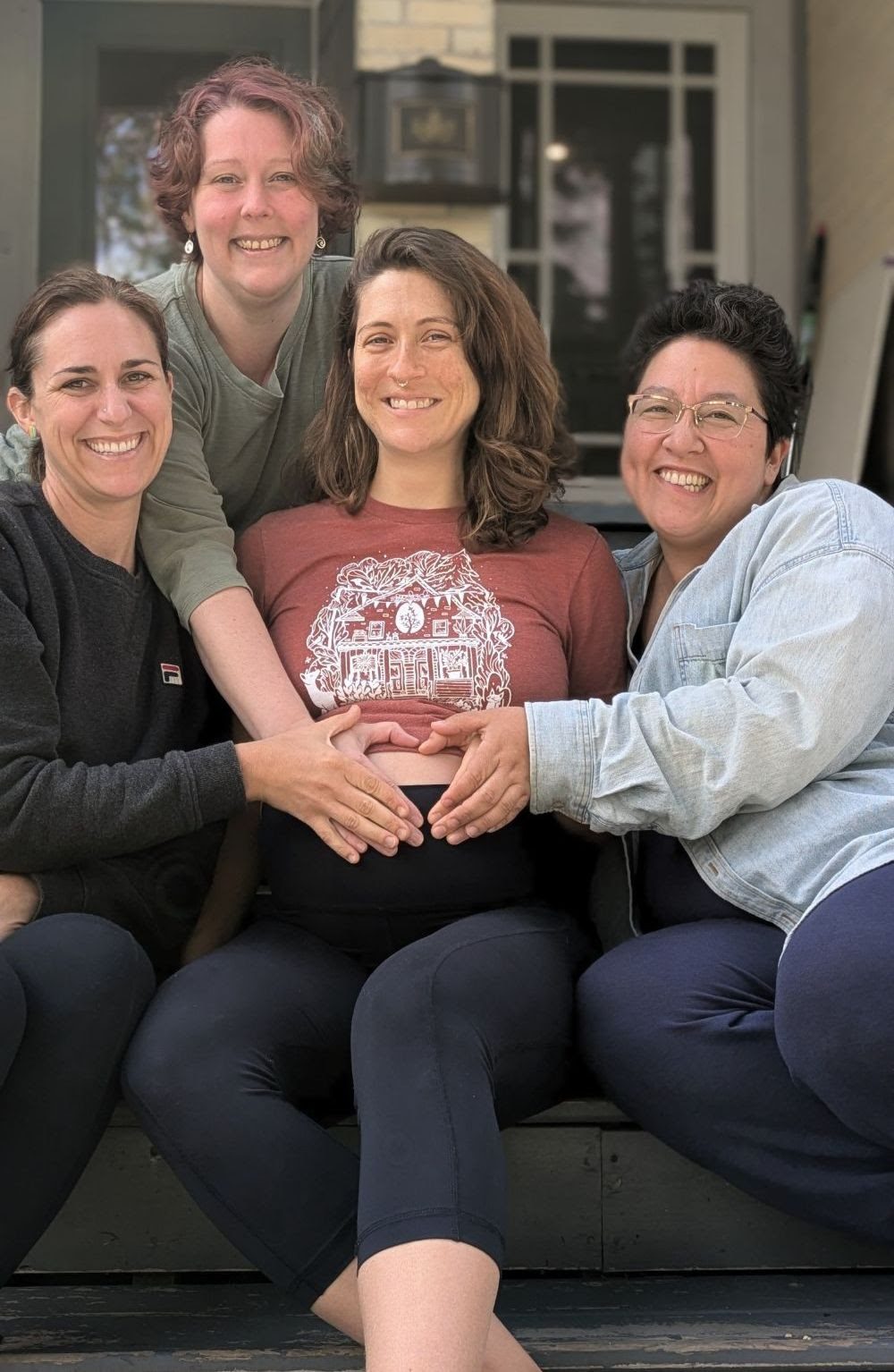
(This post comes to you from Wendy – pictured below on the right – Operations Manager, strength & yoga teacher, and resident-barefoot-shoe-enthusiast, at the Branches)
I have always loved to walk barefoot outside. I enjoy the tactile stimulation I feel when walking on different surfaces. I walk barefoot so I can feel the burn of hot pavement in the summer and the gentle sharpness of blades of grass; the cool squishiness of walking through the mud and the grittiness between my toes when walking in the sand.
Barefoot shoes (also called minimal shoes) allow me a little bit of that sensory stimulation when I can’t (or shouldn’t) walk barefoot. It means I can still feel the bumpiness underneath the grass, the sharp pebbles at the edge of a dirt road. Does it hurt sometimes? Sure! I’ve landed on a few rocks while running that sent a few choice words streaming out of my mouth. But those experiences never made me want to switch back to the relative void of sensation I felt when walking in thick-soled shoes.
I initially started wearing barefoot/minimal shoes because I was experiencing knee pain and trying to find a way to improve it. I had heard minimal shoes might help, so I decided to give them a try. However, as soon as I started walking in that first pair of barefoot sneakers, I no longer really cared if they cured my knee pain – it just felt so good to walk in them!
Those shoes were the first pair of shoes that I didn’t have to ‘break in.’ My feet didn’t feel like they were being squished. I didn’t have to deal with the pain and irritation of blisters and calluses, in fact, I could actually wiggle my toes! Over time my knee pain did improve, but the reason I keep wearing barefoot shoes has more to do with the connectedness I felt with my body and the world around me.
I used to have a nice pair of ‘technical’ hiking boots that I invested in because I thought they were what I needed to be able to hike ‘safely.’ Ironically, I’ve had fewer injuries since I switched to minimal hiking boots. My balance is better, and my feet and ankles are stronger now that they can move more freely. I can both feel and respond better to the changes in the ground beneath me. I can feel the curves and edges of rocks as I walk across them, and I can respond with more agility to those small changes in balance, bending my feet and ankles to ‘grip’ the rocks as I go. Thick soled shoes take a lot of that sensory information away, leaving me feeling like I’m teetering while trying to balance on rocks, and stumbling as my foot leans too far off an edge it can’t feel. There’s a disconnect between what’s happening underneath me and what my body is doing in traditional hiking boots. That connectedness means I’m actually more confident hiking in minimal shoes because I slip and fall less often.
The connectedness to my body and the world around me is what has ultimately made me a barefoot shoe convert, and now, something of a proselytizer! I want everyone to experience the gentle invigoration of walking with more sensation and agility. Switching to barefoot shoes is something of a process – for most people a good amount of preparation is needed to build up the foot and ankle strength needed to enjoy wearing minimal shoes. If you’re interested in the (eventual) hedonism of barefoot shoes, start your journey with me at my Free Your Feet workshop, a staple offering that we host every year or two at the Branches.
Looking forward to walking in the mud sometime soon, Wendy
(We have Emma to thank for putting together this timely piece of writing, and including practical resources for coping during this stressful time)
At The Branches, we frame our yoga practice as a way to nurture self care and build our inner resilience so that we can work for a better world. I have been contemplating this “mission statement” of ours in the past few weeks. It feels like a catalytic moment to put our practice into practice. We don’t know what life will look like with the looming tariff war. There is a great deal of uncertainty we all face at this moment in time. And, the curiosity, embodiment and inner connection we practice in yoga can be part of how we face that uncertainty.
Can we approach this difficult time the way we might approach a difficult pose in a class? Can we stay attentive to our breath and feel the ground beneath us? Can we find the moments of lightness amidst the challenge?
I have found it really difficult to read the news recently without spiraling into anxiety and fear. But I have been reminding myself that the way I hold my body and the way I choose to breathe can help me stay grounded. I am also reminding myself that reaching out for connection, and talking to others that share similar concerns is also deeply helpful.
I wanted to share a few resources that are helping me stay grounded, and that are reminding me of the bigger picture.
The first is a printable PDF created by Leslie, one of our studio directors. It is called the Autonomic Nervous System Toolkit. You might have come across it already; it contains a bunch of techniques for bringing yourself and your nervous system back to the present moment. When I read the news, the threat-detection part of my nervous system can go into overdrive and I can feel my mind and heart racing a mile a minute. This toolkit is for that moment, so you can come back to yourself and decide what makes sense to do next.
The second resource is a very practical article about how to buy Canadian during this economic stalemate with the US. The author details what all the terminology means (how Made in Canada is different from terms like 100% Canadian) and encourages us to make changes in a range of sectors (not just groceries but service providers, entertainment, social media). It is rousing and encouraging and thoughtful. I hope you give it a read.
And lastly, this resource is about how to stay grounded in the Trump era. It is a long form article, written by a career activist. It gives a great deal of practical suggestions for how to approach change in your own sphere of influence and community, while keeping an eye on the larger powers. I came across it a few months ago and I keep coming back to it again and again. It is really helpful to read the thoughts and ideas of someone who has spent their life working for positive change, and who is not naive about how slowly that change comes about.
Thank you for being part of a community that cares about the world. Our yoga practice could easily be a way that we escape from or ignore the difficulties of the world. Instead we hope that yoga practice can be a place of refuge that allows us reprieve, so we can then return to our work in the world, renewed and more prepared to act with thoughtfulness, care and compassion.
(Leena, studio co-director and teacher, shares her strength training origin story, below…)
My strength training journey has been a lesson in humility and patience. It has taught me that if I want to go far, I have to go slow.
I started seriously lifting weights about three years ago. I wanted to rebuild my strength after having twins, and hoped lifting weights would help with some chronic pain. I started working with dumbbells and kettlebells on my own, but in the first few months,it didn’t go that well. After a session of lifting, pain in my neck and shoulders would flare up, resulting in days of headaches. I felt lost and discouraged.
Finally I decided to sign up for a 3 month program with Kathryn Bruni Young of Mindful Strength. We had brought Kathryn to the studio a few times to teach workshops, and I trusted her knowledge and approach.
The most important thing I learned from Kathryn was progressive loading. But it took me a few false starts before I really took it to heart.
In our first session, Kathryn taught all of the movements with really light weights so we could just focus on learning the movements and having decent form. I was relieved that my neck felt fine afterwards. That led to me overdoing it in the second session. I was feeling cocky after the first session had felt so easy, and when Kathryn said we could go slightly heavier, I picked up much heavier weights. By that evening, my neck pain had flared up, and a bad headache followed.
I talked over my pain and approach with Kathryn, decided to apply more humility and patience, and went somewhere in the middle for the third session. After that moderate progression, I had a little bit of tension, but no headache – I was finally feeling some progress!
Everything came together for me when later in the program, we had some lectures with Neil Pearson, an incredible pain science teacher. Neal emphasized how pain and tissue damage are often not correlated, and how pain, especially chronic pain, is simply a rudimentary form of communication. Pain is our body asking for a change.
I realized my neck pain was communicating that it needed more muscular support (to get stronger), and that I also needed to go slow.
When the body is adapting, especially in an area where pain is chronic, progressive loading needs to be truly progressive – slow and gradual. Now about 3 years later, I’ve kept up and increased my strength training. I train 2-3 times a week, and now I can easily deadlift well over my body weight, and my squat is not too far behind. I still have to work to find that threshold of progressing at the right pace. Some days I do too much and my pain does flare up, but it’s much less than before.
I am delighted that I now feel so much sturdier and fortified in my body. Areas where I had chronic pain or soreness have faded or gone away completely. My twins are now six, and carrying them feels easy, almost easier than when they were tiny little three year-olds. When you’re stronger, daily life is easier, and that really is a joy! (As well as a privilege).
I used to think that yoga asana practice would be enough for me to feel strong and capable. Now, I feel so passionate about the mix of yoga and strength work. Yoga is awesome for my mental health, my nervous system, and for enjoying a good stretch. But the strength that you can really only get from lifting heavy weights has brought my body much needed challenge and balance.
The Strength Essentials classes have really taken off at The Branches in the last few years, thanks to Nicole’s dedication and passion for it. We are now up to five Strength Essentials classes per week. Because more and more people are getting serious about strength training, we have been working on a new resource to bring together some of our top recommendations and resources.
Nicole has put together a Strength Training Resource & FAQ that will live on our website. It offers great information and resources about progressive loading, working with pain, and also some protein and nutrition tips to support your strength journey. In it you’ll find my favorite four-ingredient homemade protein bar recipe that has been part of fueling my muscle building!
(This post comes to you from the brain of Emma Dines, studio co-director and teacher)
I have been thinking a lot recently about how I came to have a fairly positive relationship with my body as a kid and teenager, and how that led to my work at The Branches.
I think a lot of it had to do with my mom.
My mom grew up on a farm with two older brothers who called her “fat”, which affected her sense of self for a long time. When she had me, my mom was determined that me and my siblings would feel differently about our bodies. She was vigilant (and my dad was too) about never commenting on or talking about our bodies in a negative way. I still got the fatphobic messaging of mainstream culture from TV and school, but my childhood home was my first experience of Body Neutrality.
I am so proud that Body Neutrality (and Body Positivity) are core values of The Branches, and that they shape how we teach our classes. Our teachers are careful not to use language that privilege some bodies over others — that insinuates that being stronger or more flexible is “better”, more desirable or even the goal of yoga. Our teachers use language that attempts to acknowledge, inform, respect and celebrate a range of different bodies and needs. We are careful about our language because most of the world is not, and we want to be a safe space for people to feel into, experience and learn from and in their bodies.
My body has gone through a lot of changes in the last few years. I had two kids, I turned forty, the hormonal changes of perimenopause are coming for me and the body I taught yoga with for 10 years has changed. I’ve done a lot of work to reconnect with my changing body, and to replace my internalized fatphobia with Body Neutrality. One thing I am grateful for, and that I think comes from so many years of integrating Body Neutrality into my teaching, is that when I am teaching, I am so rarely self conscious about my body shape or size. My body becomes a tool to explain spinal movement or joint centration. Any fixation on what I look like evaporates. I really hope that is a shared experience in my classes. I hope that when people are moving and breathing in my class, they have an experience of their bodies that is so much more vast and varied than just what they look like.
I’m so grateful to my mom for cutting out the noise in my childhood and giving me space to hear myself. And now, with kiddos of my own, I am intent on sharing Body Neutrality and Body Positivity with them.
Some amazing resources I’ve found that are inspiring and radicalizing me on these topics are the Maintenance Phase podcast and the book Fat Talk: Parenting in the Age of Diet Culture by Virginia Sole-Smith. I also continue to love The Body is not an Apology by Sonya Renee Taylor.
I honestly cannot shut up about all of them (ask me about the BMI! Ask me!!) and would love to chat further about all of this, so don’t be a stranger. Catch me after class or shoot me a note anytime.
I also re-vamped a printable journaling prompt on Growing Body Neutrality/Positivity. If you want to spend a little time reflecting on this, print it out and give some of this a think.
(A seasonal reflection from Branches’ co-director & teacher, Emma)
As the winter solstice approaches, I am contemplating my relationship to darkness.
Three years ago near the start of winter, I gathered with a group of ten women about this very topic. We sat in a circle and each took a turn answering the question “What is your relationship to darkness?”
As each person answered, we slowly crossed over the border of friendship into the space of intimates. We became more fully human to one another. We gave one another the great honour of bearing witness to some of our deepest pain. We also got to see one another embodying incredible strength or hard-won healing. The pain or difficulty wasn’t necessarily finished or over (as we know that’s not how grief or trauma works) but hearing others articulate how darkness had been part of shaping them was breathtaking.
Darkness is part of the human experience. Whether that is the literal darkness of night, or the metaphorical darkness of harm, loss, grief and pain, we all carry our knowledge of darkness with us.
And if that is true, the opposite is also true. We are all affected and shaped by light; by the beauty that we are and that we see. By the love we have received, and that we have learned to give. By the light of day, by warmth and summertime. Darkness and light are both an intrinsic part of our life on this earth.
As we head into the longest nights of the year, I can feel the darkness calling me. And when I feel the metaphorical darkness arising too strongly, when grief or rage become too much, I lean into my felt sense of darkness. The sometimes magical feeling of being outside on a quiet, snowy night. The twinkling of stars that are only visible because of the darkness. The soft darkness at the end of an evening yoga practice. I remember I can be held by darkness, not only challenged by it.
I have honed my relationship to darkness through my yoga practice; perhaps you have too. I have returned from places of deep sadness by coming to my mat again and again. I have also learned to be with darkness by walking with others at The Branches; in the talking circles of our yoga teacher training communities, and different groups gathering for yoga retreats and workshops over the years.
The darkness of winter and night is regenerative, and cyclical, and there are many ways we make our ways through it. In community with others; with our plethora of practices (therapy, yoga, art, meditation, dog walking, you name it). We make it through the darkness with the long arc of time and the (hopefully) even longer arc of love.
As the year draws to a close, I hope you are finding connection to yourself and community. On behalf of Leena, Wendy, Nicole and all the teachers and staff at The Branches, we wish you a season of rest, renewal and delight.
Solstice blessings, Emma
P.S. Sitting in circle is something we do in our Yoga Teacher Training programs, and something I have both led and participated in in a wide range of contexts over the last fifteen years. If learning how to gather people in community and conversation is of interest to you, I hope to share my experience with this and mentor others to start their own circles in a workshop format in the coming spring. Do be in touch if that’s something you want to hear more about.
(A personal share from Leena as she recounts her own challenges getting a good night’s rest, and excerpts from conversations with Kimmi, Yoga Nidra spaceholder, which led to developing a sleep series for Branches On-Demand)
I’ve had the pleasure of collaborating with Kimberley (Kimmi) for over a year now, hosting her Yoga Nidra workshops and courses at The Branches. When she approached me with a proposal for an online series called Restoring Rhythmic Sleep, I immediately thought:
Yes! This is the carefully an lovingly designed series I wish I had had when I was struggling with my own sleep issues while adjusting to life with small kids
Any parent knows how grueling the first year(s) can be with sleep challenges. When my first baby was born in 2016, I went back to work at the studio when he was only 4 months old because I needed to negotiate and renew the studio’s lease. There were weeks when my stress was quite high, and my sleep rhythms were so disrupted by nighttime feeding that even once my son was settled back to sleep, I would lay awake with my brain racing. I wish that I had had the tools and practices of Yoga Nidra during that time of stress and sleeplessness.
Kimmi’s passion for sharing practices for sleep comes very directly from her personal experiences. Her journey with Yoga Nidra (sometimes called Yogic Sleeping) began during a period of debilitating insomnia and intense stress about a decade ago. At the time she was doing academic research and was also a yoga teacher, but she was too exhausted to maintain a yoga asana practice. She came across a Yoga Nidra workshop with a guest teacher at Queen Street Yoga (our old studio), and during the workshop she had one of the most restful experiences she’s had in years. While she recognized that Yoga Nidra wasn’t a magic bullet, she had a profound sense that the practice could help her. While on medical leave due to her severe insomnia, she dedicated herself to studying and practicing Yoga Nidra, and little by little her energy came back and her sleep rhythms stabilized. She went on to complete an advanced training in Yoga Therapy focusing on Nidra.
In a conversation recently, Kimmi and I got to talking about how insomnia doesn’t come out of nowhere. So often it’s related to profound stresses, some of which are deep and systemic. As a racialized woman, Kimmi sees Yoga Nidra as “a healing justice practice and a form of soft resistance to systems of oppression.” Alongside psychotherapy, Yoga Nidra was essential to her in working through and healing from stress injuries caused by racism and misogyny.
Kimmi often begins a Yoga Nidra with a reminder like this:
There isn’t anything you need to do to earn this rest. No certain number of items you needed to check off your to-do list. To simply be a human, a human who is tired, is more than enough. It is your fundamental human right, and a basic need, to rest.
In today’s hustle culture, this reminder is quietly revolutionary! Embedded within capitalism are so many beliefs that we are not deserving of sleep and rest. Yoga Nidra disrupts those assumptions and offers an invitation to reclaim rest as a birthright.
I truly hope you’ll check out our Branches On Demand library for Kimmi’s new series, and find some revolutionary rest for yourself. The well-rounded series includes:
gentle movement practices for morning and evening
a midday “Yoga Nidra Nap”
a bedtime Nidra session to help you drift off to sleep
a very chill practice to help you get back to sleep if you’re stuck awake in the middle of the night.
(A note from Branches’ teacher, Nicole, a perimenopausal gal who is passionate about the benefits of progressive overload!)
If you’ve been online lately, and especially if you’re perimenopausal, you may have noticed that menopause(!) is having a moment. As a perimenopausal woman who didn’t even know this was a thing until a few years ago, I’m relieved that this topic is finally being discussed in public forums. I’m also frustrated that it has taken as long as it has to reach the mainstream, considering about half the population will experience this life-altering transition.
If you haven’t been following the “meno-sphere,” I’ll briefly catch you up! One of the hottest topics at the moment is strength training, and specifically lifting heavy. This is essential for perimenopausal and postmenopausal people to build or maintain muscle mass and especially bone mineral density. The conversation around what exactly constitutes lifting heavy has exploded online as this can, understandably, be a point of confusion.
I love this conversation because strength work is my lane. I created and developed the Strength Essentials class over the last few years at The Branches. I’ve gotten super-passionate about both strength training and self-advocacy in my perimenopausal journey, and I find myself at the intersection where one pursuit (strength training) can help me through the other (perimenopause). Here are a few things that I think are important to think about when considering what lifting heavy means.
1. Using weights that feel hard, doesn’t necessarily equate to lifting heavy. Rather, lifting heavy falls into a category of near-maximal effort. For example, if you build up to using weight that you can lift for a maximum of 5 repetitions (or fewer!) and no more, you are working in the heavy zone! (And just to be extra clear, you don’t have to lift in the heavy zone for every single set – or even as part of every workout – to make progress.)
The next one is less technical but something to really contemplate and consider. Which is…
2. You are stronger than you think.
Not only have I learned this to be true about myself, but I’ve become more aware of how pervasive it is for people — especially women — to underestimate their physical capabilities.
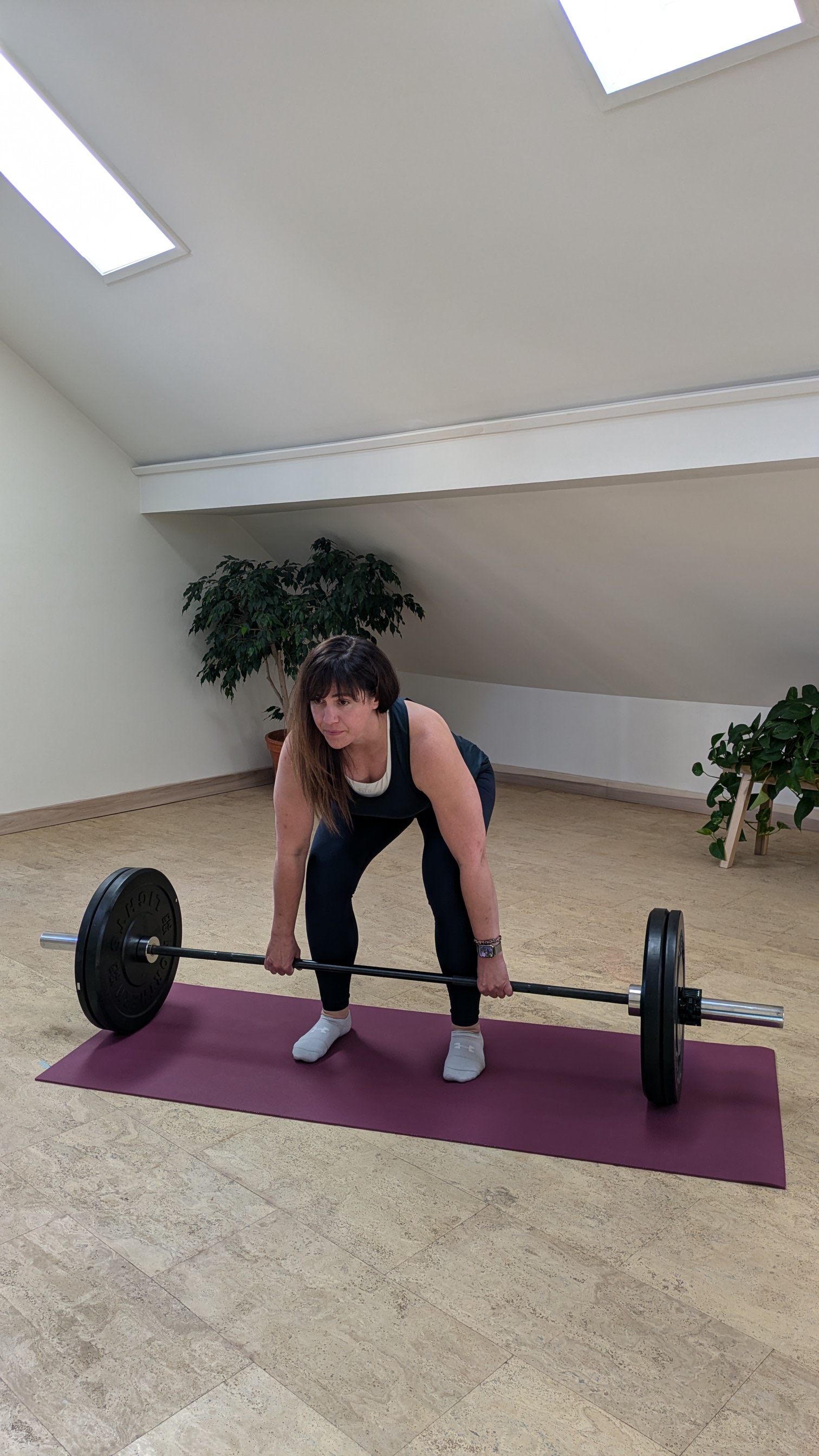
Let me illustrate with this quick real-life example. You may have noticed that Leena bought us a barbell; I couldn’t have been more excited or surprised! The day it arrived, she texted me with a photo and said “Christmas came early!” I was pumped.
Prior to the barbell arriving, our heaviest single weight was a 35 pound kettlebell — and while more experienced participants had long since built the confidence to use it, many newer students were of the mindset that it was just too heavy for them.
Imagine my delight when folks were stepping up to deadlift the bar which is 35 pounds on its own— plus 20 pounds (or more) with plates — on day one! The ‘bar’ to entry (pun intended) equaled the former heaviest weight in the room, and people were blowing right past their preconceived limitations on the first try.
So how do we go from getting started to lifting heavy? My suggestion is to begin with weights that feel do-able but challenging, and then increase the weight incrementally over time. When a given weight starts to feel too easy, bump it up by a little. You’ll get better at knowing when to do this with practice. Generally speaking, you’ll use relatively heavier weights for lower-body work (think large muscle groups) than you will for upper-body work (smaller muscle groups).
Remind yourself that building strength isn’t a sprint! And, to yield the bone-building benefits of strength work during mid-life (and beyond), we need to be lifting the heaviest weight possible that we can manage with control and confidence. You don’t have to start “lifting heavy” from day one but you do need to increase the loads you’re lifting systematically over time to get stronger (AKA progressive overload). Getting stronger leads to increased independence as we age, and allows us to do more of the things we want to do, with self-assurance, today.
The hard work of building strength is gratifying in itself but the benefits really seal the deal! And while everyone’s journey is unique, here are some of the quality-of-life enhancements that I’ve personally experienced through consistent training:
Better moods, energy, and an outlet for stress reduction
A sense of personal satisfaction from striving for – and achieving – performance goals
Socializing and good times with like-minded folks
Perimenopause symptom management (it’s not a fix-all but it helps me in a big way)
Increased muscle mass
I would love to hear if these ideas resonate with you and learn more about your foray into strength work — or, to hear what’s troubling you about getting started or keeping up with it. And if you want to join me for Strength Essentials, we’re lifting heavy every Monday and Thursday.
Cheering you on in your strength and/or perimenopause journey,
This is an abridged version of a speech that I (Emma) gave at my college residence earlier this month. I was asked by the dean of students to come and speak to students about attitudes and biases around bodies and how that coincides with my work at The Branches. Afterwards so many students came to talk with me about the content of my speech, to ask questions and to thank me for sharing this perspective. It was so heartening to chat with students about their passion for changing the narrative around body size and pushing back against fatphobia.
Hi. I’m here to talk about bodies.
I think about bodies a lot because I’m a yoga teacher. I teach people about how their bodies move, how their joints work, how moving their bodies in different ways might help them feel more settled or grounded, or more energized. I also think about the language that is used around bodies a lot because I do a lot of writing and marketing copy for The Branches.
At The Branches we are really committed to not replicating the narratives around bodies that are prevalent in wider popular culture. We’re really careful not to signal fatphobia, or invoke self hatred to sell yoga or embodiment practices. We don’t use weight loss as a motivator to come to yoga. We are not the norm. But it’s really important to us not to play into that cultural insecurity around body size. And I would even call it an intentionally manufactured cultural insecurity.
I think fatphobia or fear/hatred of fatness is very slowly becoming more obvious to us. To compare it to a different “ism”, racism, In 2020 after the murder of George Floyd and the surge of Black Lives Matters protests, it seemed like there was the start of a larger cultural awareness of systemic racism and other forms of racism. But I don’t think fatphobia has really had its moment yet, of realizing that it’s everywhere; its the water that we drink, its the air that we breathe. It’s still this shameful thing to be fat. We don’t say fat, we are uncomfortable saying that word. We wouldn’t describe someone as fat. Because that would be considered an insult. Hmm. What’s so bad or shameful about being fat?
As I continue talking about this I invite you to notice in your own bodies, how you feel every time that I say “fat”. And if you would feel that if I was using a different descriptive word like tall or short. Just notice what internal reactions come up when you hear the word “fat”. Is it uncomfortable? And Why?
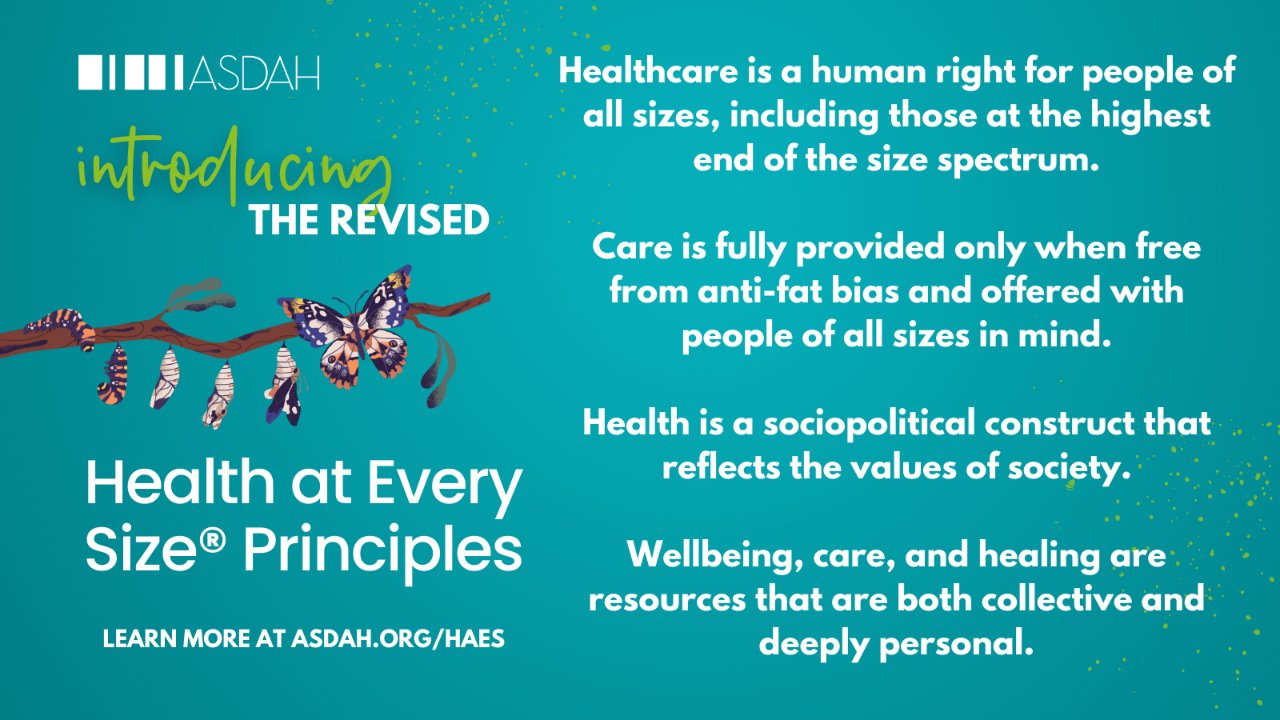
I think the number one assumption about fatness that leads to this discomfort or shame is that it indicates unhealthiness. Our culture and the medical industry in general look at weight as one of if not THE main indicator of health. However there a number of political movements and a growing body of research that pushes back against that assumption, one of which is a framework called Health At Every Size or HAES (pronounced hays) as well as ASDAH – the association for size diversity and health.
Take that name in for a moment – Health At Every Size. There is emerging evidence that health looks different on everyone. That even if we all ate the same diet and engaged in similar physical activity it is likely we would continue to look about as differently from each other as we do now. Health at Every Size. Your size does not indicate how healthy you are.
Perpetuating this assumption that fatness equals unhealthiness, has dire consequences for bigger people accessing quality healthcare. Research shows that fat people get treated differently by doctors, that their health concerns may be minimized or ignored, and that this can be compounded by other intersectional identities like racial identity, disability, gender. There is a movement within what is called fat activism to abolish the BMI, the Body Mass Index as a healthcare tool. The BMI was a statistical tool developed to measure weight and height across broad swaths of the population and was never meant to be an indicator of individual health. I’m going to say that again. (repeat) But guess who pressured doctors to use it as an individual health marker? The weight loss industry.
Someone that I look up to and respect so much and written a lot and thought a lot about bodies and culture is Sonya Renee Taylor and one question she asks in her book The Body is Not an Apology, is “Who is making money off of your self hatred?”. Who is invested LITERALLY in our culture being afraid or ashamed of their body size? The makers of Ozempic, their net worth is now more than $500 billion. The diet industry, the weight loss pill industry is a serious industry and it has its fingers in healthcare.
So this is the cultural soup in which I am trying to teach yoga and movement. I’m trying to reach people outside of these created biases around health and size, and invite people to connect with themselves amidst all of this.
So I’m here to talk about bodies but I’m also here to talk about culture change. The Branches is a yoga studio but it’s also a site of quiet rebellion against white supremacist, capitalist culture. Everything we do, in as many ways as we can we are working to disrupt that narrative. The narrative that creates a hierarchy of bodies that puts thin, white, able bodied, cisgendered, straight, rich, male on top and then ranks every other type of difference underneath that in descending order of worth.
We can do better than that.
At The Branches we call this aspect of our work “Body Positivity”. Body Positivity is a term with a history. Body Positivity was created by Fat, Black, queer women and femmes, and was intended as a political statement/practice for those whose bodies were the least accepted by the mainstream; racialized people, fat people, disabled people. In the mainstream Body Positivity exists somewhat but has kind of been watered-down to simplified ideas like “love the body you have”. It’s fine but a bit less political. But we think of Body Positivity as valuing and respecting all bodies.
This also doesn’t mean that you come to The Branches and we’re like TIME TO BE BODY POSITIVE. Don’t you hate to be told to be positive if you’re not feeling positive? So while our value is Body Positivity, celebrating and respecting all bodies, in practice, in the class it sounds like neutrality. It sounds like the yoga teacher using language that is incredibly neutral. That’s gender neutral. That’s ability neutral. That’s shape neutral. We’re really intentional that all of our teachers use language that offers different suggestions for ways of moving, ways of doing the pose that isn’t hierarchical. It’s not better to be flexible, it’s not better to be able to do the pose in the way it might look in a yoga magazine. We try to talk really neutrally, really frankly about getting into the poses and how you might need to change it a bit if your body is shaped this way or that way, and that neutrality allows people to have their own experience. Some days it might be positive. Some days it might be neutral or negative. But we’re attempting to give everybody a mental break from the hierarchy that’s often perpetuated in fitness or yoga spaces and allow people to just be.
One of the first ways we started shaping the culture of our studio in this way was in 2013. I took a training with an amazing teacher named Tiina Veer who created the term “Yoga for Round Bodies”. Tiina really opened my eyes to fatphobia, and how excluded so many people feel from yoga spaces. Soon after I started teaching a course called Yoga for Round Bodies. So many people came to that course and told me that they finally felt invited and welcomed into a yoga space because of that title. Because they knew that they wouldn’t be the only person of size in the class. One of them described the class “like a regular yoga class but with room for my boobs”.
And over the last ten years the overall demographic of our classes in terms of body size has really changed. And some of the people who originally started in that class went on to do our Yoga Teacher Training and now they teach that class and other classes. So not only is the student demographic in terms of body size changing; the teacher demographic of body size is changing. We have more fat yoga teachers. Yay. Representation matters.
About 8 years ago we also adopted a practice called “No Body Talk” among our teachers, desk staff and volunteers. All teachers and volunteers first do some training or learning about Health at Every Size, fat acceptance, and then everyone signs an agreement to work to eliminate any body-shaming, fat-shaming or weight loss and diet talk from conversation at the studio. We were already really intentional about language used by teachers in our classes, but we wanted to go further and hopefully have the whole experience of being at The Branches a break, a haven from that kind of conversation.
And now it’s been so long I sometimes don’t notice it anymore, until I’m in a context where I hear someone disparaging themselves or someone else for their size or shape. I feel surprised when I hear that now…that’s when I realize what a refuge The Branches has become for me and what that has given me space to focus on. What broader and more creative thoughts am I more able to have when I’m not preoccupied with how I look or trying to fit into that impossible hierarchy?
So these are some of the ways that we maintain that sense of being a haven, being a quietly radical space for people to come to and enjoy being in their bodies alongside others.
Even though I espouse this value of Body Positivity or Body Neutrality, something that I never say as a yoga teacher, is “love your body”. I’m not the first person to say this but it’s not really possible to love your body if the world hates your body. Whether that hatred is rooted in fatphobia, racism, ableism, transphobia, homophobia, sexism, all the isms, even healthism. It’s not possible to love your body in a world that hates your body so we need to do it together. We need to love and respect each other’s bodies.
I called my speech “Nurturing Cultures that Celebrate All Bodies”. I wanted to let you in on the intentional cultural practices that we’ve created over time because these are all replicable in different ways, in different contexts. Leena and I are kind of the hosts of the party that is The Branches – it’s a chill party, not a rager – and we set the stage for how that culture plays out. And it is my hope that you will be creative and intentional as you shape the cultures that you participate in. That you thoughtfully investigate your underlying assumptions about yourself or about people who are different from you and intentionally choose what kind of experience you want others to have, what kinds of values you want to embody. I hope you throw parties or run your clubs with clear intentions to uplift one another, to celebrate and respect one another. We need this in a world full of division. We need this type of small scale, homegrown intentionality, solidarity and unity.
My favourite thing about being pregnant is that it’s temporary. (It’s Leslie here, btw).
Ha! That tells you a lot about how it’s going! No, my real favourite thing about it is growing a family with the best person to ever become a dad (in my opinion). But seriously, I’m really ready to get the pregnancy part over with.
I was saying to a student the other day that I’d spent a good 38 years conditioning my body to do a handful of specific things (like hiking, yoga postures, rock climbing, and sittin’ around), none of which were being pregnant or giving birth. How radical it is to have to adapt to such a new and different demand at this point in life!
This need for radical adaptation feels like a Type 2 Gift (kind of like Type 2 Fun, the kind you enjoy after the fact). I might not entirely love this experience (does anyone love indigestion, restless legs, or a squished bladder?), but even if I never got a cute baby out of it, the upheaval offers valuable lessons that I can appreciate.
It’s humbling to go through physical (and mental and emotional) changes that you can’t control. We all have to do that as we age, and many of us have to do it in response to injury, illness and all sorts of other stuff we can’t predict or plan. I never planned on a pregnancy at “advanced maternal age,” yet here I am, compression leggings and Tums in hand. My yoga practice (and all the other activities I normally love) are dialed down (or are paused completely), and I’m reflecting daily on all the folks in our community, parents or not, who have navigated radical changes to their bodies and lives. Much respect and love to each of you.
Pregnancy has me asking myself old questions in a new light. When should I grip tighter and fight for something even though it’s hard? When should I let go, and surrender to forces stronger than me? How can I be present with all that each moment offers me, pleasant and unpleasant? What choice do any of us have but to try to adapt to the ebb and flow of our capacities? I’m lucky to feel supported enough to think of it this way. Making a mental note to remember this big talk when I’m in the middle of labour!😉
My last classes will be next week, starting August 26th. On my way out, thank you to: -the students in my classes tuning in to my words and their own bodies more keenly than ever as I’ve demonstrated less and less -the YTT grads teaming up with me to do those demonstrations when they can -the teachers taking over my classes: Wendy, Emma, Alissa and Leena -the admin team taking over my management work, including the return of Nicole DeNoble behind the scenes (she last joined us during Emma’s leave with baby Iris)
I’ll see you on the other side of the rollercoaster of labour and birth. Wish me luck!
Yours in embracing the unfathomable adventure of life, Leslie
I have read many essays and articles by climate activists with the message that to address the climate crisis, we must choose things that both have impact, and bring us joy. Because without joy, we will not be able to sustain our commitment to the crisis.
We need joy as an anchor for our commitment.
Gardens are a source of great joy for me. My own garden is a site of solace, a place to connect with the earth and notice the pace of growth. It is a place to practice nurturance and attention. When I step outside my door to colourful new blooms, or the graceful twining of a bean plant up a pole, I am infused with joy. It fulfills so many of the values that I hold; to live in more connection with the land, to contribute to a healthier ecosystem by feeding bird and bee populations, and to share beauty with others. I’m so grateful to greet the garden outside The Branches on my way to work, seeing the bulbs pop up in the spring, and the berry bushes and trees begin to bear fruit.
Leena worked hard on planting the front garden of The Branches with native plants and shrubs a few summers ago. I vaguely knew that native plants were “good for the environment” but I didn’t have a good grasp on the importance and impact of native plants until I attended an info night on native plants in my neighbourhood. And what I learned that night drastically changed my thinking (and my garden).
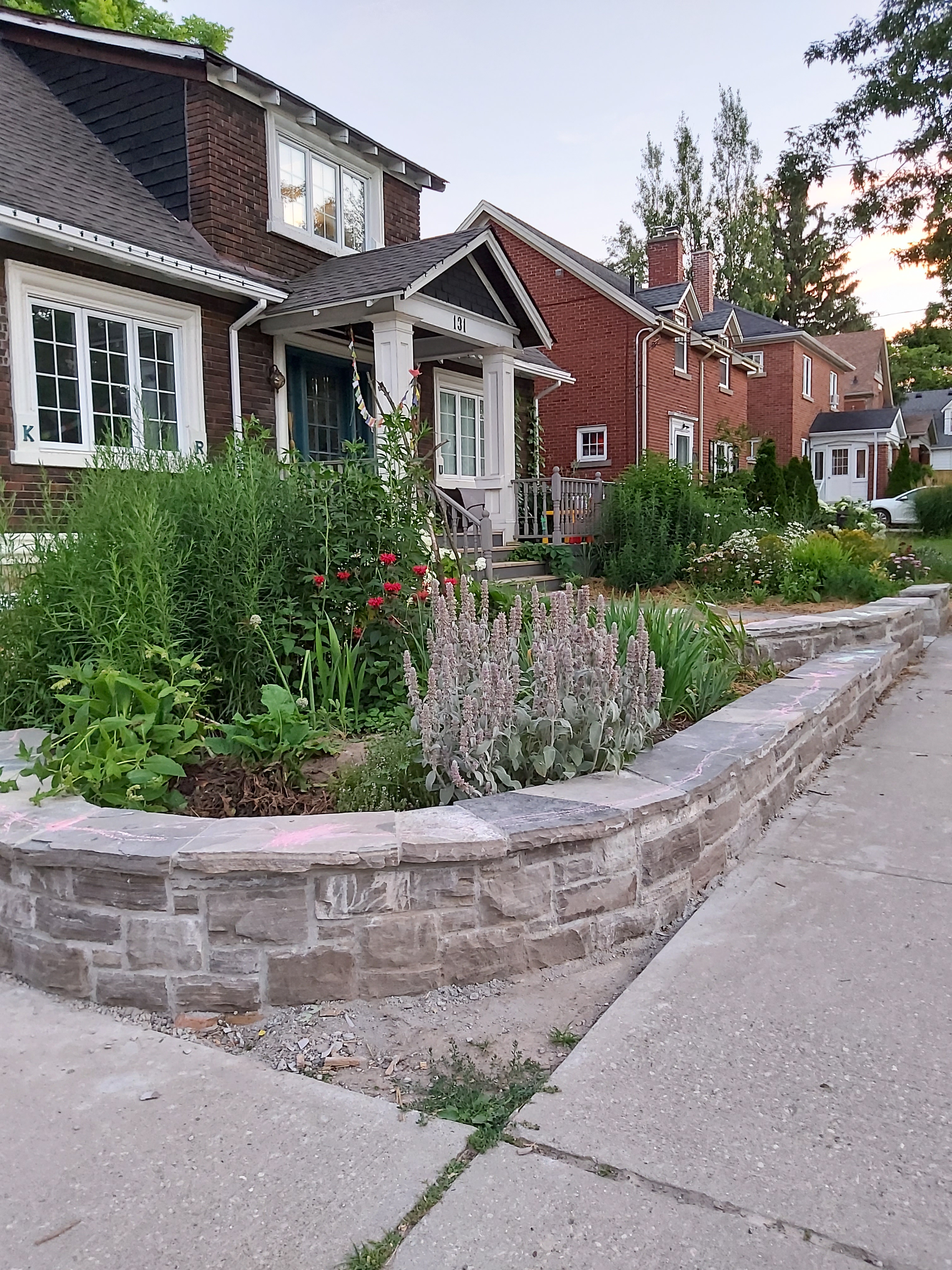
A mix of native and non-native plants
I had always thought that any sort of garden with flowers and trees could feed birds and butterflies and contribute to a healthier ecosystem. What I learned was that most of the ornamental flowers and trees that we commonly see in gardens are not nutritionally appropriate for this region’s animal and insect populations. Plants native to our bio-region (meaning that they co-evolved with the birds and insects in this area) have the best and in some cases only nutrition able to sustain certain species. There are certain butterflies and birds that are dying out because the plants they need to survive have been replaced either by grass lawns or by non-nutritive but popular flowers and shrubs.
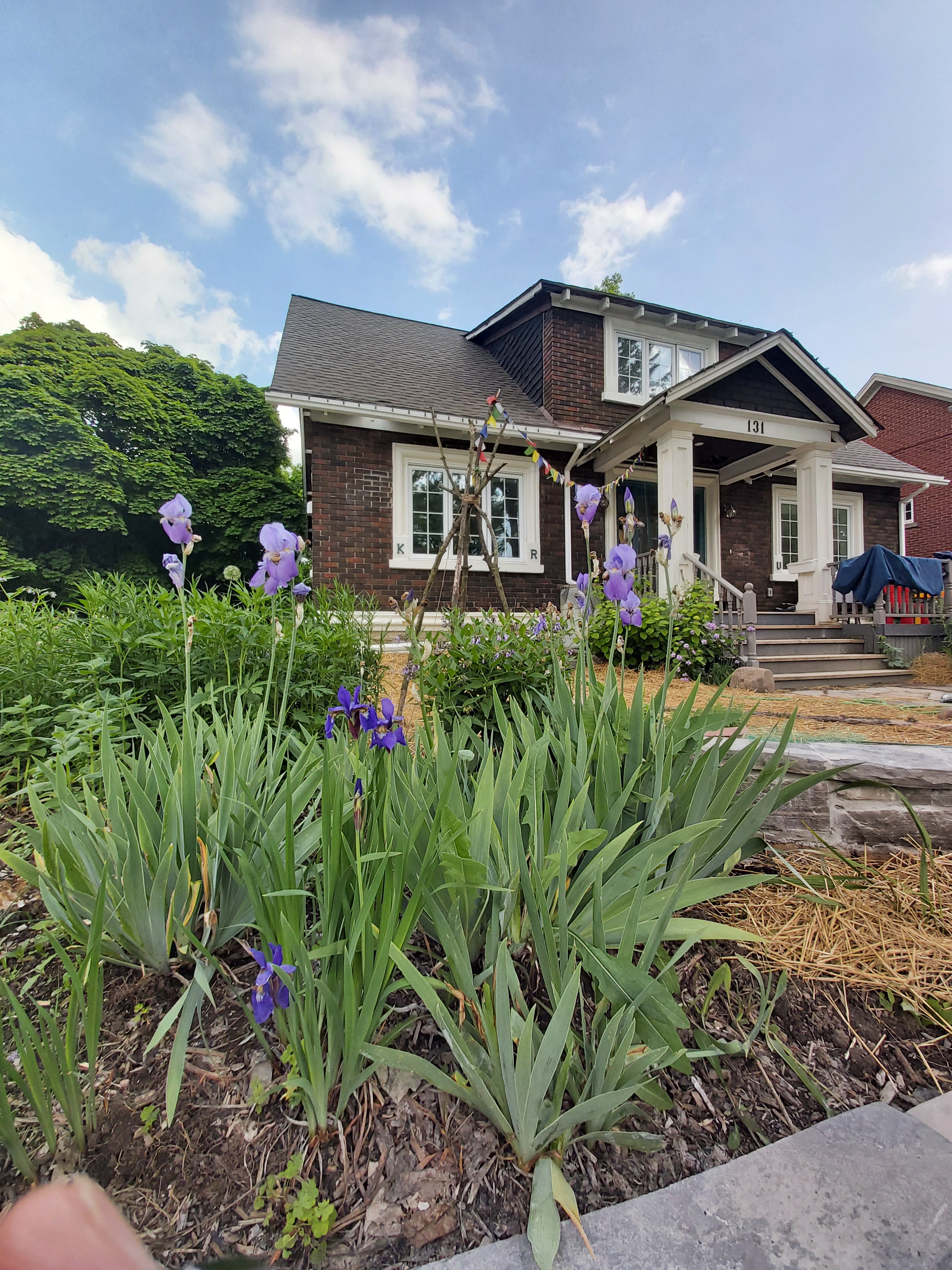
Non-native Irises out front of my house
I thought of the flowers in my garden and realized that while they were beautiful they were also nutritionally empty for the wider ecosystem.
The other important piece I learned that night was about how much land in the city of Kitchener-Waterloo is privately owned, and how much of that privately owned land has the potential to host native species. So much of the land (that is not paved by roads and driveways or occupied by buildings) is covered by grass, which gives zero nutrition to the wider ecosystem, and is also incredibly taxing on the ecosystem as it requires water to stay green. If even a small amount of that privately owned land was converted to native plants, shrubs and trees, it could greatly contribute to the resurgence of local fragile insect populations.
After the event, I marched home and looked at my garden. I looked at the grass on the boulevard, and the non-native perennials I had planted. I saw how much potential this small bit of land had, and I committed myself to converting as much of it as possible to native plants and shrubs.
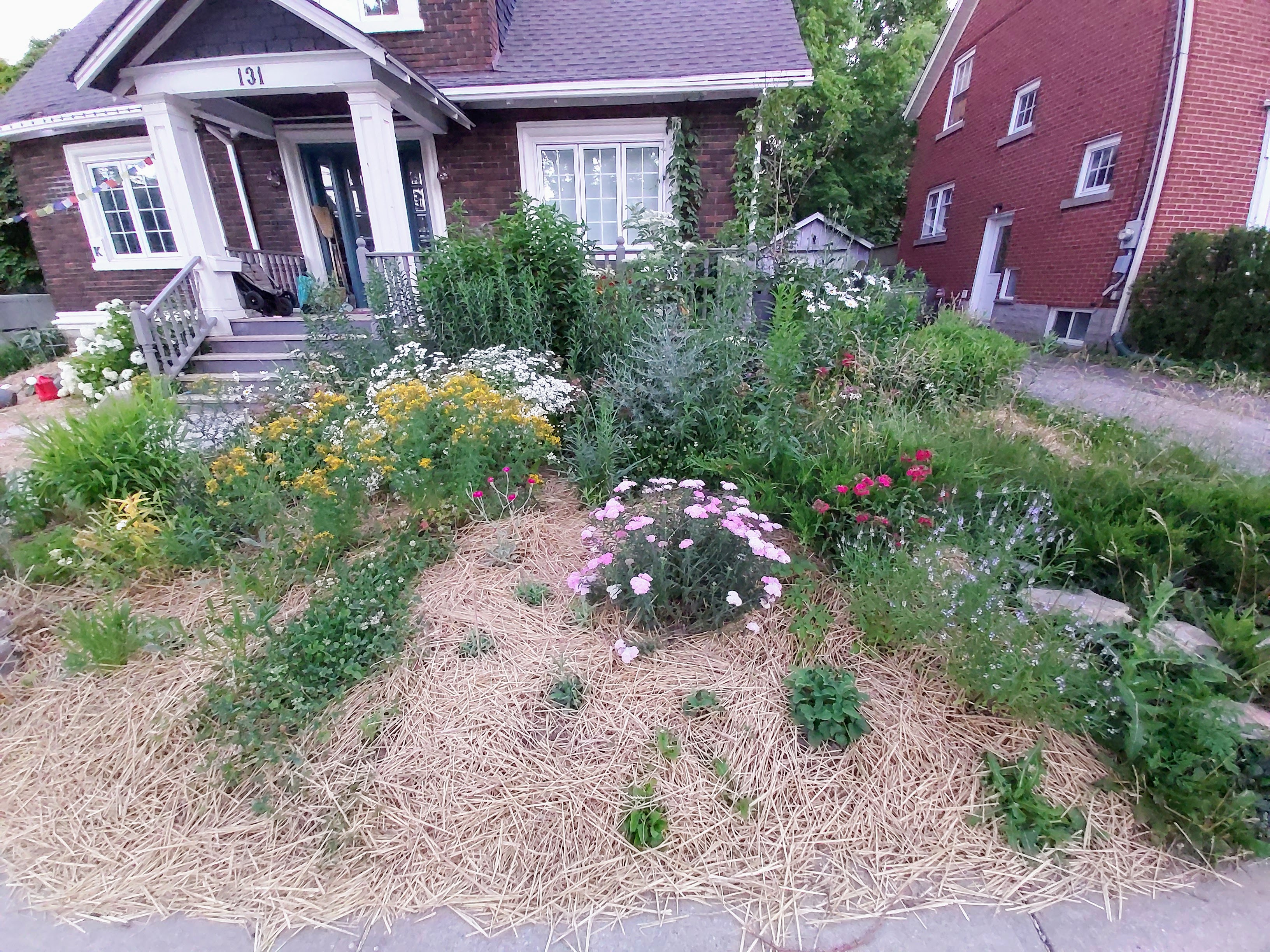
Many native plants in here, small but growing! Pearly everlasting, wild strawberry, narrow leaf vervain, lancelead coreopsis, feverfew, butterfly milkweed, liatris, aster
Tending to and enlarging the native plant population in my home garden is one small way that I am attending to the climate crisis. When I feel overwhelmed by the scale of the challenge, I am heartened to remember that nurturing gardens on privately owned land is actually a huge point of leverage in the ecosystem of a city. I also hold alongside that, an awareness of the privilege I have in owning land and the complicated and problematic nature of land ownership.
I am not satisfied with confining this commitment to my own garden. I am dreaming and scheming about how I might re-naturalize parts of the school yard where my son will start JK in September, or how I might get a grant to install native plants outside the Kitchener Public Library.
At The Branches, we are also dreaming about how we might spread more awareness about native plants to our community (this newsletter is one step), and get more native plants into the gardens of our members. Stay tuned for ways you can get involved in that next spring.

 The Branches