
barefoot bliss

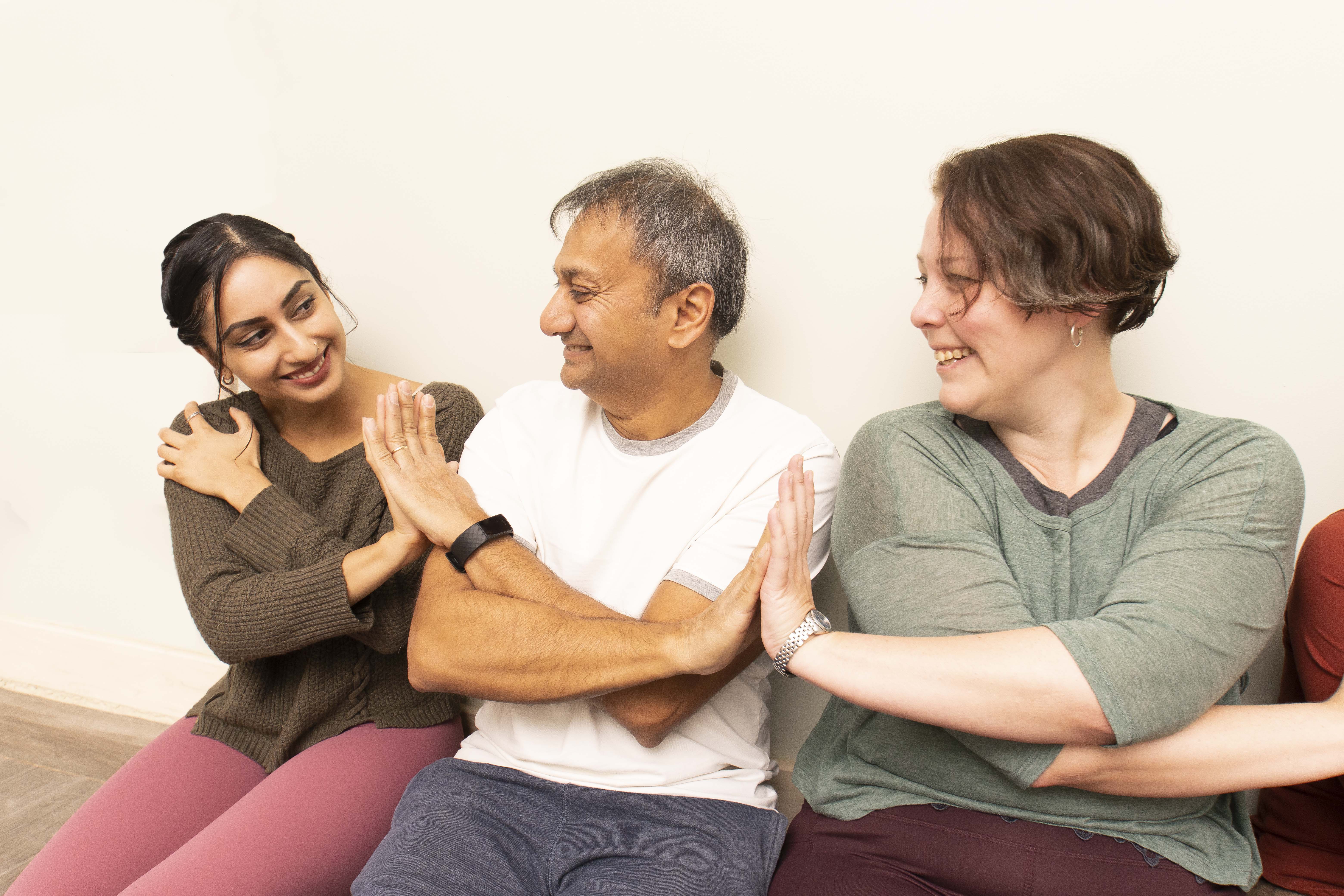
(This post comes to you from Wendy – pictured below on the right – Operations Manager, strength & yoga teacher, and resident-barefoot-shoe-enthusiast, at the Branches)


I have always loved to walk barefoot outside. I enjoy the tactile stimulation I feel when walking on different surfaces. I walk barefoot so I can feel the burn of hot pavement in the summer and the gentle sharpness of blades of grass; the cool squishiness of walking through the mud and the grittiness between my toes when walking in the sand. 

Barefoot shoes (also called minimal shoes) allow me a little bit of that sensory stimulation when I can’t (or shouldn’t) walk barefoot. It means I can still feel the bumpiness underneath the grass, the sharp pebbles at the edge of a dirt road. Does it hurt sometimes? Sure! I’ve landed on a few rocks while running that sent a few choice words streaming out of my mouth. But those experiences never made me want to switch back to the relative void of sensation I felt when walking in thick-soled shoes. 

I initially started wearing barefoot/minimal shoes because I was experiencing knee pain and trying to find a way to improve it. I had heard minimal shoes might help, so I decided to give them a try. However, as soon as I started walking in that first pair of barefoot sneakers, I no longer really cared if they cured my knee pain – it just felt so good to walk in them! 

Those shoes were the first pair of shoes that I didn’t have to ‘break in.’ My feet didn’t feel like they were being squished. I didn’t have to deal with the pain and irritation of blisters and calluses, in fact, I could actually wiggle my toes! Over time my knee pain did improve, but the reason I keep wearing barefoot shoes has more to do with the connectedness I felt with my body and the world around me. 

I used to have a nice pair of ‘technical’ hiking boots that I invested in because I thought they were what I needed to be able to hike ‘safely.’ Ironically, I’ve had fewer injuries since I switched to minimal hiking boots. My balance is better, and my feet and ankles are stronger now that they can move more freely. I can both feel and respond better to the changes in the ground beneath me. I can feel the curves and edges of rocks as I walk across them, and I can respond with more agility to those small changes in balance, bending my feet and ankles to ‘grip’ the rocks as I go. Thick soled shoes take a lot of that sensory information away, leaving me feeling like I’m teetering while trying to balance on rocks, and stumbling as my foot leans too far off an edge it can’t feel. There’s a disconnect between what’s happening underneath me and what my body is doing in traditional hiking boots. That connectedness means I’m actually more confident hiking in minimal shoes because I slip and fall less often. 

The connectedness to my body and the world around me is what has ultimately made me a barefoot shoe convert, and now, something of a proselytizer! I want everyone to experience the gentle invigoration of walking with more sensation and agility. Switching to barefoot shoes is something of a process – for most people a good amount of preparation is needed to build up the foot and ankle strength needed to enjoy wearing minimal shoes. If you’re interested in the (eventual) hedonism of barefoot shoes, start your journey with me at my Free Your Feet workshop, a staple offering that we host every year or two at the Branches.

Looking forward to walking in the mud sometime soon,
Wendy
let’s talk about perimenopause and heavy lifting

(A note from Branches’ teacher, Nicole, a perimenopausal gal who is passionate about the benefits of progressive overload!)


If you’ve been online lately, and especially if you’re perimenopausal, you may have noticed that menopause(!) is having a moment. As a perimenopausal woman who didn’t even know this was a thing until a few years ago, I’m relieved that this topic is finally being discussed in public forums. I’m also frustrated that it has taken as long as it has to reach the mainstream, considering about half the population will experience this life-altering transition.

If you haven’t been following the “meno-sphere,” I’ll briefly catch you up! One of the hottest topics at the moment is strength training, and specifically lifting heavy. This is essential for perimenopausal and postmenopausal people to build or maintain muscle mass and especially bone mineral density. The conversation around what exactly constitutes lifting heavy has exploded online as this can, understandably, be a point of confusion.

I love this conversation because strength work is my lane. I created and developed the Strength Essentials class over the last few years at The Branches. I’ve gotten super-passionate about both strength training and self-advocacy in my perimenopausal journey, and I find myself at the intersection where one pursuit (strength training) can help me through the other (perimenopause). Here are a few things that I think are important to think about when considering what lifting heavy means. 

1. Using weights that feel hard, doesn’t necessarily equate to lifting heavy. Rather, lifting heavy falls into a category of near-maximal effort. For example, if you build up to using weight that you can lift for a maximum of 5 repetitions (or fewer!) and no more, you are working in the heavy zone! (And just to be extra clear, you don’t have to lift in the heavy zone for every single set – or even as part of every workout –  to make progress.)  

The next one is less technical but something to really contemplate and consider. Which is…

2. You are stronger than you think.

Not only have I learned this to be true about myself, but I’ve become more aware of how pervasive it is for people — especially women — to underestimate their physical capabilities.

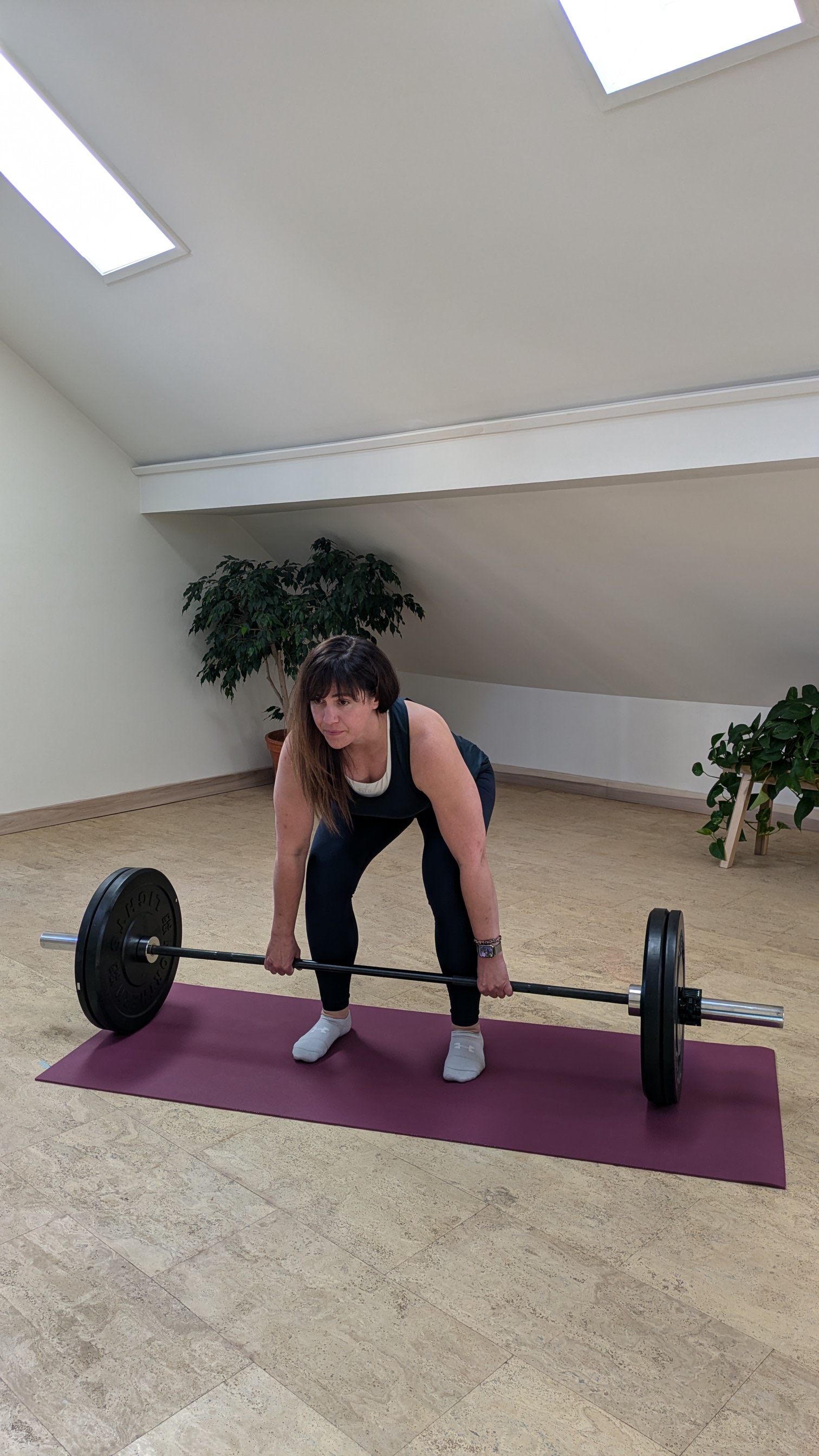
Let me illustrate with this quick real-life example. You may have noticed that Leena bought us a barbell; I couldn’t have been more excited or surprised! The day it arrived, she texted me with a photo and said “Christmas came early!” I was pumped

Prior to the barbell arriving, our heaviest single weight was a 35 pound kettlebell — and while more experienced participants had long since built the confidence to use it, many newer students were of the mindset that it was just too heavy for them. 

Imagine my delight when folks were stepping up to deadlift the bar which is 35 pounds on its own— plus 20 pounds (or more) with plates — on day one! The ‘bar’ to entry (pun intended) equaled the former heaviest weight in the room, and people were blowing right past their preconceived limitations on the first try. 

So how do we go from getting started to lifting heavy? My suggestion is to begin with weights that feel do-able but challenging, and then increase the weight incrementally over time. When a given weight starts to feel too easy, bump it up by a little. You’ll get better at knowing when to do this with practice. Generally speaking, you’ll use relatively heavier weights for lower-body work (think large muscle groups) than you will for upper-body work (smaller muscle groups).

Remind yourself that building strength isn’t a sprint! And, to yield the bone-building benefits of strength work during mid-life (and beyond), we need to be lifting the heaviest weight possible that we can manage with control and confidence. You don’t have to start “lifting heavy” from day one but you do need to increase the loads you’re lifting systematically over time to get stronger (AKA progressive overload). Getting stronger leads to increased independence as we age, and allows us to do more of the things we want to do, with self-assurance, today. 

The hard work of building strength is gratifying in itself but the benefits really seal the deal! And while everyone’s journey is unique, here are some of the quality-of-life enhancements that I’ve personally experienced through consistent training: 

  • Better moods, energy, and an outlet for stress reduction
  • A sense of personal satisfaction from striving for –  and achieving – performance goals
  • Socializing and good times with like-minded folks 
  • Perimenopause symptom management (it’s not a fix-all but it helps me in a big way)
  • Increased muscle mass 

I would love to hear if these ideas resonate with you and learn more about your foray into strength work — or, to hear what’s troubling you about getting started or keeping up with it. And if you want to join me for Strength Essentials, we’re lifting heavy every Monday and Thursday. 

Cheering you on in your strength and/or perimenopause journey,

Nicole 

Competing with grandmas?

Leslie here.

You know that feeling when the reality of your limitations hits you smack across the face? When presented with a new challenge you can’t overcome (yet, or ever), I call that getting humbled. Getting humbled can offer us a lesson in acceptance and equanimity, and it can also motivate us to try harder.

When we stack up against others, sometimes we are humbled by our peers, or by those who retain the gifts of their youth, and sometimes… we get humbled by our elders.

And when I was the ripe young age of 22, an entire society of grandmas humbled me with nothing less than their commendable squat form.

I was living in South Korea, testing my teaching ambitions in an English-immersion kindergarten. Not only could my 5 year-old students drop down into and hang out in easeful and cozy squats like their little toddler siblings, but so could their parents, and even their grandparents.

Ajummas – Korean grandmas – could be found casually squatting to rest, socialize, gather herbs, connect with their grandkids, do house chores, and simply move in response to their own desires and demands of daily life.

As someone with aspirations towards physical health and freedom of movement, I was both mystified by my own incapacity to squat as well as they could, and motivated to get on their level. 

There is some evidence showing that the typical bone structure of folks of East Asian descent supports the deep joint positions required for a squat. This fact, combined with not having grown up in a squat-normative culture, makes me unsure that I’ll ever quite match their ease, but that hasn’t stopped me from trying! Now at 38, my squat is more comfortable and closer to a resting position than ever.

Part of what makes squatting doable is hip mobility. My days as a foreign English teacher in Korea were formative in many ways, but one is that I will never take hip mobility for granted again – it really is a use-it-or-lose-it game. 

To that end, if your hips are feeling stiff and sore, or you realize that your hips don’t move as well as you’d like them to, I highly recommend our series Hip Mobility May. It’s got all my best ideas on how to directly improve your experience of your hip joints – both the feeling and the function.

Try it! And I’ll see you in a squat sometime soon 🙂 

Hip Mobility May can be found inside Branches On Demand, our streaming service. You can join for FREE for your first 7 days, then it’s $25/month after that, with no minimum commitment. All the content from Hip Mobility May will be live from May 1 – June 15. Each month, BOD subscribers get access to a new series. Check it out!