
This post was written by Kimberley Luu, who is offering a Trauma-Informed Yoga Nidra Teacher Training through The Branches, starting in January 2026.
Years ago, I committed myself to yoga nidra practice. I had a vision that if I
kept training, I’d eventually never have to deal with this pesky condition
called insomnia again. I thought I would be able to enter conscious, deep
sleep with the snap of my fingers and live vibrantly off less hours of sleep. I
imagined mastering relaxation, but only for the covert purpose of being
“productive”; never missing a day of work due to burnout again.
Today, it’s amusing to reflect on the naivety of these dreams. Indeed, I was
a little off… yet, I feel no inkling of disappointment or regret. I’m no Swami
Rama (the renunciate who shocked scientists with his superhuman rest
abilities), but I did end up learning a lot of other valuable lessons.
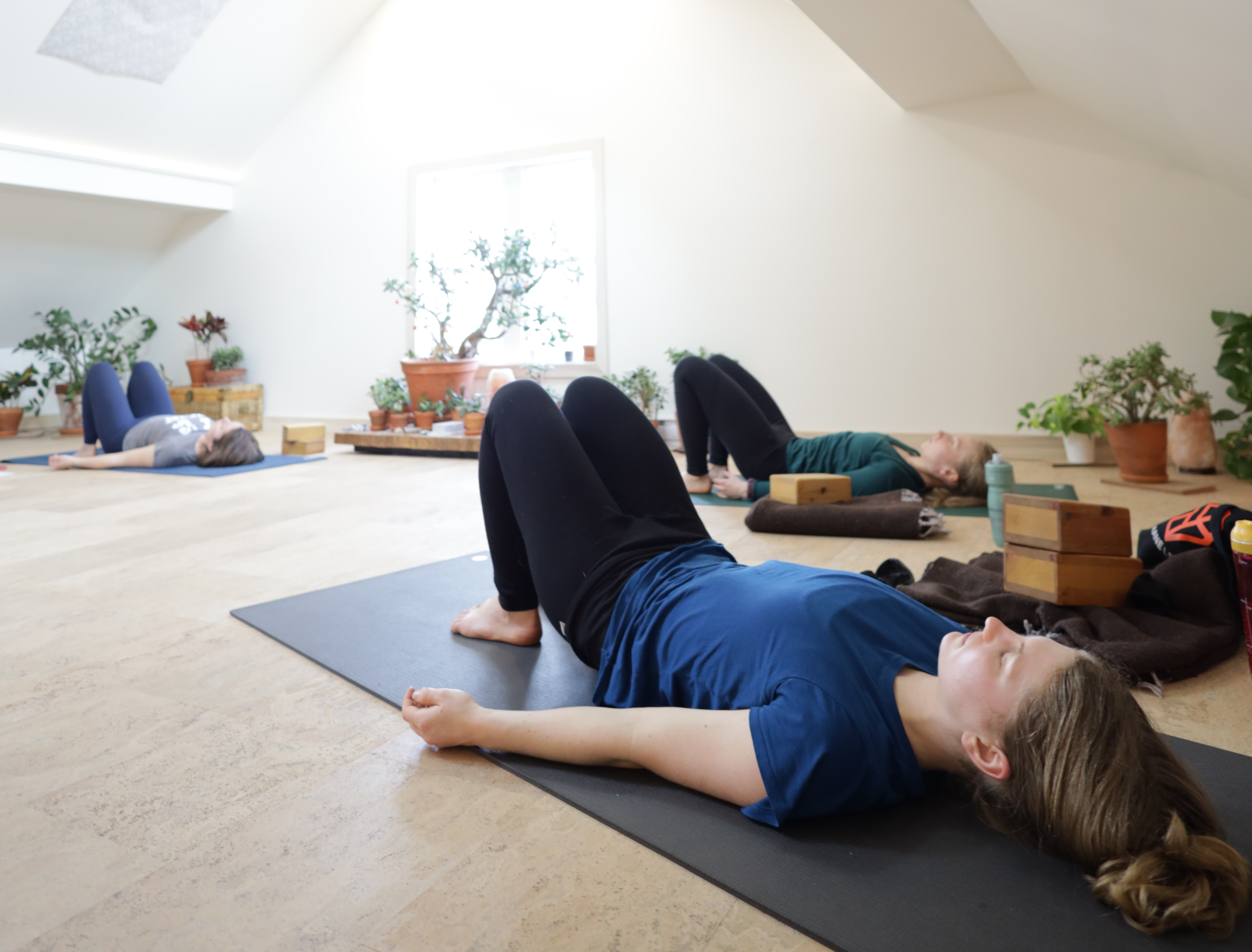
- Losing consciousness is not a good measure of sleep quality.
You can be wide awake and deeply resting. You can also be fast asleep and spiraling in restlessness.
This is one of the first statements that Swami Satyananda makes in his foundational book, yet, learning this first hand is something that has taken a huge burden off my shoulders. Regular sleep is important, but I’m no longer as concerned about being completely unconscious for the entire night.
For instance, if I’m anxious and wide awake for my last couple sleep
cycles, I engage in a yoga nidra technique which involves broadening awareness, softening the mental grips around thoughts, and letting them unfold in a larger container of acceptance and kindness.
Same goes for naps—I just lie down, close my eyes, and broaden
awareness. It doesn’t matter if I fully clock out. I know in my heart that this is still quality rest. - Experiencing insomnia once in a while is normal and okay.
During my initial stages of chronic-insomnia recovery, I still felt on edge about its potential return. Even one night of sleeplessness would spike my fears of relapse. But with yoga nidra training embodied, I am now confident that I have the tools to come back to balance, even if I have a bad night or two. I know I’ll be tired for a bit, but that’s okay. I’ve grown greater acceptance that experiencing some insomnia is just a part of being human, and it’s unrealistic to expect otherwise. Life happens, situations happen—stressful ones, and even exciting ones, like the night before my wedding day, when I didn’t sleep a wink! 😉 - Attachment to “perfect relaxation” only breeds suffering.
Although my initial goals involved “mastering” relaxation, I slowly dropped this when it became clear that this was only creating tension in my body. What I’ve realized is more important than constant relaxation is the cultivation of spacious awareness. Rather than suppressing our stressful experiences, yoga nidra trains us to embrace all arising perceptions in a broader mental container. We allow all experiences to be as they are—whether that experience is bliss or a stormy mess. This shift in orientation is what’s truly healing and liberating. So, I’m no longer attached to the experience of relaxation as much as I was before. It’s as fleeting as the wind, but spacious awareness is always here. - Better than yoga nidra’s benefit of “productivity” is its ability to
reveal what matters most.
Yes, yoga nidra can make you productive in the sense of giving you the capacity to do more: it mitigates stress and anxiety, enhances alertness, and refreshes cognitive resources. However, more valuable is its ability to gently reveal what is truly meaningful. By slowly peeling away the layers of conditioning (which are
often under the influence of modern hustle culture), we come into greater connection with our life purpose(s) and guiding core values.
Through this process, we may find ourselves gradually shifting from the endless race to the top, towards intentional work that supports what genuinely matters to us. - Practice doesn’t grow more complex over time… it gets
unbelievably simple.
One of the aspects of yoga nidra practice that I initially found so helpful was that it provided structured steps on how to chill. This was much more effective than receiving the classically unhelpful advice: “just relax!” My mind craved constant activity, and yoga nidra told me precisely what to focus on, offering various techniques that kept me engaged until it ushered me into deep, conscious rest.
Yet, as I’ve grown more familiar with this state, it has become increasingly easier to visit again, without having to take so many steps. While it’s still great to be able to lean on those steps whenever I need them, most of the time now I enjoy a simplified practice: resting in my heart space, broadening awareness, and surrendering to what is.
.
Want to explore a deeper relationship with yoga nidra and maybe
even share it with others? Kimberley’s Trauma-informed Yoga Nidra Teacher Training begins with a 6-week Deep Dive course, which provides a supportive container for long-term personal practice. This is followed by 2 facilitator training weekends, which will equip you with all the tools you’ll need to confidently share yoga nidra from the heart.

 The Branches