Jen Helmuth (she/her) is a grad of our 2024 250-hour YTT program. She is a psychotherapist and yoga teacher currently teaching a yoga course for teen mental health with The Branches.
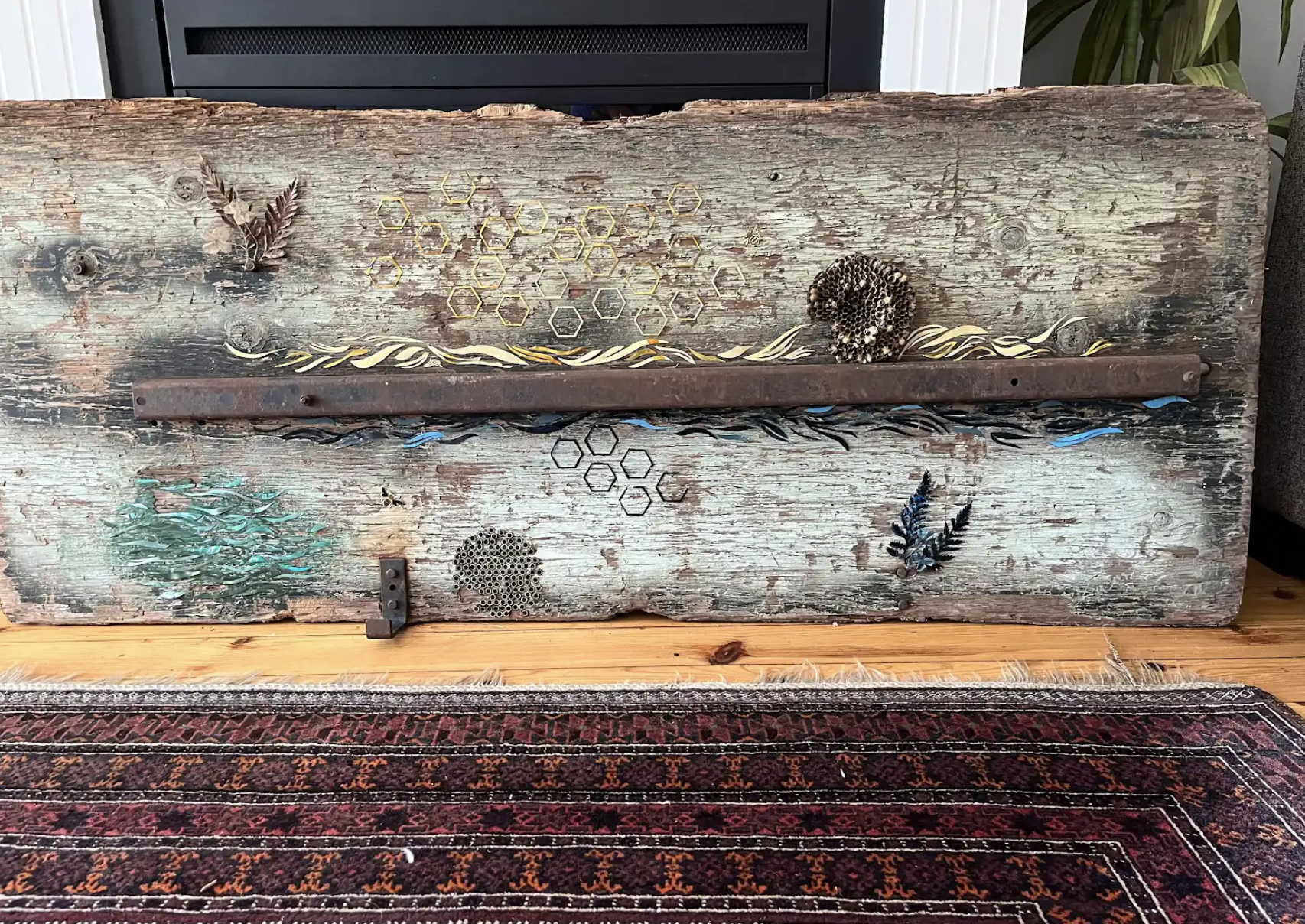
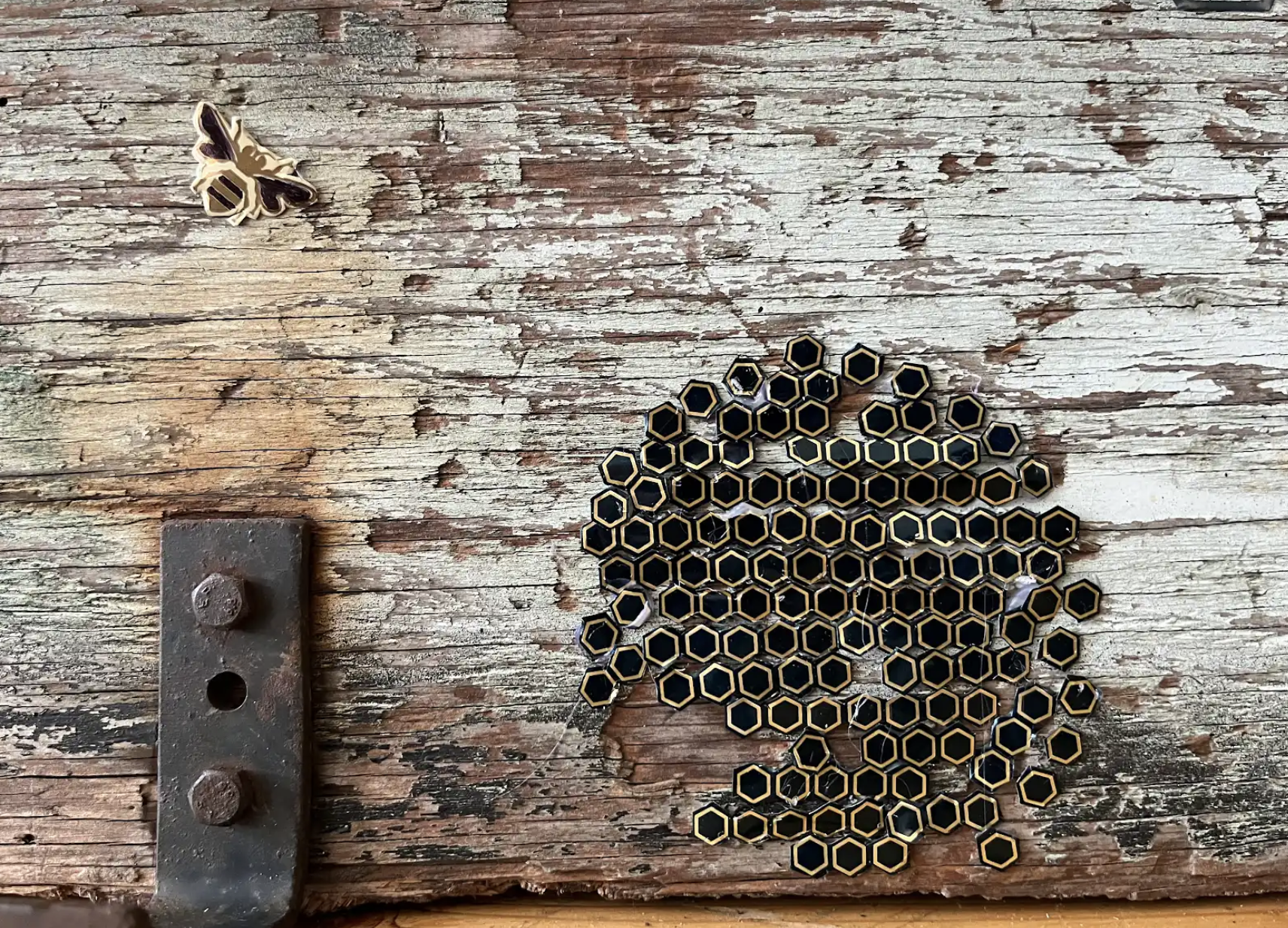
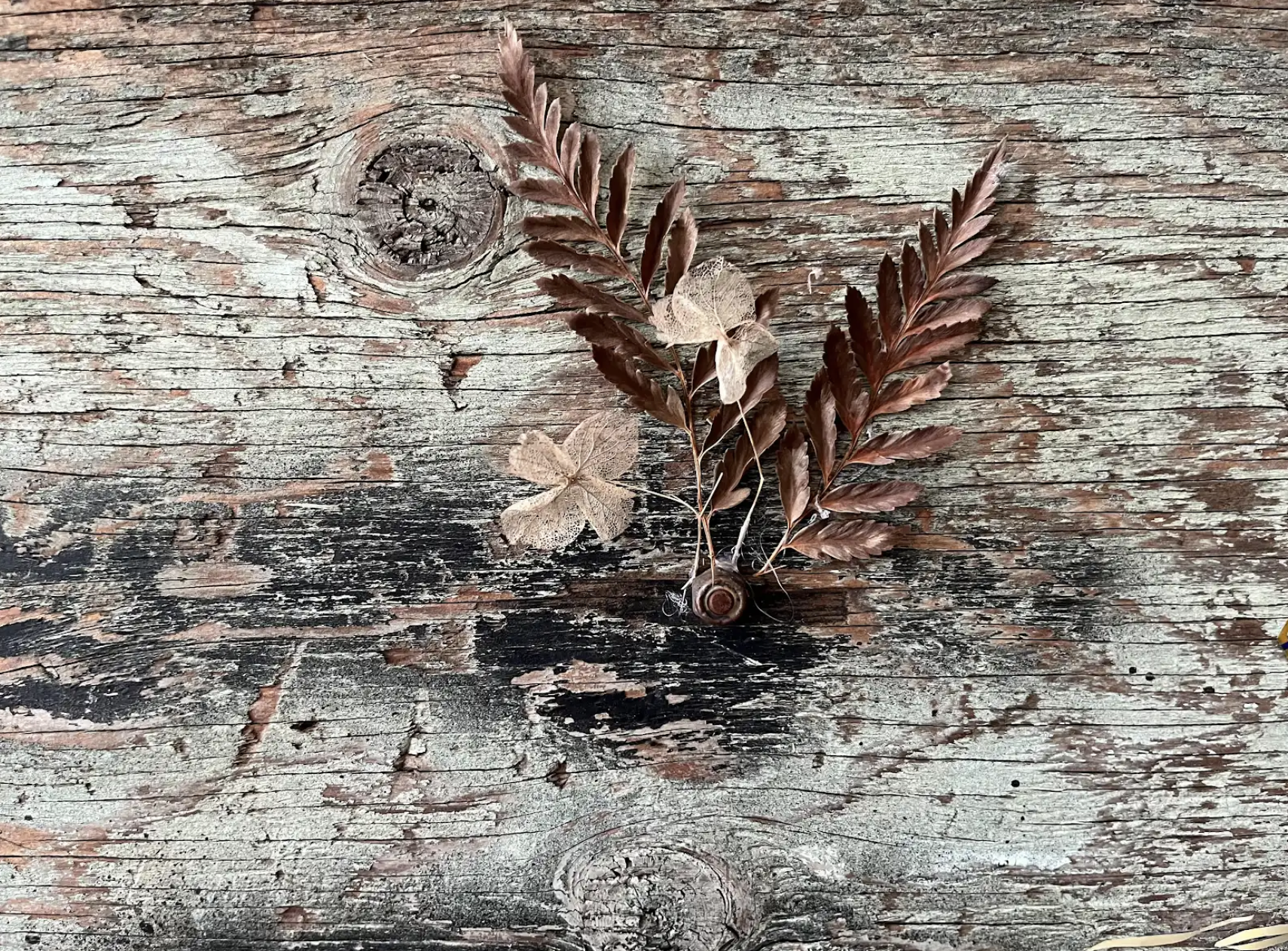
I’m sitting on the couch staring down my most recent piece of art. I’m not sure how I feel about it. This piece gradually came together over the course of my recent Yoga Teacher Training. The “canvas” is an old weathered piece of wood that had been used as a tailgate on a truck. I found it propped up on the side of the road. It has a long metal bar across the middle that divides it in half. I’ve worked in my signature embellishments using cut up beer cans and adding natural objects I find on my walks.
When I saw the tailgate, I loved the character of the wood and the metal bar through the middle. I knew I wanted to explore the theme of dualism: top and bottom, before and after, organic and inorganic, yin and yang. I wanted to play with the complementary forces we see and experience in life all around us. This theme shows up in yoga as the play between effort and ease, leading and following, doing and being.
I also wanted to play with the idea of art imitating nature, like many yoga poses do. I love how we get into shapes called downward dog, cat and cow, pigeon, fish and eagle, to name a few. I like to imagine early yoga practitioners mimicking the shapes and movements of what they observed in the world around them. I think about taking on the energy of these creatures as we embody their forms, like the confident roar in lion’s pose, complete with the funny face and forceful breath.
As I started creating my artwork on this tailgate, I followed the elements of the wood: the grain, the knotholes and other characteristics. Using the metal bar that divides the piece in half horizontally, I made the top half to represent the “source” such as nature, ideals, and teachers – the things that inspire us, the things we want to emulate. Below the metal bar would be the “imitation” and exploration of approximating what’s on top while still working with the character of the wood.
And now, as I sit here staring at it from across the room, I think: “It’s still not quite done”. This is the third time I’ve brought the piece out of my studio and placed it across from my couch so I can study it upright from a distance. Each time I bring it out of the studio I’m sure it’s done; and each time I look at it from the couch, it doesn’t look finished. This confounds me. With most of my art, I know when it’s done. And now I’m sitting here wanting to fix it again. I’m focussing my attention on the places where the bottom half is not fully representing the ideal of the top half. It really needs some more swooshes here, and a few over there – and also more honeycombs.
Do I really need to take it back to the studio again? I’ve done enough art to know that the process is as much of a teacher as the end result. As I stare at it, willing the art to reveal it’s message to me, I realize that I’m exclusively focussed on the “imitation” half. This is what I keep tweaking on every return to the studio. It’s not up to snuff. It doesn’t properly reflect the grandiosity of the “original” on top that it’s trying to mirror. And I’m not satisfied. I want to keep adjusting, improving, approximating. The imitation can do better. If it doesn’t look close enough to the original, then the theme of “imitation” will be lost.
That’s when it dawns on me, and a few lessons come hurtling at me across the room from this piece of art. The imitation will never look like the original – and that’s OK, in fact, that’s the point! You have to work with the character of the wood and the different materials and structure, so of course it won’t look the same. The point in imitation is the exploration of what it might feel like to embody a different shape, being, or energy for a brief time.
I also realize another lesson is that it is not helpful to focus on what’s wrong with the imitation. Where your focus goes your energy flows. This is a constant theme in my life: wanting to tinker until perfection is achieved. It’s why I’ve taken this piece back to my studio several times for a few more tweaks. This piece is trying to teach me with it’s refusal to look pleasingly finished to my eye. Can I let go of the effort of adjusting and find ease in allowing this lesson to seep into my being?
And furthermore, the space on the bottom half that I think is incomplete might actually represent potential. Opportunity. It might suggest value in the yearning to keep imitating; to appreciate the sense that something is not yet finished. Maybe another lesson for me from this piece of art is to find the complementary force of “finished”. This art is “ongoing”. It leaves room for change, for evolution, for more to come. And by not feeling “complete” it lights a desire to keep imagining what could be.
Imitation is about the process of embodying the essence of something – whether it is an animal, an element, an idea or a shape the teacher is demonstrating. The point is not to shed your own self to become something else. In fact, the point might even be to notice things around you worth imitating and imagining inhabiting their shape or energy for a breath or two. The practice of imitating is how we learn to work with the materials we’ve got and to find new ways of expressing our unique qualities in ways we might not have imagined had it not been for watching our dog stretch in the morning. The imitation will be beautiful when we are respectfully working with the materials we have, rather than trying to hide those characteristics to become something else.
This is a big shift and learning for me during this yoga teacher training. The goal is not to practice until you can touch your toes or balance in crow pose or to precisely match the yoga textbook pictures. The value of practicing yoga is the yearning to feel on the inside what you are trying to approximate on the outside – over and over again. The gap between the original and the imitation is a space of potential, imagination and learning. And regardless of whether your pose is a perfectly finished imitation on the outside, the process has the opportunity to be rewarding and feel satisfactory on the inside. Just like this “ongoing” piece of art sitting across from me in my living room.

 The Branches