
(A note from Branches’ teacher, Nicole, a perimenopausal gal who is passionate about the benefits of progressive overload!)
If you’ve been online lately, and especially if you’re perimenopausal, you may have noticed that menopause(!) is having a moment. As a perimenopausal woman who didn’t even know this was a thing until a few years ago, I’m relieved that this topic is finally being discussed in public forums. I’m also frustrated that it has taken as long as it has to reach the mainstream, considering about half the population will experience this life-altering transition.
If you haven’t been following the “meno-sphere,” I’ll briefly catch you up! One of the hottest topics at the moment is strength training, and specifically lifting heavy. This is essential for perimenopausal and postmenopausal people to build or maintain muscle mass and especially bone mineral density. The conversation around what exactly constitutes lifting heavy has exploded online as this can, understandably, be a point of confusion.
I love this conversation because strength work is my lane. I created and developed the Strength Essentials class over the last few years at The Branches. I’ve gotten super-passionate about both strength training and self-advocacy in my perimenopausal journey, and I find myself at the intersection where one pursuit (strength training) can help me through the other (perimenopause). Here are a few things that I think are important to think about when considering what lifting heavy means.
1. Using weights that feel hard, doesn’t necessarily equate to lifting heavy. Rather, lifting heavy falls into a category of near-maximal effort. For example, if you build up to using weight that you can lift for a maximum of 5 repetitions (or fewer!) and no more, you are working in the heavy zone! (And just to be extra clear, you don’t have to lift in the heavy zone for every single set – or even as part of every workout – to make progress.)
The next one is less technical but something to really contemplate and consider. Which is…
2. You are stronger than you think.
Not only have I learned this to be true about myself, but I’ve become more aware of how pervasive it is for people — especially women — to underestimate their physical capabilities.
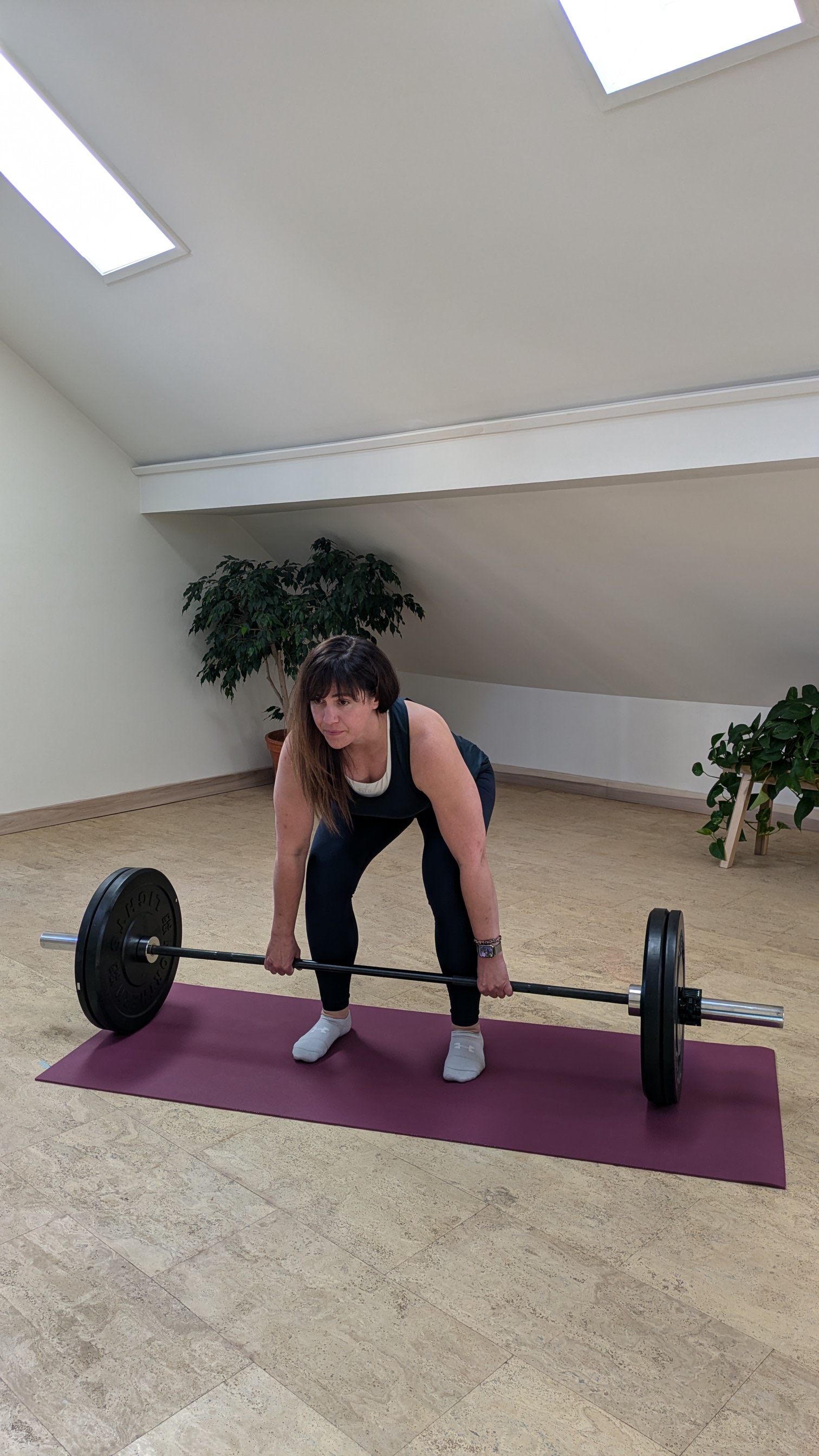
Let me illustrate with this quick real-life example. You may have noticed that Leena bought us a barbell; I couldn’t have been more excited or surprised! The day it arrived, she texted me with a photo and said “Christmas came early!” I was pumped.
Prior to the barbell arriving, our heaviest single weight was a 35 pound kettlebell — and while more experienced participants had long since built the confidence to use it, many newer students were of the mindset that it was just too heavy for them.
Imagine my delight when folks were stepping up to deadlift the bar which is 35 pounds on its own— plus 20 pounds (or more) with plates — on day one! The ‘bar’ to entry (pun intended) equaled the former heaviest weight in the room, and people were blowing right past their preconceived limitations on the first try.
So how do we go from getting started to lifting heavy? My suggestion is to begin with weights that feel do-able but challenging, and then increase the weight incrementally over time. When a given weight starts to feel too easy, bump it up by a little. You’ll get better at knowing when to do this with practice. Generally speaking, you’ll use relatively heavier weights for lower-body work (think large muscle groups) than you will for upper-body work (smaller muscle groups).
Remind yourself that building strength isn’t a sprint! And, to yield the bone-building benefits of strength work during mid-life (and beyond), we need to be lifting the heaviest weight possible that we can manage with control and confidence. You don’t have to start “lifting heavy” from day one but you do need to increase the loads you’re lifting systematically over time to get stronger (AKA progressive overload). Getting stronger leads to increased independence as we age, and allows us to do more of the things we want to do, with self-assurance, today.
The hard work of building strength is gratifying in itself but the benefits really seal the deal! And while everyone’s journey is unique, here are some of the quality-of-life enhancements that I’ve personally experienced through consistent training:
- Better moods, energy, and an outlet for stress reduction
- A sense of personal satisfaction from striving for – and achieving – performance goals
- Socializing and good times with like-minded folks
- Perimenopause symptom management (it’s not a fix-all but it helps me in a big way)
- Increased muscle mass
I would love to hear if these ideas resonate with you and learn more about your foray into strength work — or, to hear what’s troubling you about getting started or keeping up with it. And if you want to join me for Strength Essentials, we’re lifting heavy every Monday and Thursday.
Cheering you on in your strength and/or perimenopause journey,
Nicole

 The Branches