
This is an abridged version of a speech that I (Emma) gave at my college residence earlier this month. I was asked by the dean of students to come and speak to students about attitudes and biases around bodies and how that coincides with my work at The Branches. Afterwards so many students came to talk with me about the content of my speech, to ask questions and to thank me for sharing this perspective. It was so heartening to chat with students about their passion for changing the narrative around body size and pushing back against fatphobia.
Hi. I’m here to talk about bodies.
I think about bodies a lot because I’m a yoga teacher. I teach people about how their bodies move, how their joints work, how moving their bodies in different ways might help them feel more settled or grounded, or more energized. I also think about the language that is used around bodies a lot because I do a lot of writing and marketing copy for The Branches.

At The Branches we are really committed to not replicating the narratives around bodies that are prevalent in wider popular culture. We’re really careful not to signal fatphobia, or invoke self hatred to sell yoga or embodiment practices. We don’t use weight loss as a motivator to come to yoga. We are not the norm. But it’s really important to us not to play into that cultural insecurity around body size. And I would even call it an intentionally manufactured cultural insecurity.
I think fatphobia or fear/hatred of fatness is very slowly becoming more obvious to us. To compare it to a different “ism”, racism, In 2020 after the murder of George Floyd and the surge of Black Lives Matters protests, it seemed like there was the start of a larger cultural awareness of systemic racism and other forms of racism. But I don’t think fatphobia has really had its moment yet, of realizing that it’s everywhere; its the water that we drink, its the air that we breathe. It’s still this shameful thing to be fat. We don’t say fat, we are uncomfortable saying that word. We wouldn’t describe someone as fat. Because that would be considered an insult. Hmm. What’s so bad or shameful about being fat?
As I continue talking about this I invite you to notice in your own bodies, how you feel every time that I say “fat”. And if you would feel that if I was using a different descriptive word like tall or short. Just notice what internal reactions come up when you hear the word “fat”. Is it uncomfortable? And Why?
I think the number one assumption about fatness that leads to this discomfort or shame is that it indicates unhealthiness. Our culture and the medical industry in general look at weight as one of if not THE main indicator of health. However there a number of political movements and a growing body of research that pushes back against that assumption, one of which is a framework called Health At Every Size or HAES (pronounced hays) as well as ASDAH – the association for size diversity and health.
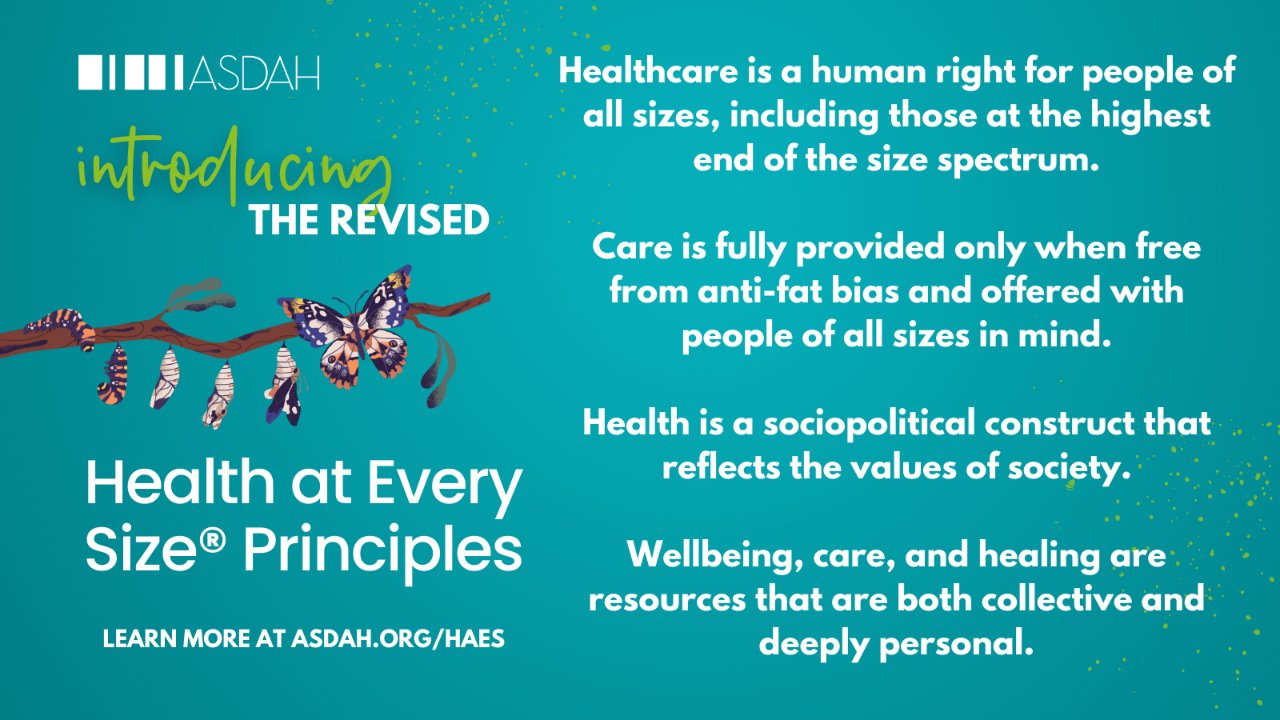
Image from https://asdah.org/
Take that name in for a moment – Health At Every Size. There is emerging evidence that health looks different on everyone. That even if we all ate the same diet and engaged in similar physical activity it is likely we would continue to look about as differently from each other as we do now. Health at Every Size. Your size does not indicate how healthy you are.
Perpetuating this assumption that fatness equals unhealthiness, has dire consequences for bigger people accessing quality healthcare. Research shows that fat people get treated differently by doctors, that their health concerns may be minimized or ignored, and that this can be compounded by other intersectional identities like racial identity, disability, gender. There is a movement within what is called fat activism to abolish the BMI, the Body Mass Index as a healthcare tool. The BMI was a statistical tool developed to measure weight and height across broad swaths of the population and was never meant to be an indicator of individual health. I’m going to say that again. (repeat) But guess who pressured doctors to use it as an individual health marker? The weight loss industry.
Someone that I look up to and respect so much and written a lot and thought a lot about bodies and culture is Sonya Renee Taylor and one question she asks in her book The Body is Not an Apology, is “Who is making money off of your self hatred?”. Who is invested LITERALLY in our culture being afraid or ashamed of their body size? The makers of Ozempic, their net worth is now more than $500 billion. The diet industry, the weight loss pill industry is a serious industry and it has its fingers in healthcare.
So this is the cultural soup in which I am trying to teach yoga and movement. I’m trying to reach people outside of these created biases around health and size, and invite people to connect with themselves amidst all of this.
So I’m here to talk about bodies but I’m also here to talk about culture change. The Branches is a yoga studio but it’s also a site of quiet rebellion against white supremacist, capitalist culture. Everything we do, in as many ways as we can we are working to disrupt that narrative. The narrative that creates a hierarchy of bodies that puts thin, white, able bodied, cisgendered, straight, rich, male on top and then ranks every other type of difference underneath that in descending order of worth.
We can do better than that.
At The Branches we call this aspect of our work “Body Positivity”. Body Positivity is a term with a history. Body Positivity was created by Fat, Black, queer women and femmes, and was intended as a political statement/practice for those whose bodies were the least accepted by the mainstream; racialized people, fat people, disabled people. In the mainstream Body Positivity exists somewhat but has kind of been watered-down to simplified ideas like “love the body you have”. It’s fine but a bit less political. But we think of Body Positivity as valuing and respecting all bodies.
This also doesn’t mean that you come to The Branches and we’re like TIME TO BE BODY POSITIVE. Don’t you hate to be told to be positive if you’re not feeling positive? So while our value is Body Positivity, celebrating and respecting all bodies, in practice, in the class it sounds like neutrality. It sounds like the yoga teacher using language that is incredibly neutral. That’s gender neutral. That’s ability neutral. That’s shape neutral. We’re really intentional that all of our teachers use language that offers different suggestions for ways of moving, ways of doing the pose that isn’t hierarchical. It’s not better to be flexible, it’s not better to be able to do the pose in the way it might look in a yoga magazine. We try to talk really neutrally, really frankly about getting into the poses and how you might need to change it a bit if your body is shaped this way or that way, and that neutrality allows people to have their own experience. Some days it might be positive. Some days it might be neutral or negative. But we’re attempting to give everybody a mental break from the hierarchy that’s often perpetuated in fitness or yoga spaces and allow people to just be.
One of the first ways we started shaping the culture of our studio in this way was in 2013. I took a training with an amazing teacher named Tiina Veer who created the term “Yoga for Round Bodies”. Tiina really opened my eyes to fatphobia, and how excluded so many people feel from yoga spaces. Soon after I started teaching a course called Yoga for Round Bodies. So many people came to that course and told me that they finally felt invited and welcomed into a yoga space because of that title. Because they knew that they wouldn’t be the only person of size in the class. One of them described the class “like a regular yoga class but with room for my boobs”.
And over the last ten years the overall demographic of our classes in terms of body size has really changed. And some of the people who originally started in that class went on to do our Yoga Teacher Training and now they teach that class and other classes. So not only is the student demographic in terms of body size changing; the teacher demographic of body size is changing. We have more fat yoga teachers. Yay. Representation matters.
About 8 years ago we also adopted a practice called “No Body Talk” among our teachers, desk staff and volunteers. All teachers and volunteers first do some training or learning about Health at Every Size, fat acceptance, and then everyone signs an agreement to work to eliminate any body-shaming, fat-shaming or weight loss and diet talk from conversation at the studio. We were already really intentional about language used by teachers in our classes, but we wanted to go further and hopefully have the whole experience of being at The Branches a break, a haven from that kind of conversation.
And now it’s been so long I sometimes don’t notice it anymore, until I’m in a context where I hear someone disparaging themselves or someone else for their size or shape. I feel surprised when I hear that now…that’s when I realize what a refuge The Branches has become for me and what that has given me space to focus on. What broader and more creative thoughts am I more able to have when I’m not preoccupied with how I look or trying to fit into that impossible hierarchy?
So these are some of the ways that we maintain that sense of being a haven, being a quietly radical space for people to come to and enjoy being in their bodies alongside others.
Even though I espouse this value of Body Positivity or Body Neutrality, something that I never say as a yoga teacher, is “love your body”. I’m not the first person to say this but it’s not really possible to love your body if the world hates your body. Whether that hatred is rooted in fatphobia, racism, ableism, transphobia, homophobia, sexism, all the isms, even healthism. It’s not possible to love your body in a world that hates your body so we need to do it together. We need to love and respect each other’s bodies.
I called my speech “Nurturing Cultures that Celebrate All Bodies”. I wanted to let you in on the intentional cultural practices that we’ve created over time because these are all replicable in different ways, in different contexts. Leena and I are kind of the hosts of the party that is The Branches – it’s a chill party, not a rager – and we set the stage for how that culture plays out. And it is my hope that you will be creative and intentional as you shape the cultures that you participate in. That you thoughtfully investigate your underlying assumptions about yourself or about people who are different from you and intentionally choose what kind of experience you want others to have, what kinds of values you want to embody. I hope you throw parties or run your clubs with clear intentions to uplift one another, to celebrate and respect one another. We need this in a world full of division. We need this type of small scale, homegrown intentionality, solidarity and unity.
Thank you.

 The Branches